


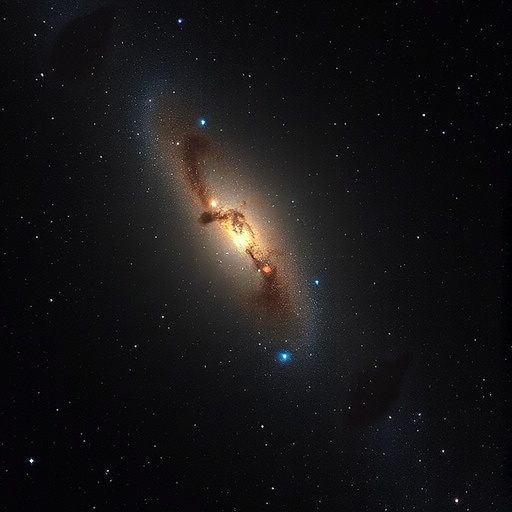
An international team of astrophysicists has unveiled a novel model that sheds light on the complex processes governing the formation and evolution of the universe’s oldest star clusters, known as globular clusters. This groundbreaking research, led by Mark Gieles from the Institute of Cosmos Sciences at the University of Barcelona, provides compelling insights into the role of extremely massive stars (EMS) — those exceeding 1,000 times the mass of our Sun — in cosmic history. The findings, recently published in the esteemed journal Monthly Notices of the Royal Astronomical Society, not only illuminate the early stages of star clusters but also raise intriguing questions about the nature of the universe shortly after the Big Bang.
Globular clusters, which are essentially dense, spherical conglomerations of stars typically containing hundreds of thousands to millions of celestial bodies, serve as an ancient archive of the universe. Most of these clusters are over 10 billion years old, suggesting they coalesced shortly after the Big Bang. These remnants of our universe’s formative years are a treasure trove of astronomical data, yet they hold mysteries regarding their chemical compositions and evolutionary paths. For decades, astronomers have grappled with puzzling chemical signatures observed within these clusters, which reveal unusual abundances of elements like helium, nitrogen, oxygen, sodium, magnesium, and aluminum.
In this new study, Gieles and his team propose that the presence of extremely massive stars during the formative years of these globular clusters played a crucial role in shaping their chemical profiles. The research extends a model known as the inertial-inflow model, which describes star formation, by adapting it to the extreme conditions of the early universe. The team posits that in the most massive globular clusters, turbulent gas can naturally give rise to EMS that weigh between 1,000 and 10,000 solar masses. These massive stars, with their immense gravitational pull, create conditions conducive to further star formation while simultaneously ejecting stellar winds rich in high-temperature hydrogen combustion products.
Mark Gieles emphasizes the significance of these findings by stating, “Our model shows that just a few extremely massive stars can leave a lasting chemical imprint on an entire cluster.” This assertion effectively connects the underlying physics of globular cluster formation with the various chemical signatures we observe today. The research indicates that EMS could be responsible for enriching the surrounding gas, giving rise to chemically distinct populations of stars within these ancient structures.
An interesting aspect of this model is the timescale involved in this process, which occurs remarkably fast — within just one to two million years. This rapid onset precedes any supernova explosions, thus ensuring that the gas within the cluster remains free from contamination created by explosive stellar death. This finding is particularly groundbreaking as it opens new pathways for understanding the processes involved in the synthesis of elements in the universe, linking them with the birth of stars, clusters, and potentially even galaxies.
The implications of the research stretch well beyond the confines of our Milky Way galaxy. The authors speculate that the nitrogen-rich galaxies recently observed by the James Webb Space Telescope (JWST) are likely dominated by the same EMS-rich globular clusters which formed during the universe’s early epoch. Paolo Padoan, a co-author from Dartmouth College, suggests, “Extremely massive stars may have played a key role in the formation of the first galaxies.” This statement underscores the potential for EMS to have been pivotal both in terms of creating new stars and shaping the chemical structure of emerging galaxies that sprouted from primordial material.
The research also presents a compelling case for re-evaluating our understanding of black hole formation. The colossal EMS are anticipated to end their lifecycles by collapsing into intermediate-mass black holes, with masses greater than 100 solar masses. This collapse could potentially result in detectable gravitational wave signals, further bridging the connection between high-energy astrophysical events and our understanding of cosmological evolution.
Furthermore, the study’s approach offers a unifying framework that intertwines concepts of star formation, cluster evolution, and chemical enrichment. By positing that EMSs played a crucial role in not just enriching globular clusters but also in catalyzing the birth of the first black holes, the findings elucidate how these ancient stars drove the dynamics of early galaxy formation.
This research provides valuable insights that not only enhance our understanding of globular clusters, but also suggest that some of the fundamental processes governing star birth and death in the early universe might be more interconnected than previously thought. As we learn more about this enigmatic period, it becomes increasingly evident that these stars shaped not only their immediate environments but also the broader context of cosmic evolution.
As we stand on the brink of new discoveries prompted by advanced observational tools, the insights gleaned from this study highlight the profound implications of EMS on the cosmos. By reexamining the role of these massive stars, we open new avenues for future research, potentially revealing more about the early epochs of star and galaxy formation and the resultant complexities that led to the universe as we observe it today.
With the future of astronomical research in focus, we anticipate further developments in understanding the intricate dynamics that govern the cosmos. High-resolution observations and simulations that build on these findings will be vital in forging our path forward, allowing us to unravel more of the mysteries embedded in the universe’s oldest structures and the sources of light and elements that form the bedrock of everything we see.
The ongoing journey into the heart of star formation and evolutionary processes promises to yield not just a deeper appreciation of our origins, but also practical insights that may one day illuminate modern scientific challenges.
Keywords
Cite Scienmag News
Grant Pearson. (November 4, 2025). Gigantic Stars Illuminate the Formation of the Universe’s Oldest Star Clusters. Scienmag. https://scienmag.com/gigantic-stars-illuminate-the-formation-of-the-universes-oldest-star-clusters/
Grant Pearson. "Gigantic Stars Illuminate the Formation of the Universe’s Oldest Star Clusters." Scienmag, 4 November 2025, https://scienmag.com/gigantic-stars-illuminate-the-formation-of-the-universes-oldest-star-clusters/. Accessed 4 September 2026.
Grant Pearson. "Gigantic Stars Illuminate the Formation of the Universe’s Oldest Star Clusters." Scienmag. November 4, 2025. https://scienmag.com/gigantic-stars-illuminate-the-formation-of-the-universes-oldest-star-clusters/


