


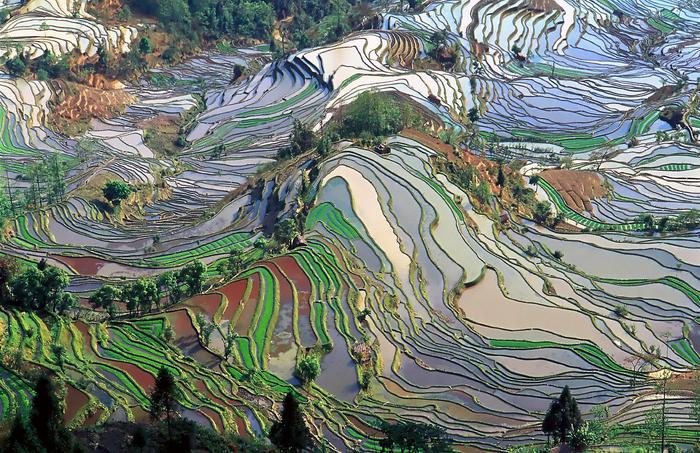
Rice, a crop synonymous with warmth and monsoon-fed landscapes, is facing an unprecedented threat from the planet’s rapid heating. This staple, central to the survival of more than half the global population, has always thrived in environments marked by moderate heat and abundant water. Originating from tropical regions like the Malay and Indochina peninsulas, the wild ancestors of rice have demonstrated a remarkable history of adapting to climate fluctuations—mostly in the direction of cooler, more temperate conditions. Yet, this ancient adaptability may now be reaching its biological limits as global temperatures climb to extremes never before recorded in the crop’s evolutionary realm.
The wild and domesticated forms of rice have carved out their place in human history by responding to post-glacial warming that allowed them to spread into central China and South Asia roughly 9,000 years ago. This geographical expansion coincided with human societies transitioning from hunter-gatherers to agricultural communities that centered their economies on cultivation. Early rice varieties helped fuel the rise of complex civilizations, driving trade networks and establishing cultural ties across vast areas of Asia. However, the story that enabled rice’s success through cooler adaptations starkly contrasts with the urgent challenge rice now faces in a warming world.
The rate of climate warming projected over the next half-century exceeds, by a factor of 5,000, any environmental change rice has previously encountered. This exacerbates the concern because thermal stress in crops generally follows non-linear patterns: prolonged exposure to elevated temperatures can cause irreversible physiological and developmental damage. Rice is particularly sensitive to heat during critical growth phases such as flowering and grain filling. Current data reveals that rice typically cannot tolerate mean annual temperatures above 82 degrees Fahrenheit, with a monthly maximum beyond 104 degrees Fahrenheit considered intolerable for normal growth. These cutoffs draw a hard boundary for sustainable rice production under climate scenarios.
The consequences of surpassing these thermal limits are stark. Large rice-growing regions of Southeast Asia, including Indonesia and Malaysia, are predicted to experience mean annual temperatures above the crop’s tolerance threshold by 2070. This thermal encroachment threatens to devastate millions dependent on rice for food security and economic stability. In India, now the world’s leading rice producer, heat stress is projected to become a significant impediment, with monthly maxima frequently exceeding 104 degrees Fahrenheit during the hottest months. Such conditions could lead to widespread yield reductions and jeopardize livelihoods.
Interestingly, the history of rice offers insight into its adaptability but also highlights its thermal constraints. Around 4,200 years ago, an abrupt cooling period triggered widespread societal disruptions across Eurasia. Rice farmers responded by developing cold-resistant strains, enabling cultivation to extend into northern territories with temperate climates, including the Korean Peninsula and Japan. However, rice lacks the flexibility to similarly adapt to extreme heat by accelerating development or altering growth patterns without quality or yield penalties. Unlike animals who can modify behavior to avoid heat stress, rice must endure environmental conditions to photosynthesize and produce grain.
Researchers have employed an interdisciplinary approach, integrating archaeological records from more than 800 sites with satellite climate data and botanical databases. Their findings confirm that rice has never historically grown in areas with mean annual temperatures exceeding its current thresholds. Exceptions in some hot, arid regions are likely explained by trade rather than local cultivation. Synthesizing this with future climate models reveals a bleak future: most traditional rice-growing regions will become climatically unsuitable within decades without adaptive interventions.
Advancements in genetic engineering and breeding programs offer potential mitigations by developing heat-tolerant rice varieties. However, the scale and pace of climate change present formidable obstacles to such solutions. The process of tailoring new strains requires significant time, resources, and access to cutting-edge agricultural science — luxuries not equally available to all farming communities, particularly subsistence farmers in vulnerable regions. Consequently, adaptation may deepen existing inequalities, with some populations benefitting from improved cultivars while others face crop failures and food shortages.
The projected scenarios underscore the necessity for global collaboration to combat fossil fuel emissions and implement climate-resilient agricultural strategies. Growing tropical rice varieties in temperate zones or shifting cultivation to higher latitudes may compensate for losses in certain areas, but they come with substantial agronomic and socio-economic challenges. This transition demands coordinated policy design, infrastructure investment, and comprehensive support systems for farmers worldwide.
Moreover, the agronomic complexity of rice underscores that temperature stress is only one facet of climate impact. Changes in precipitation patterns, increased frequency of extreme weather events, and elevated pest and disease pressures compound the vulnerability of rice systems. Integrated research efforts combining climate science, plant biology, and socio-economic studies will be critical to develop robust adaptation frameworks.
In conclusion, rice cultivation stands at a crossroads, reflective of broader challenges confronting global agriculture in the Anthropocene. The projected warming trends threaten to eclipse the thermal thresholds that have supported rice’s millennia-long legacy. Without decisive action and innovative scientific advancements, the nutritional backbone for billions may fracture under accelerating climate stress. Urgent attention is required to safeguard both the crop and the vulnerable human populations dependent on it, underscoring the intertwining of ecological health and human resilience in a warming world.
News Publication Date: 14-Jan-2026.
Web References:
References:
Gauthier, N., Alam, O., Purugganan, M., & d’Alpoim Guedes, J. (2026). Projected warming will exceed the long-term thermal limits of rice cultivation. Communications Earth & Environment.
Cite Scienmag News
Alan Morgan. (April 14, 2026). Rice Cultivation Hits Thermal Limit After 9,000 Years of Evolution. Scienmag. https://scienmag.com/rice-cultivation-hits-thermal-limit-after-9000-years-of-evolution/
Alan Morgan. "Rice Cultivation Hits Thermal Limit After 9,000 Years of Evolution." Scienmag, 14 April 2026, https://scienmag.com/rice-cultivation-hits-thermal-limit-after-9000-years-of-evolution/. Accessed 4 September 2026.
Alan Morgan. "Rice Cultivation Hits Thermal Limit After 9,000 Years of Evolution." Scienmag. April 14, 2026. https://scienmag.com/rice-cultivation-hits-thermal-limit-after-9000-years-of-evolution/


