


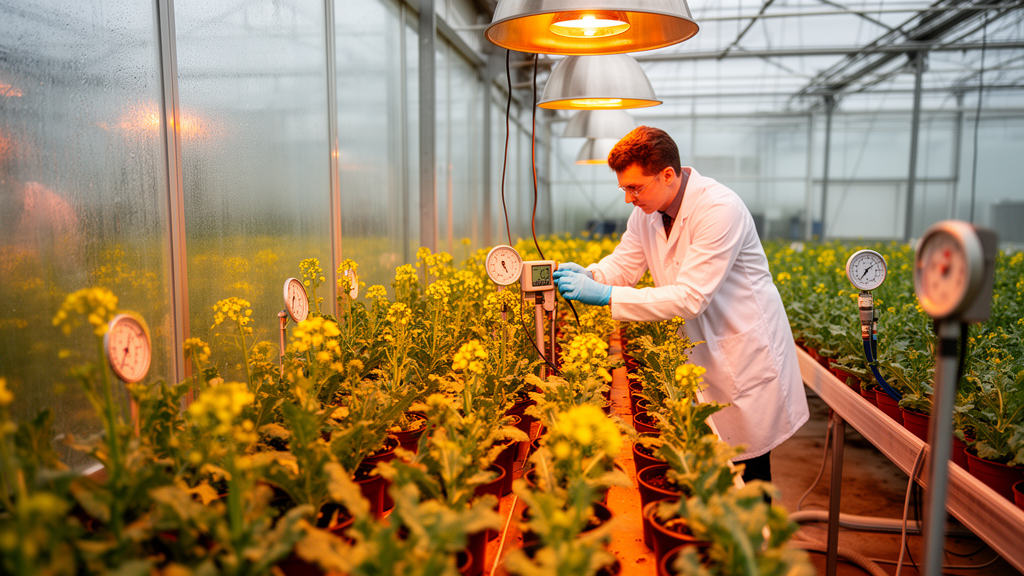
A two-year field screening of 154 Indian mustard genotypes identified RH-2049 and RH-2050 as the strongest candidates for breeding heat-tolerant varieties. Researchers compared grain yields from timely-sown crops, representing non-stress conditions, with yields from late-sown crops exposed to terminal heat during flowering and seed filling. The experimental material included commercial cultivars, advanced breeding lines and germplasm accessions evaluated at Chaudhary Charan Singh Haryana Agricultural University in Hisar, India. Grain yield declined under late sowing across the panel, but some lines maintained considerably more of their potential than widely used varieties. RH-2049 ranked highest for the study’s key productivity and tolerance measures, while RH-2050 combined high yields in both environments with one of the smallest proportional yield reductions.
Terminal heat is a particular threat to Indian mustard because the crop’s reproductive phase is vulnerable to elevated temperatures. Optimal temperatures are reported as 15–25 °C during vegetative growth and 18–22 °C during reproductive development. Above 30 °C, heat can impair pollen viability, reduce fertilization, cause flower abortion and shorten the period available for filling seeds. Late sowing exposed the experimental crops to approximately 3 °C more heat at siliqua initiation: 23.9 °C rather than 20.25 °C in 2020–21 and 23.15 °C rather than 20.55 °C in 2021–22. The hotter environment accelerated maturity and reduced grain yield, creating a field-based test of the genetic responses associated with terminal heat tolerance.
The study used an augmented block design rather than a conventional replicated trial. Four check varieties were repeated across ten blocks, while each of the 150 test entries was allocated once in every season. Each plot contained two rows, each 4 metres long, with 45-centimetre row spacing and 15-centimetre plant spacing. The researchers recorded grain yield separately for each genotype at physiological maturity and then calculated 11 indices from paired yields under the two sowing dates. This design made it possible to compare a large and diverse panel under contrasting thermal environments, although the reliance on check varieties for estimating experimental error and the single unreplicated appearance of test entries constrain the precision with which individual genotypes can be generalized beyond these trials.
The statistical analysis found significant genetic differences among the 154 entries for all 11 indices at P < 0.01 after adjustment for blocks. Broad-sense heritability exceeded 80% for every index, ranging from 80.20% for the stress tolerance index, or STI, to 85.48% for the relative stress index, RSI. STI also had the largest genotypic coefficient of variation, 35.33%, indicating substantial variation among genotypes in the combined expression of yield under stress and non-stress conditions. The expected genetic advance as a percentage of the mean was 65.3% for STI and 60.4% for percent yield reduction, or PYR. These are estimates of variation and expected response under the experimental conditions, not direct measurements of gains in newly released cultivars.
Correlations and principal component analysis helped identify which indices carried distinct information. The first principal component accounted for 73.18% of the total variation and was associated with yield under both sowing dates, STI, mean relative performance, harmonic mean, geometric mean productivity and mean productivity. The second component explained 26.27% and was dominated by measures of stress susceptibility. Yet the exceptionally high cumulative value of 99.45% also reflected mathematical redundancy among the 11 measures rather than 13 fully independent dimensions of tolerance. STI, mean productivity, geometric mean, harmonic mean and mean relative performance had correlations of 0.998–1.00. The yield index was an exact rescaling of stressed yield, SSPI was a constant multiple of tolerance, and PYR was a linear transformation of the yield stability index.
Because of that redundancy, the researchers recommended a simpler screening framework: STI as the primary selection measure, supported by geometric mean productivity, with PYR or yield stability added when the aim is to flag the most susceptible entries. STI uses both the genotype’s stressed and non-stress yields and the squared grand mean for the non-stress environment, allowing it to reward genotypes that perform well under both conditions rather than merely producing high yields in favorable weather. Geometric mean productivity also combines the two yields, while lower PYR denotes a smaller loss under heat. The analysis does not show that these calculations measure independent physiological mechanisms; rather, it shows that a compact pair can summarize much of the ranking information contained in the full set of indices.
Ward’s hierarchical clustering divided the panel into 13 groups based on STI, geometric mean productivity, mean productivity, harmonic mean and mean relative performance. Cluster 6, containing six genotypes, performed best overall, with an STI of 1.52, a yield stability index of 0.90 and mean productivity of 28.03. Its members were RH-2049, RH-2050, RH-725, RH-2004, RH-2041 and RH-1935, all highlighted as potential donors of heat-tolerance traits. RH-2049 recorded the highest values for STI, yield index, mean productivity, geometric mean productivity, harmonic mean and mean relative performance, as well as the highest yield in both environments. RH-2050 had the lowest RSI and PYR among the highlighted susceptible comparisons and maintained high performance under both sowing dates. Cluster 5 also combined relatively high yield potential with good tolerance.
By contrast, the study classified Varuna, Radhika and Pusa Vijay as heat susceptible. Their grain-yield losses exceeded 40%, reaching 42.39% for Radhika, 41.50% for Varuna and 40.11% for Pusa Vijay. Their high yields under timely sowing did not translate into stable performance when terminal heat occurred. RH-2020 also performed well, with a yield stability index of 0.94 and an SSPI of 3.23, although it did not occupy the same leading position as RH-2049 and RH-2050 on the principal productivity measures. The results therefore illustrate why heat tolerance cannot be inferred simply from a variety’s output in a normal season: a high-yielding cultivar may remain competitive in favorable conditions yet lose a large share of its yield when flowering and grain filling coincide with extreme heat.
For breeders, the findings offer a field-screening route to narrowing a large collection before more intensive crossing and replicated testing. The six Cluster 6 lines are positioned as candidate parents, while the opposite end of the performance space contains susceptible but established high-yielding varieties that could contribute other agronomic characteristics. The authors proposed combining phenotypic index selection with previously reported simple-sequence-repeat marker–trait associations from the same 154-genotype panel, although the present experiment did not itself validate marker-assisted selection or produce new cultivars. Important limits remain: the trial covered one location, two Rabi seasons and two sowing dates; it did not establish performance across India’s broader mustard-growing regions; and late sowing created a suite of environmental differences in addition to heat, including changes in rainfall and relative humidity. Follow-up multi-location trials would therefore be needed to test whether the apparent advantages of RH-2049, RH-2050 and their cluster companions persist across additional environments, farming practices and seasons.
Subject of Research: Field evaluation of yield-based heat-stress tolerance indices for breeding heat-tolerant Indian mustard
Article Title: Comparative analysis of heat stress indices for selection of thermo-tolerant genotypes in Indian mustard (Brassica juncea L.)
Article References: Choudhary, R. R., Avtar, R., Sharma, R., Kumar, M., Jajoriya, R., Punia, S. S., Rajput, S. S., Singh, M., Kumar, P., Dhaka, B., & Poonia, M. K. (2026). Comparative analysis of heat stress indices for selection of thermo-tolerant genotypes in Indian mustard (Brassica juncea L.). Discover Plants, 3(1), Article 472. https://doi.org/10.1007/s44372-026-00953-x
Image Credits: AI Generated
DOI: 10.1007/s44372-026-00953-x
Keywords: Indian mustard, Brassica juncea, heat stress, terminal heat, stress tolerance index, genotype screening, grain yield, crop breeding, climate resilience, Comparative, analysis, heat
Cite Scienmag News
Alan Morgan. (October 21, 2026). RH-2049 and RH-2050 lead mustard heat-stress screening. Scienmag. https://scienmag.com/rh-2049-and-rh-2050-lead-mustard-heat-stress-screening/
Alan Morgan. "RH-2049 and RH-2050 lead mustard heat-stress screening." Scienmag, 21 October 2026, https://scienmag.com/rh-2049-and-rh-2050-lead-mustard-heat-stress-screening/. Accessed 21 October 2026.
Alan Morgan. "RH-2049 and RH-2050 lead mustard heat-stress screening." Scienmag. October 21, 2026. https://scienmag.com/rh-2049-and-rh-2050-lead-mustard-heat-stress-screening/


