


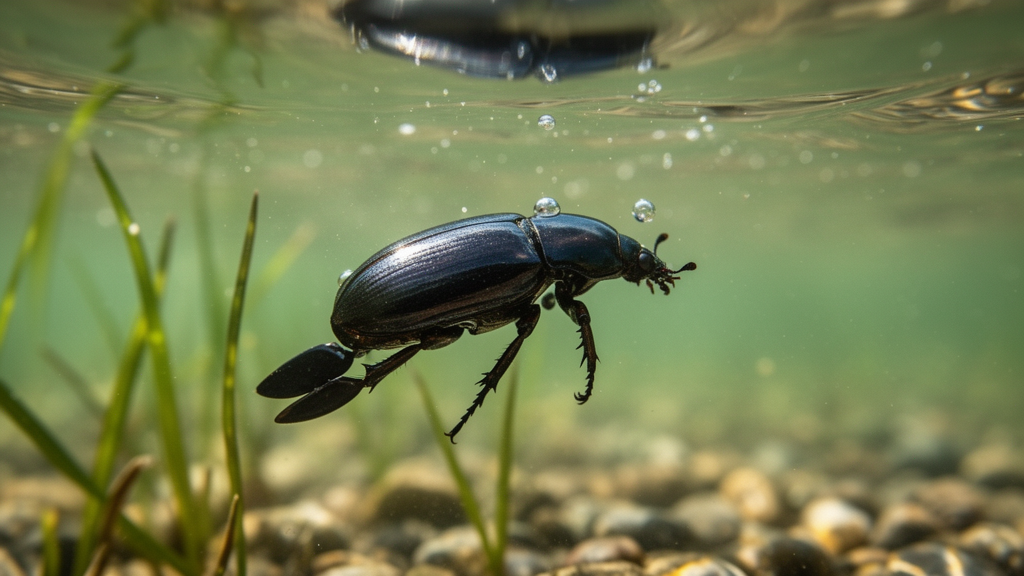
An exhaustive faunistic review of museum specimens, private collections, literature records and recent field surveys supported a checklist of 139 Hydradephaga species that have formed populations in Switzerland, either in the past or at the time of the study. The checklist covers five aquatic beetle families: Dytiscidae, Haliplidae, Gyrinidae, Noteridae and Hygrobiidae. It is a synthesis of occurrence and collection evidence rather than a controlled ecological experiment.
The researchers compiled 43,770 Swiss occurrence records. Of these, 72% were based on specimens deposited in museums, 8% came from the literature and 20% came from private collectors, volunteer observers, research institutes or ecology offices. The review examined material in Swiss natural history museum collections, consulted four museums outside Switzerland and incorporated records from private collections, institutional datasets and professional and amateur entomologists. Relevant Swiss literature was also assessed, and the authors followed the nomenclature and systematics of the Catalogue of Palaearctic Coleoptera.
Targeted field surveys covered 361 km² and contributed 4,327 occurrences over five years. The researchers assessed whether records provided sufficiently reliable evidence of presence for inclusion on the national checklist, considering unambiguous labelling, reliable collections and other supporting information. They distinguished species that currently or formerly formed populations in Switzerland from 53 taxa placed in square brackets because the available evidence did not establish that they belonged to the Swiss fauna pending new data.
Within the 139-species list, Dytiscidae accounted for 113 species, Haliplidae for 16, Gyrinidae for seven, Noteridae for two and Hygrobiidae for one. The review removed seven taxa retained in earlier checklists: Deronectes opatrinus, Graptodytes flavipes, Gyrinus urinator, Hydaticus continentalis, Hygrotus parallelogrammus, Hyphydrus aubei and Stictonectes lepidus. The exclusions reflected evidence such as misidentifications, incomplete labels, unreliable collection histories or unverifiable literature records.
Records from problematic sources, including the Charles Maerky collection, were treated with particular caution. Other doubtful records involved incorrect identifications, uncertain localities, confusion over collection or original localities, potentially foreign place names and ecological or chorological inconsistencies. For some Haliplus species and highly similar Agabus species, reliable identification required examination of male genitalia; records based exclusively on female specimens were therefore excluded as unverifiable. Species supported by fewer than 30 valid observations were documented individually, including the examined material and published records used to justify inclusion.
Recent collection and field work also clarified the status of several taxa. A male Rhantus suturellus collected in a peat bog in the canton of Neuchâtel confirmed its presence in Switzerland, and the recently described Boreonectes alpestris was documented from Ticino. The researchers reported rediscoveries of Agabus brunneus, Haliplus mucronatus, Ilybius crassus, Hydaticus transversalis, Hydroporus figuratus, Hydroporus longicornis and Nebrioporus assimilis after intervals of at least 25 years without reported Swiss records. Dytiscus circumcinctus was found in 2022 and 2023 after more than 50 years without data. The surveys did not uncover a species new to Switzerland.
Updated occurrence maps showed the highest recorded species richness in lowland and thermophilous areas, although several localized species occurred at high elevations. Ilybius crassus was recorded from a small number of peat bogs in the Jura and northern Alps, while Ilybius erichsoni was associated with isolated alpine ponds at high elevations. Agabus congener and A. lapponicus occurred in overlapping Alpine regions but were not found together in the same ponds. These maps represent documented occurrences and the coverage of the compiled data, not a complete census of every aquatic habitat in Switzerland.
The authors also compared species-level occurrence patterns between 1964–1993 and 1994–2023. For species known from more than five localities during both periods, they compared the relative proportion of 5 × 5 km areas occupied in each period. The steepest reported reductions included Agabus paludosus at 62%, A. biguttatus at 60%, Hydroporus melanarius at 44% and H. nigellus at 42%. The comparison concerned the relative proportions of occupied grid areas rather than raw counts of areas, and it was limited to species meeting the stated locality threshold.
Sixteen of the 139 species had not been found during the five-year survey. Examples included Hydaticus grammicus, last recorded in Switzerland in 1942, and Dytiscus latissimus, last recorded in 1948. The authors described several such populations as probably extinct, while regarding other long-unsighted species as potentially present but requiring confirmation. They concluded that Swiss knowledge of Hydradephaga was sufficiently substantial to support a consolidated national list and revised distribution maps, and said that some assessments in Switzerland’s 1994 red list required revision. The principal limitation is that the checklist depends on historical collection access, recording practices and survey coverage; it does not directly estimate abundance throughout the country.
Subject of Research: Faunistic checklist of Swiss aquatic beetles in the group Hydradephaga
Article Title: An updated checklist of the Hydradephaga of Switzerland ( Coleoptera )
Article References: Cosandey, V., Chittaro, Y., & Sanchez, A. (2024). An updated checklist of the Hydradephaga of Switzerland (Coleoptera). Alpine Entomology, 8, 87-119. https://doi.org/10.3897/alpento.8.124813
Image Credits: AI Generated
Keywords: Swiss fauna, aquatic beetles, Hydradephaga, taxonomic checklist, biodiversity records, museum collections, distribution maps, species richness, faunistic review, Coleoptera, updated, checklist
Cite Scienmag News
Drew Townsend. (October 20, 2026). Review of 43,770 records supports 139-species checklist of Swiss aquatic beetles. Scienmag. https://scienmag.com/review-of-43770-records-supports-139-species-checklist-of-swiss-aquatic-beetles/
Drew Townsend. "Review of 43,770 records supports 139-species checklist of Swiss aquatic beetles." Scienmag, 20 October 2026, https://scienmag.com/review-of-43770-records-supports-139-species-checklist-of-swiss-aquatic-beetles/. Accessed 20 October 2026.
Drew Townsend. "Review of 43,770 records supports 139-species checklist of Swiss aquatic beetles." Scienmag. October 20, 2026. https://scienmag.com/review-of-43770-records-supports-139-species-checklist-of-swiss-aquatic-beetles/


