


Aphids are among the strangest reproducers in the animal kingdom. Every one of the roughly 5,000 known species cycles between parthenogenetic generations, in which females clone themselves without mating, and a single bisexual generation that restores genetic recombination. No aphid is known that lacks parthenogenetic generations entirely, and no other group among the approximately 120,000 species of true bugs and their relatives shows this strict, regular alternation.
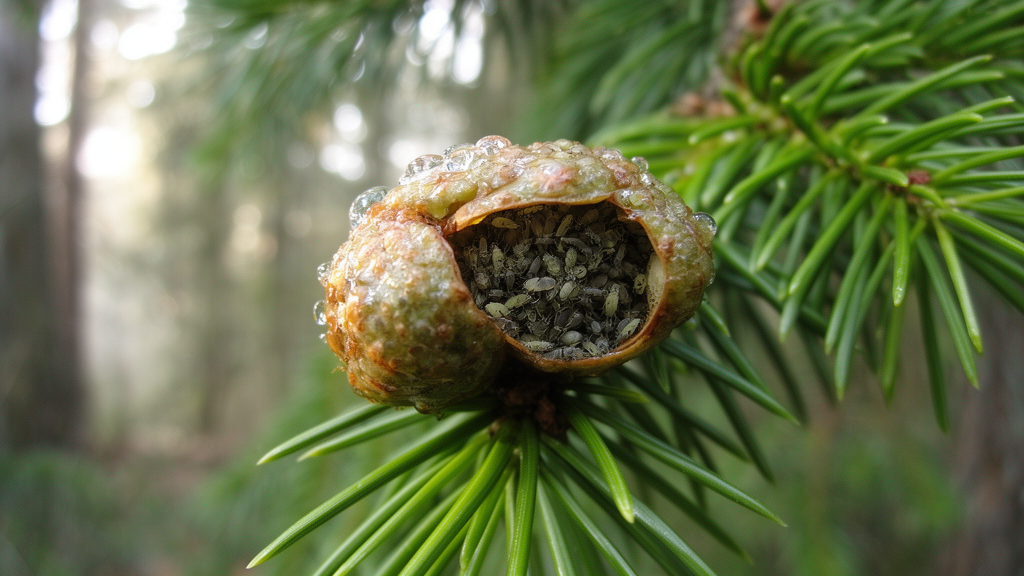
These galls are not tumors in the usual sense. Both the strobilus and the adelgid gall are shortened shoots whose needles have been transformed into covering scales, and the transformation stays within the normal morphological variation of the plant. Crucially, the gall is produced not by the aphid's saliva alone but by the specific response of the growing spruce bud to being penetrated by that saliva, which is why monophagous soft scales feeding on the very same branches never produce galls at all.
The central insight of the gallophilous theory concerns the timing of gall opening. Spruce galls do not split open when the aphids inside need them to; they open according to the physiology of the particular tree and branch. Even trees of the same species in the same locality differ in light exposure, water and nutrient supply, age, and crown architecture, so the opening of adelgid galls stretches over months.
Around St. Petersburg in northwestern Russia, this process runs from mid-June to late August; on Hokkaido in Japan, from mid-June to early September. Galls ripen first on the lower branches and then on the upper ones, and in some cases individual cavities within a single gall open at different times, or not at all, dooming the nymphs inside to death.
Similar extended opening is documented in other gall-forming aphids, including the hickory phylloxera Phylloxera devastatrix, whose galls open from early May to mid-June, and the poplar aphid Pemphigus spyrothecae, whose galls open from late August to November and sometimes never. This prolonged, asynchronous opening, the author argues, made effective panmixia impossible for the ancestral aphids locked inside. On any given day, only a small fraction of males and females emerged from opened galls, and these tiny insects, with their relatively weak powers of purposeful flight, could not find each other in sufficient numbers to sustain random mating.
Sexually mature females still trapped in unopened galls were physically isolated from males that had already emerged. Winged females that did escape scattered across suitable food plants, and most remained unfertilized. In a situation that repeated itself every warm season for millions of years, females capable of parthenogenetic reproduction gained a decisive selective advantage: they no longer needed to synchronize their reproductive development with anyone else, and each could lay viable eggs whether she emerged early, late, or not at all.
But parthenogenesis alone could not solve the deeper problem of restoring genetic recombination. The theory proposes that the solution came through migration. The third generation of these ancestral aphids settled on secondary host plants such as larches, firs, pines, and other conifers, where sap sucking never produces closed galls and there are no physical barriers to mating.
The remaining difficulty was re-synchronizing the appearance of males and females in mass numbers at the same place. The only reliable cue available was the simultaneous end of shoot growth on conifers, which occurs by late June or early July in modern conditions. At that moment, nutrition deteriorates sharply, and winged sexuparae emerge en masse from the desynchronized parthenogenetic lines on the secondary hosts.
These sexuparae switch from thelytoky to deuterotoky, producing eggs of both sexes, and fly back to spruce, where they lay eggs on the undersides of needles. From these eggs a bisexual generation develops relatively synchronously, and mass cross-fertilization with all its genetic benefits is finally achieved, concentrated in one place at one time. This framework also explains several otherwise puzzling features of the aphid bisexual generation.
Because it always develops in the second half of the year, when feeding conditions on woody plants deteriorate, sexual individuals are small, have reduced fertility, often producing only a single egg that fills the entire abdominal cavity, and in many cases do not feed at all. The loss of wings in the sexual generation and in the early parthenogenetic generations on secondary hosts also follows logically: to achieve synchrony, both generations must stay put, the first until fertilization and the second until shoot growth ends. The cytogenetic machinery itself reinforces the cycle.
Aphid males produce only two sperm per meiosis, both carrying X chromosomes, so all offspring of fertilization are XX females. Parthenogenetic females, through a special mini-meiosis that eliminates one X chromosome set, can produce embryos with either one or two X chromosomes, generating males as well as females. The bisexual generation is therefore necessarily followed by a parthenogenetic one, a system the author suggests became so deeply entrenched over hundreds of millions of years that abandoning it became impossible even after aphids shifted to flowering plants.
The fossil and comparative evidence supports this reconstruction. The first aphid remains are known from the Triassic, or possibly the Permian, long before flowering plants became significant. The most archaic living aphids, the adelgids, are obligately tied to gymnosperms, retain a functional ovipositor, and lay eggs in every generation.
Their sister family, the phylloxeras, has lost the ovipositor and has no gymnosperm associations, which the author interprets as evidence that phylloxeras arose from an ancient adelgid ancestor only after angiosperms spread in the Cretaceous. Phylloxeras, in turn, are most diverse in North America, where they feed primarily on hickories, the only Nearctic angiosperms of the Cretaceous period known to form galls. The larger internal space of hickory galls compared with the cramped cavities of spruce cones allowed several parthenogenetic generations to develop inside before the gall opened, and made egg-laying inside the gall possible without an ovipositor, explaining the loss of that organ.
The transition to viviparity, the hallmark of the advanced superfamily Aphidoidea, is traced through the eriosomatids, which the author identifies as a probable transitional form. In these aphids, parthenogenetic offspring are occasionally born still enclosed in shells that are homologous to the egg chorion, a plesiomorphic feature pointing from ovoviviparity toward placental viviparity. Moreover, the embryos in migrating eriosomatid females develop simultaneously rather than sequentially, so a female arriving on a secondary host deposits all her offspring within a short period, much like oviparous scale insects.
Once placental viviparity combined with telescopic embryonization, in which an embryo already contains embryos of the next generation, appeared among gall-dwelling eriosomatids, aphids could accelerate generation turnover dramatically regardless of when the gall opened, freeing them from the rigid timing constraints of their spruce-dwelling ancestors. The theory also carries implications beyond aphids. Among terrestrial animals, regular cyclical parthenogenesis has been convincingly demonstrated only in gall wasps, which likewise live in closed galls, and their emergence from galls is similarly extended over time, producing comparable diversity of life cycles.
Other gall-forming hemipterans, such as scale insects, psyllids, and most true bugs, form no closed galls and show no cyclical parthenogenesis, although other forms of parthenogenesis are common among them. The gallophilous theory thus offers a unified explanation for one of the most aberrant reproductive systems in the animal kingdom: the closed gall itself, by fragmenting the mating opportunities of a population across weeks and months, created the selective pressure that first favored parthenogenesis and then locked aphids into a cycle they can no longer escape.
Subject of Research: Evolutionary origin of cyclical parthenogenesis in aphids through life in closed spruce galls
Article Title: Gallophilous theory of cyclical parthenogenesis in aphids ( Homoptera , Aphidinea )
Article References: Gavrilov-Zimin, I. A. (2024). Gallophilous theory of cyclical parthenogenesis in aphids (Homoptera, Aphidinea). Comparative Cytogenetics, 18, 247-276. https://doi.org/10.3897/compcytogen.18.136095
Image Credits: AI Generated
DOI: 10.3897/compcytogen.18.136095
Keywords: aphids, cyclical parthenogenesis, adelgids, spruce galls, phylloxeras, viviparity, telescopic embryonization, host plant alternation, cytogenetics, evolutionary biology, Hemiptera, Adelgidae
Cite Scienmag News
Drew Townsend. (October 20, 2026). Research report: Gallophilous theory of cyclical parthenogenesis in aphids ( Homoptera , Aphidinea ). Scienmag. https://scienmag.com/research-report-gallophilous-theory-of-cyclical-parthenogenesis-in-aphids-homoptera-aphidinea/
Drew Townsend. "Research report: Gallophilous theory of cyclical parthenogenesis in aphids ( Homoptera , Aphidinea )." Scienmag, 20 October 2026, https://scienmag.com/research-report-gallophilous-theory-of-cyclical-parthenogenesis-in-aphids-homoptera-aphidinea/. Accessed 20 October 2026.
Drew Townsend. "Research report: Gallophilous theory of cyclical parthenogenesis in aphids ( Homoptera , Aphidinea )." Scienmag. October 20, 2026. https://scienmag.com/research-report-gallophilous-theory-of-cyclical-parthenogenesis-in-aphids-homoptera-aphidinea/


