


A study combining molecular analysis of old herbarium specimens with morphological comparisons proposes treating Galium transcarpaticum as a subspecies of Galium mollugo rather than as an independent species. The authors present the new combination Galium mollugo subsp. transcarpaticum (Stojko & Tasenk.) A.V.Novikov, Nachychko & Zinenko, describing it as a conservative taxonomic solution that requires further testing with broader sampling and additional genetic data.
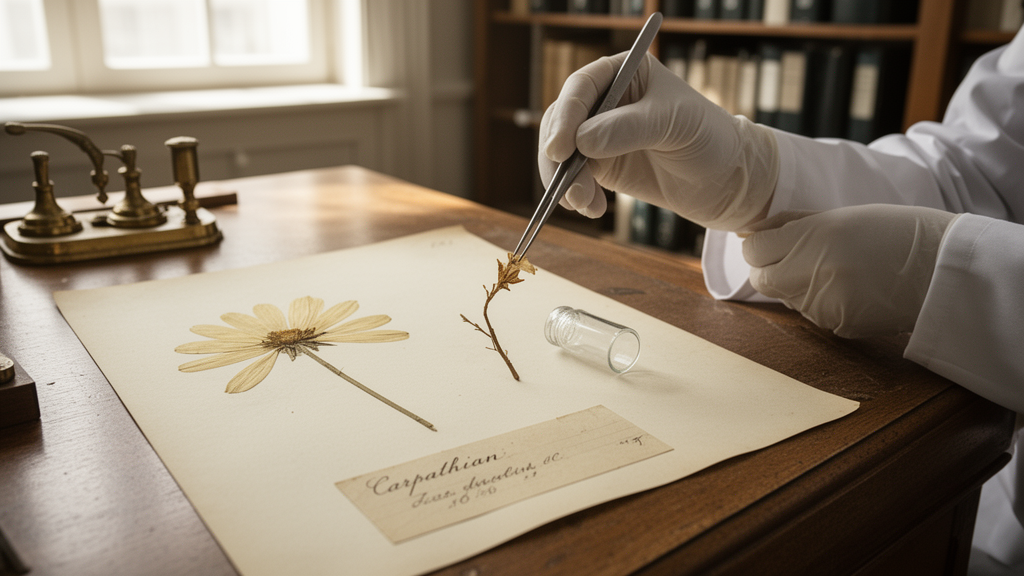
The research focused on material in the LWS herbarium collected in the Ukrainian Carpathians by Lydia Tasenkevich, one of the botanists who described G. transcarpaticum in 1979. Researchers examined six herbarium specimens assigned to G. transcarpaticum and three assigned to G. mollugo. Because older, heat-treated herbarium material often contains degraded DNA, the analysis targeted short nuclear and plastid markers.
Five regions—ITS, trnH-psbA, atpB-rbcL, trnL (c-d) and trnL (e-f)—were successfully amplified for three specimens of each taxon. Sequencing was performed with the Sanger method, and the aligned sequences were analyzed in Bayesian phylogenetic analyses. One analysis used nucleotide data alone; a second added coded insertion and deletion characters. The longer plastid regions trnC-ycf6 and rpoB-trnC were not successfully amplified.
The nucleotide-only analysis did not recover G. transcarpaticum as a monophyletic group: its accessions were intermixed with Ukrainian specimens assigned to G. mollugo. The 223-base-pair ITS fragment and 304-base-pair trnH-psbA fragment did not distinguish the two taxa. The analyzed trnL (c-d) and trnL (e-f) fragments also did not provide a meaningful separation among G. transcarpaticum, G. mollugo and the reference sequence assigned to G. album, which appeared in the same clade with little internal structure.
Three differences were found in the 634-base-pair atpB-rbcL chloroplast spacer: one insertion and two deletions unique to the sampled G. transcarpaticum accessions. When these indels were included as coded characters, the G. transcarpaticum accessions formed a separate clade from the Ukrainian G. mollugo accessions. However, support for that clade was moderate, with a posterior probability of 0.71, while the combined G. mollugo–G. transcarpaticum clade had stronger support, at 0.96. The authors therefore considered the indel signal insufficient to confirm species-level separation.
Morphological examination of LWS specimens showed that G. transcarpaticum shares most of its characters with G. mollugo, but several traits showed partly overlapping ranges or a continuum. Compared with the examined G. mollugo specimens, G. transcarpaticum generally had shorter main shoots, shorter and narrower basal leaves, more leaves per whorl, and larger flowers and fruits. Its mature fruits were generally dark brown, whereas those of G. mollugo were described as lighter and reddish-brown. No single character was an absolute distinction, but the authors said a combination of traits could separate the taxa.
Herbarium records summarized the recognized distribution of G. transcarpaticum in the Ukrainian Carpathians, where it is associated with open limestone outcrops in the upper mountain vegetation belt at elevations of 800–1,100 metres above sea level. The cited habitat includes xerothermic and mesophytic calcareous communities. In contrast, the examined G. mollugo material came from more mesic and nutrient-rich settings, including eutrophic moist alluvial soils, meadows, forest glades and forest margins. The study’s authors suggested that geographic isolation and specialized habitat preferences may have helped maintain the morphological distinctions, although the molecular evidence did not establish a genetically independent species.
The analysis also raised a question about the placement of a public GenBank sequence labeled G. album within the lineage containing G. mollugo and G. transcarpaticum. The authors said this could reflect specimen misidentification, limited resolution from the selected markers, or a close evolutionary relationship, and they did not resolve the issue. Comparative public sequences were used only to provide broader phylogenetic context, while conclusions about the focal specimens relied on traceable herbarium material.
The study has important constraints. Only nine focal herbarium specimens were analyzed, and degraded DNA allowed just a subset of the selected markers to be amplified. The authors also lacked authentic material of G. album subsp. suberectum for destructive sampling, although that taxon had previously been reported as tetraploid, compared with the diploid chromosome number reported for G. mollugo and G. transcarpaticum. The authors state that a more robust assessment requires broader population-level sampling, freshly collected material and either more informative molecular markers or genome-wide data. The proposed subspecific rank therefore remains an integrative interpretation rather than a definitive resolution of the taxon’s status.
Subject of Research: Taxonomic reassessment of Galium transcarpaticum from the Ukrainian Carpathians using herbarium DNA, morphology and ecological data
Article Title: Some light shed on Galium transcarpaticum ( Rubiaceae ) from the Ukrainian Carpathians
Article References: Novikov, A., Nachychko, V., & Zinenko, O. (2026). Some light shed on Galium transcarpaticum (Rubiaceae) from the Ukrainian Carpathians. PhytoKeys, 278, 91-103. https://doi.org/10.3897/phytokeys.278.201206
Image Credits: AI Generated
DOI: 10.3897/phytokeys.278.201206
Keywords: Galium transcarpaticum, Galium mollugo, plant taxonomy, herbarium genomics, phylogenetics, Ukrainian Carpathians, Rubiaceae, subspecies classification, limestone habitats, Some, light, shed
Cite Scienmag News
Juliet Wilcox. (October 20, 2026). Herbarium DNA and morphology study supports subspecific status for Galium transcarpaticum. Scienmag. https://scienmag.com/herbarium-dna-and-morphology-study-supports-subspecific-status-for-galium-transcarpaticum/
Juliet Wilcox. "Herbarium DNA and morphology study supports subspecific status for Galium transcarpaticum." Scienmag, 20 October 2026, https://scienmag.com/herbarium-dna-and-morphology-study-supports-subspecific-status-for-galium-transcarpaticum/. Accessed 20 October 2026.
Juliet Wilcox. "Herbarium DNA and morphology study supports subspecific status for Galium transcarpaticum." Scienmag. October 20, 2026. https://scienmag.com/herbarium-dna-and-morphology-study-supports-subspecific-status-for-galium-transcarpaticum/


