


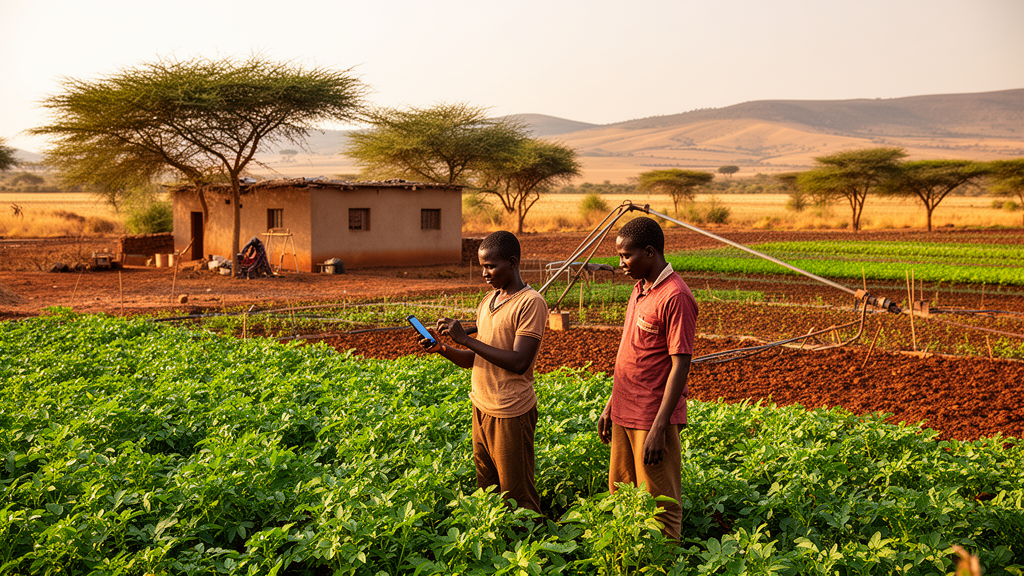
A systematic review finds that machine-learning and remote-sensing systems developed for large-scale monocultures are not readily transferable to Ethiopia’s fragmented, intercropped smallholder landscapes. Prepared under Preferred Reporting Items for Systematic Reviews and Meta-Analyses 2020 guidelines, the review examines evidence in four domains: in-season crop-yield forecasting, digital soil mapping, real-time biotic-stress detection and agro-meteorological modeling. Its main finding is a mismatch between the resolution of available satellite observations and the sub-hectare scale at which smallholders may need agricultural information.
The review treats this as an implementation gap: computational methods can be mature in laboratory or large-scale settings without becoming useful at the field level. Coarse satellite pixels may cover substantially more land than an individual farming plot, while models developed around extensive, standardized crop systems may not translate directly to fragmented and intercropped environments. The analysis therefore questions the assumption that strong computational performance alone demonstrates practical value for Ethiopian smallholders.
It instead asks whether outputs can become sufficiently localized, timely and accessible to support decisions in small agricultural holdings. Three recurring constraints are identified in the synthesized evidence: scarcity of localized data, hardware limitations and the “last-mile” connectivity divide between analytical systems and farming communities. These barriers can prevent geospatial intelligence from reaching its intended users even when a model successfully detects or estimates a pattern.
The review also argues that agricultural extension services must be restructured to integrate digital outputs into everyday smallholder decision-making, rather than leaving advanced tools outside the support structures through which farmers receive information and assistance. These are strategic recommendations rather than results from a new field trial. Its contribution is a review-based critique of why sophisticated geospatial tools have not yet delivered equivalent field-level utility across Ethiopia’s smallholder systems.
The authors connect this digital-agriculture challenge to Sustainable Development Goal 2 on zero hunger and Sustainable Development Goal 13 on climate action. The stated objective is to enhance crop productivity and build resilience amid climate variability, but the review does not establish that the proposed computing model or extension-service changes have already produced those outcomes. The evidence instead supports a cautious conclusion: Ethiopia’s smallholder precision agriculture requires systems designed around field-scale constraints, local data, accessible hardware, reliable connectivity and existing decision-making networks.
Subject of Research: Implementation challenges for machine learning and remote sensing in Ethiopian smallholder agriculture
Article Title: Machine learning and remote sensing for smallholder precision agriculture in Ethiopia
Article References: Asefa, A. (2026). Machine learning and remote sensing for smallholder precision agriculture in Ethiopia. Discover Sustainability. https://doi.org/10.1007/s43621-026-04538-2
Image Credits: AI Generated
DOI: 10.1007/s43621-026-04538-2
Keywords: Ethiopia, smallholder agriculture, machine learning, remote sensing, precision agriculture, edge computing, tinyML, digital soil mapping, agro-meteorology, food security, Machine, learning
Cite Scienmag News
Alan Morgan. (October 26, 2026). Review identifies scale gap in Ethiopia’s smallholder digital agriculture tools. Scienmag. https://scienmag.com/review-identifies-scale-gap-in-ethiopias-smallholder-digital-agriculture-tools/
Alan Morgan. "Review identifies scale gap in Ethiopia’s smallholder digital agriculture tools." Scienmag, 26 October 2026, https://scienmag.com/review-identifies-scale-gap-in-ethiopias-smallholder-digital-agriculture-tools/. Accessed 26 October 2026.
Alan Morgan. "Review identifies scale gap in Ethiopia’s smallholder digital agriculture tools." Scienmag. October 26, 2026. https://scienmag.com/review-identifies-scale-gap-in-ethiopias-smallholder-digital-agriculture-tools/


