


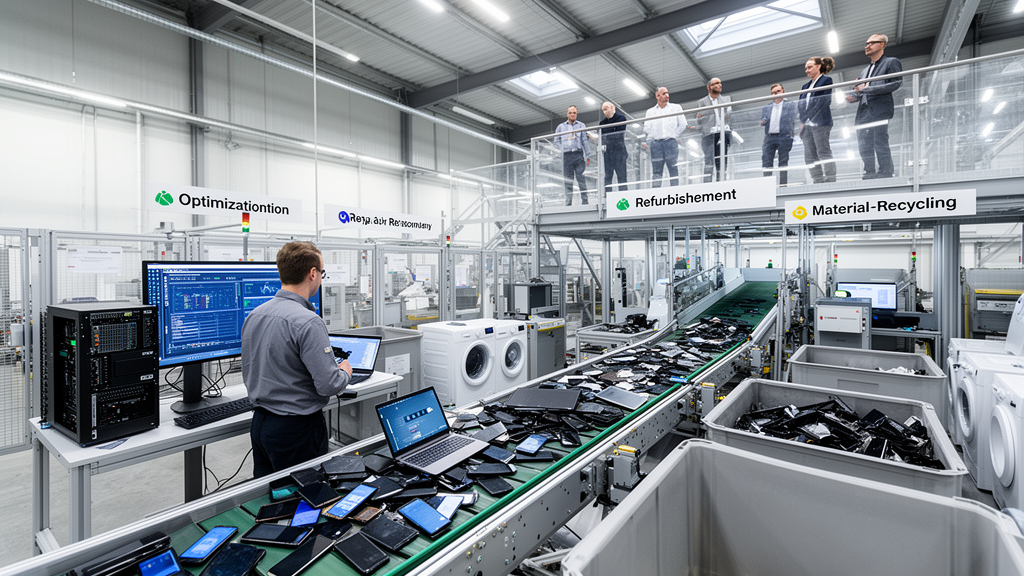
A learning-based hybrid multi-objective metaheuristic generated high-quality solutions for a modeled circular e-waste supply chain and reduced median normalized IGD+ by 60.6% relative to standard NSGA-II under an equal exact-evaluation budget. The researchers developed a Circular, Sustainable, and Resilient Supply Chain framework for e-waste management using a multi-objective mixed-integer programming model. Its objectives are to minimize total cost and environmental impact while maximizing social benefits.
Circular-economy practices are represented through closed-loop product and material flows, refurbishment, recycling, and clean-technology selection. Resilience is incorporated through capacity flexibility, reserve capacity, and scenario-responsive operational decisions, allowing a network design to respond to differing operating conditions. The model addresses uncertainty in demand, e-waste returns, processing yields, operating costs, and clean-technology performance.
Rather than relying on one fixed set of assumptions, it uses a risk-weighted robust scenario-based stochastic formulation with pessimistic, most-likely, and optimistic scenarios. This approach links network decisions to multiple possible operating outcomes while retaining cost, environmental, and social objectives in the same optimization problem. For large-scale instances, the authors combined a learning-based hybrid metaheuristic with the mixed-integer model to generate a high-quality set of Pareto solutions.
For smaller instances, they used an augmented epsilon-constraint method as a benchmark. Across the evaluated instances, the hybrid approach achieved a median normalized IGD+ of 0.0086 and a median hypervolume of 0.814 under the equal exact-evaluation budget. Its computational time remained competitive.
These results demonstrate an algorithmic improvement within the study’s specified models, budget, and evaluation settings, but they do not establish that the same advantage will occur in every real supply chain. The case study links the computational results to strategic decisions concerning facility configuration, capacity flexibility, clean-technology investment, and circular recovery planning. Flexible and reserved capacity provide mechanisms for adapting when return volumes or processing yields differ from expectations, while scenario-responsive operations can adjust decisions under the conditions represented by each scenario.
Subject of Research: Multi-objective optimization of uncertain circular e-waste supply chains
Article Title: Learning-based hybrid optimization for circular E-waste supply chains under uncertainty
Article References: Tabatabaeia, S. M., & Goh, M. (2026). Learning-based hybrid optimization for circular E-waste supply chains under uncertainty. Discover Sustainability. https://doi.org/10.1007/s43621-026-04590-y
Image Credits: AI Generated
DOI: 10.1007/s43621-026-04590-y
Keywords: e-waste, circular economy, supply-chain design, multi-objective optimization, hybrid metaheuristic, NSGA-II, uncertainty modeling, clean technology, resilient supply chains, mixed-integer programming, Learning-based, hybrid
Cite Scienmag News
Violet Maxwell. (October 26, 2026). Learning-based hybrid method improves circular e-waste network optimization. Scienmag. https://scienmag.com/learning-based-hybrid-method-improves-circular-e-waste-network-optimization/
Violet Maxwell. "Learning-based hybrid method improves circular e-waste network optimization." Scienmag, 26 October 2026, https://scienmag.com/learning-based-hybrid-method-improves-circular-e-waste-network-optimization/. Accessed 26 October 2026.
Violet Maxwell. "Learning-based hybrid method improves circular e-waste network optimization." Scienmag. October 26, 2026. https://scienmag.com/learning-based-hybrid-method-improves-circular-e-waste-network-optimization/


