

Monday, October 26, 2026
Science
No Result
View All Result
  • Login
  • HOME
  • SCIENCE NEWS
  • CONTACT US
  • HOME
  • SCIENCE NEWS
  • CONTACT US
No Result
View All Result
Scienmag
No Result
View All Result
Home Science News Earth Science

Microbial recontamination associated with household water use practices in Cambodia

October 26, 2026
in Earth Science
Morgan Morrow
By Morgan Morrow Scienmag Editorial Profile - Bacteriology
Reading Time: 2 mins read
0
Microbial recontamination associated with household water use practices in Cambodia

Microbial recontamination associated with household water use practices in Cambodia

65
SHARES
587
VIEWS
Share on FacebookShare on Twitter
ADVERTISEMENT

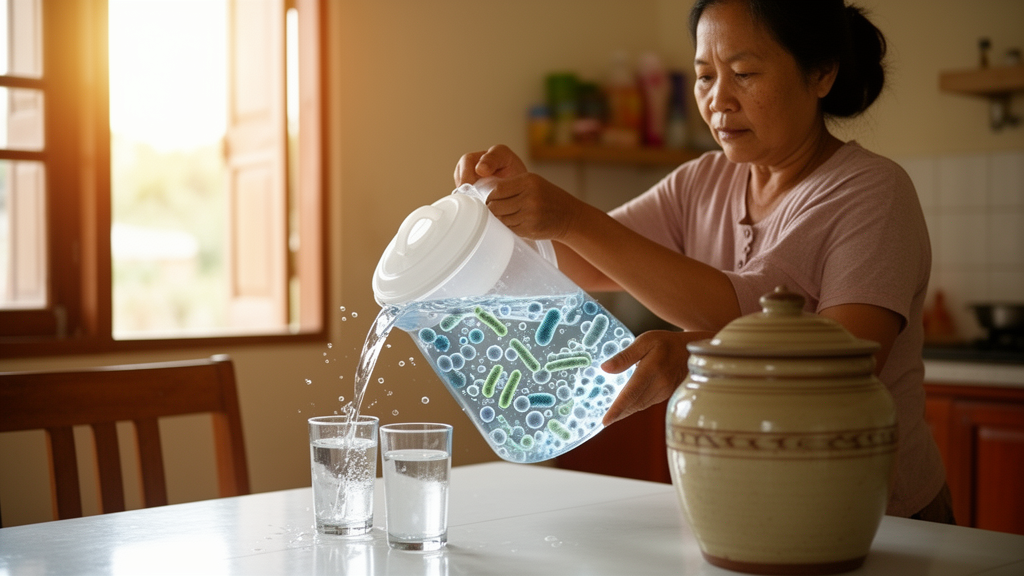
An exploratory study of 30 households in a remote riverine island community in Cambodia found substantial microbial contamination on household drinking cups, even though stored river water used for drinking and domestic purposes was generally within national physicochemical guideline ranges. The results suggest that household handling, storage or use of drinking utensils may create opportunities for microbial recontamination. Researchers investigated household water-use conditions through three complementary activities: water-quality analysis, surface swab tests and field interviews.

Bathing-water samples were collected from eight households, drinking-water samples from nine households, and swabs were taken from household water-use utensils. The limited sample and exploratory design constrain the findings, which cannot establish a direct route from a particular practice to contamination or illness. The physicochemical measurements on stored river water were generally within the relevant national guideline ranges, although exceptions were observed.

Escherichia coli was detected in only a limited number of the water samples. These findings indicate that the sampled water was not uniformly contaminated with E. coli, even though some measured physicochemical parameters fell outside guideline ranges. The clearest microbial signal came from the drinking-cup swabs.

Total coliforms reached “too numerous to count” levels in every cup-swab sample, while some samples also yielded E. coli at “too numerous to count” levels. The contrast between the water and utensil results is central to the study. Relatively favorable measurements for stored water coexisted with heavily contaminated drinking-cup surfaces.

The evidence does not identify the exact moment or mechanism of contamination. Interviews with the 30 households revealed limited awareness of safe washing practices and microbial contamination risks. These accounts provided context for the laboratory findings and showed that routine household water use was not adequately covered by existing knowledge about contamination.

The interviews do not, however, quantify the frequency of individual practices or establish the independent effect of any behavior on the swab results. Several limitations restrict how broadly the results can be interpreted. The research concerned one remote island village, included water samples from only 17 households across two sampling categories and examined a defined set of household utensils.

Its findings therefore cannot by themselves establish the prevalence of similar contamination elsewhere in Cambodia or among other remote communities. Based on the exploratory evidence, the authors say capacity-building interventions—including training on safe water use and household hygiene management—may help reduce recontamination risks in remote areas. Such training is presented as a potential response rather than a tested intervention, because the supplied study evidence does not show that any training program reduced contamination or produced measurable health benefits.

Subject of Research: Household water handling and microbial recontamination in a Cambodian riverine community

Article Title: Microbial recontamination associated with household water use practices in a remote riverine island community in Cambodia

Article References: Yazawa, T., Watanabe, M., & Sato, J. (2026). Microbial recontamination associated with household water use practices in a remote riverine island community in Cambodia. Discover Sustainability. https://doi.org/10.1007/s43621-026-04725-1

Image Credits: AI Generated

DOI: 10.1007/s43621-026-04725-1

Keywords: microbial recontamination, household water safety, Cambodia, drinking cups, Escherichia coli, total coliforms, water quality, hygiene practices, riverine communities, field interviews, Microbial, recontamination

Cite Scienmag News

Morgan Morrow. (October 26, 2026). Microbial recontamination associated with household water use practices in Cambodia. Scienmag. https://scienmag.com/microbial-recontamination-associated-with-household-water-use-practices-in-cambodia/


Morgan Morrow. "Microbial recontamination associated with household water use practices in Cambodia." Scienmag, 26 October 2026, https://scienmag.com/microbial-recontamination-associated-with-household-water-use-practices-in-cambodia/. Accessed 26 October 2026.

Morgan Morrow. "Microbial recontamination associated with household water use practices in Cambodia." Scienmag. October 26, 2026. https://scienmag.com/microbial-recontamination-associated-with-household-water-use-practices-in-cambodia/

Tags: Cambodiadrinking cupsdrinking water storage and hygieneEscherichia coliEscherichia coli detection in household waterfield interviewshousehold water quality assessmentHousehold water recontamination in Cambodiahousehold water safetyhousehold water sanitation challengeshygiene practicesimpact of water-use practices on microbial safetymicrobialmicrobial contamination of drinking cupsmicrobial recontaminationmicrobial recontamination pathwaysphysicochemical water parameters and microbial presencerecontaminationriverine communitiesriverine community water safetysurface swab testing for water utensilstotal coliformswater handling practices in rural communitieswater quality
Share26Tweet16
Previous Post

Public perception attitude and awareness toward mental illness in Palestine

Next Post

Flash-heated bamboo biochar produces tougher, absorption-dominant shielding composite

Related Posts

Review identifies scale gap in Ethiopia’s smallholder digital agriculture tools
Earth Science

Review identifies scale gap in Ethiopia’s smallholder digital agriculture tools

October 26, 2026
Bias-corrected climate models sharpen Kulfo River streamflow projections
Earth Science

Bias-corrected climate models sharpen Kulfo River streamflow projections

October 26, 2026
Survey links agile project management to sustainability outcomes among Pakistani IT managers
Earth Science

Survey links agile project management to sustainability outcomes among Pakistani IT managers

October 26, 2026
Learning-based hybrid method improves circular e-waste network optimization
Earth Science

Learning-based hybrid method improves circular e-waste network optimization

October 26, 2026
Review finds integrated natural resource governance remains rare
Earth Science

Review finds integrated natural resource governance remains rare

October 26, 2026
Indian IT survey links customized job deals to careers and quitting intentions
Earth Science

Indian IT survey links customized job deals to careers and quitting intentions

October 26, 2026
Next Post
Flash-heated bamboo biochar produces tougher, absorption-dominant shielding composite

Flash-heated bamboo biochar produces tougher, absorption-dominant shielding composite

  • Mothers who receive childcare support from maternal grandparents show more optimized

    Mothers who receive childcare support from maternal grandparents show more parental warmth, finds NTU Singapore study

    27656 shares
    Share 11059 Tweet 6912
  • University of Seville Breaks 120-Year-Old Mystery, Revises a Key Einstein Concept

    1061 shares
    Share 424 Tweet 265
  • Bee body mass, pathogens and local climate influence heat tolerance

    682 shares
    Share 273 Tweet 171
  • Researchers record first-ever images and data of a shark experiencing a boat strike

    546 shares
    Share 218 Tweet 137
  • Groundbreaking Clinical Trial Reveals Lubiprostone Enhances Kidney Function

    531 shares
    Share 212 Tweet 133
Science

Embark on a thrilling journey of discovery with Scienmag.com—your ultimate source for cutting-edge breakthroughs. Immerse yourself in a world where curiosity knows no limits and tomorrow’s possibilities become today’s reality!

RECENT NEWS

  • Hemispheric preferences associated with thinking styles in Kerala undergraduates
  • Flash-heated bamboo biochar produces tougher, absorption-dominant shielding composite
  • Microbial recontamination associated with household water use practices in Cambodia
  • Public perception attitude and awareness toward mental illness in Palestine

Categories

  • Agriculture
  • Anthropology
  • Archaeology
  • Athmospheric
  • Biology
  • Biotechnology
  • Blog
  • Bussines
  • Cancer
  • Chemistry
  • Climate
  • Earth Science
  • Editorial Policy
  • Marine
  • Mathematics
  • Medicine
  • Pediatry
  • Policy
  • Psychology & Psychiatry
  • Science Education
  • Science News
  • Social Science
  • Space
  • Technology and Engineering

Subscribe to Blog via Email

Enter your email address to subscribe to this blog and receive notifications of new posts by email.

Join 5,151 other subscribers

© 2025 Scienmag - Science Magazine

Welcome Back!

Login to your account below

Forgotten Password?

Retrieve your password

Please enter your username or email address to reset your password.

Log In
No Result
View All Result
  • HOME
  • SCIENCE NEWS
  • CONTACT US

© 2025 Scienmag - Science Magazine

Discover more from Science

Subscribe now to keep reading and get access to the full archive.

Continue reading