


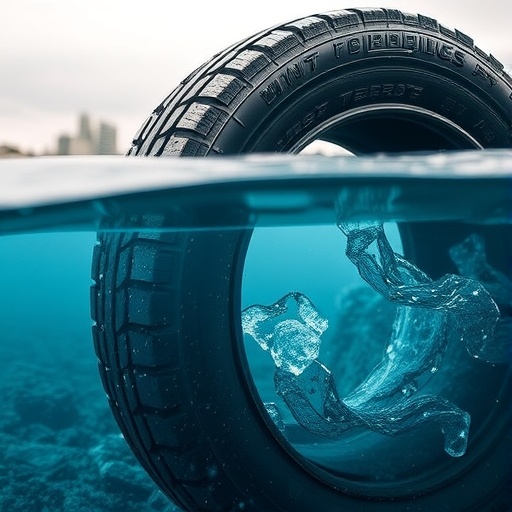
In the global battle against plastic pollution, a new and largely underestimated culprit has emerged from an unexpected source: retreaded tires. Recent groundbreaking research has unveiled that these once-recycled automotive components are a significant contributor to microplastic pollution, discharging unique chemical additives that pose distinct ecological threats in various environments. This startling revelation not only broadens our understanding of microplastic origins but also challenges current environmental protection strategies, which have so far overlooked retreaded tires as a meaningful contributor to this pervasive pollution crisis.
Microplastics—particles smaller than five millimeters—have long been recognized as a transformative environmental hazard due to their persistence, widespread distribution, and capability to transport toxic substances across ecosystems. While the spotlight has traditionally been on items like single-use plastics, synthetic textiles, and tire wear particles from new tires, retreaded tires—an economically valuable and widely used tire recycling method—have remained surprisingly neglected in scientific scrutiny. The study conducted by Liu, Cao, Lin, and colleagues delivers a meticulously detailed investigation into the microplastic release dynamics, chemical leaching profiles, and ecotoxicological consequences stemming from these reused tires.
Through advanced material characterization techniques and comprehensive leaching experiments, the researchers demonstrated that fragments derived from retreaded tires contain a distinct suite of additives compared to their virgin counterparts. These additives, which include various plasticizers, antioxidants, and vulcanization agents, were shown to leach at measurable rates into simulated environmental matrices, a process that could have been severely underestimated in prior risk assessments. The distinct chemical signature of retreaded tire particles implies that the environmental impact of microplastics is more complex and varied than previously appreciated, particularly when considering long-term ecological health.
The ecotoxicity tests carried out as part of the research emphasize the differential biological effects of these microplastic leachates. When exposed to model aquatic organisms, chemicals emanating from retreaded tire-derived particles induced a suite of adverse outcomes, ranging from cellular oxidative stress to impaired developmental processes. This observation is critical because it links the material-specific chemical complexity to real biological consequences, highlighting the urgent need to reassess microplastic pollution policies with a more nuanced understanding of additive-related toxicities.
The study’s interdisciplinary approach combined polymer science, environmental chemistry, and ecotoxicology to achieve a holistic assessment. It started with isolating microplastic particles from tires subjected to simulated wear-and-tear processes, followed by identifying their chemical additives using high-resolution mass spectrometry. Subsequently, leaching tests under environmentally relevant pH and temperature conditions mimicked natural aquatic environments, strengthening the ecological relevance of the findings. By integrating these techniques, the research unmasked the hidden pathways through which retreaded tires contribute to microplastic loads and associated chemical pollution.
One of the most alarming insights from this research is the persistence of retreaded tire microparticles within various ecosystems. Unlike some other forms of plastic debris which may degrade or fragment differently, retreaded tire particles maintain unique structural and chemical integrity over prolonged periods. This resilience further exacerbates their role as both physical pollutants and chemical contaminant sources. The persistence also implies that these particles can accumulate in sedimentary environments or biofilms, potentially entering food webs and exerting chronic effects on diverse organisms over multiple generations.
Critically, this evolving understanding of retreaded tires challenges the existing narrative surrounding sustainable tire recycling. Retreading has been championed as a cost-effective and resource-efficient strategy that extends tire life, reducing waste generation and raw material extraction. However, these new findings suggest that without stringent quality controls, especially concerning the nature of additives used and their potential environmental release, the ecological trade-offs of retreading might be more significant than anticipated. Consequently, policymakers and industry stakeholders face complex decisions to balance economic, environmental, and health priorities.
Moreover, the study spotlights an urgent gap in environmental monitoring frameworks. Currently, many global microplastic surveillance programs do not differentiate between sources or types of tire wear particles, let alone consider retreaded tire origin. The distinct chemical markers identified in retreaded tires open the door for more refined analytical methods capable of source attribution. Developing such tools would empower regulators to better track pollution sources, enforce relevant environmental regulations, and implement more targeted mitigation strategies aimed at this overlooked risk source.
The implications of this research extend beyond environmental pollution to public health concerns. Given that microplastics have been detected in human consumables and biological tissues, understanding the chemical complexity introduced by retreaded tire particles is imperative. Additives commonly employed in these tires are known to exhibit endocrine-disrupting properties and other toxic effects in mammals, raising questions about potential exposure through environmental pathways or occupational contact during tire manufacturing and recycling operations.
Furthermore, the research invites reconsideration of tire design and the additive compounds traditionally favored in retreading formulations. Innovations in green chemistry and materials science could lead to the development of additive-free or less hazardous alternatives, reducing the toxicological footprint of retreaded tires without compromising their mechanical performance. Such advancements would also benefit the broader context of tire wear particle pollution, an inherently multifaceted challenge linked to mobility, urbanization, and climate change mitigation efforts.
The public discourse around microplastics must evolve to incorporate these findings about retreaded tire contributions. Raising awareness among consumers, environmental advocates, and industry players about the concealed impacts of this widespread practice can catalyze demand for safer products and more rigorous environmental standards. Educational campaigns focused on the multifaceted origins of microplastics might also encourage behavioral shifts towards sustainable tire use, maintenance, and disposal.
Finally, this research highlights the critical need for interdisciplinary scientific collaboration to unravel the complexities of emerging pollutants. By fusing expertise in synthetic polymer chemistry, environmental toxicology, and ecological risk assessment, Liu and colleagues have set a precedent for future investigations into similarly overlooked pollution sources. The insights gained offer a promising avenue not only for environmental protection but also for designing a more sustainable and health-conscious industrial future.
In sum, the revelation that retreaded tires are a significant, chemically distinct source of microplastic pollution with potent ecotoxic effects shifts the paradigm of how we perceive recycled tire debris. It calls for an urgent reassessment of current environmental monitoring, regulatory frameworks, and tire production practices. Addressing this challenge holistically will require innovation, cooperation, and commitment but promises a critical step forward in mitigating one of the most pressing ecological threats of our time.
Cite Scienmag News
Violet Maxwell. (April 28, 2026). Retreaded Tires: Overlooked Microplastic Source with Unique Toxicity. Scienmag. https://scienmag.com/retreaded-tires-overlooked-microplastic-source-with-unique-toxicity/
Violet Maxwell. "Retreaded Tires: Overlooked Microplastic Source with Unique Toxicity." Scienmag, 28 April 2026, https://scienmag.com/retreaded-tires-overlooked-microplastic-source-with-unique-toxicity/. Accessed 3 September 2026.
Violet Maxwell. "Retreaded Tires: Overlooked Microplastic Source with Unique Toxicity." Scienmag. April 28, 2026. https://scienmag.com/retreaded-tires-overlooked-microplastic-source-with-unique-toxicity/


