


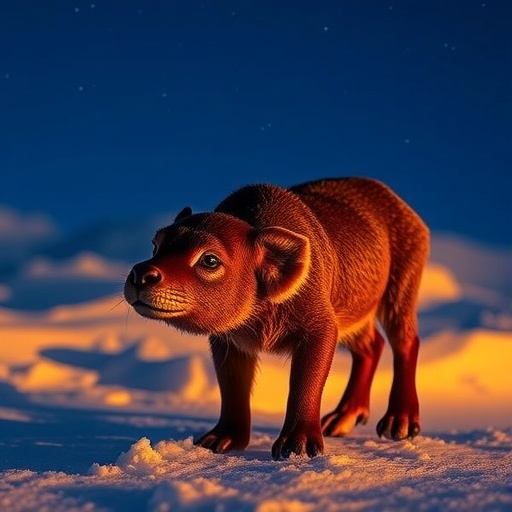
More than 70 million years ago, the Arctic was a bustling hub of ancient mammalian life teeming with diversity, far removed from the stark and frozen landscape we know today. This revelation challenges long-standing presumptions that the polar regions were mere peripheries in the evolutionary saga. A groundbreaking study spearheaded by researchers at the University of Colorado Boulder, published recently in the proceedings of a prestigious scientific journal, unearths astonishing evidence of three previously unknown species of rodent-like mammals that once thrived alongside towering dinosaurs in what is now northern Alaska.
The discovery was made possible through the meticulous analysis of fossilized teeth extracted from the Prince Creek Formation, a geological stratum located deep within the Arctic Circle. These teeth, dating back approximately 73 million years, bear silent testimony to a time when the region endured a grueling climate marked by months of winter darkness, freezing temperatures, and seasonal scarcities in nourishment. Yet, the tiny multituberculates—an extinct lineage of mammal resembling modern rodents in size—had not only survived but flourished under these extreme conditions.
The newfound species were christened as Camurodon borealis, Qayaqgruk peregrinus, and Kaniqsiqcosmodon polaris, names imbued with meaning that reflect their Arctic origins and unique adaptations. Camurodon borealis, translating to the “Northern curved-tooth,” is indicative of its specialized herbivorous dentition. Qayaqgruk peregrinus—the “little wandering hero,” named in homage to the Inuit legendary figure, Qayaq—demonstrates fascinating biogeographical connections tracing back to Mongolia. Meanwhile, Kaniqsiqcosmodon polaris, meaning “polar frost ornamented tooth,” hints at both its environmental context and distinctive dental morphology.
Intriguingly, these multituberculates exhibit a striking range of dental variability, suggesting diverse dietary strategies. Camurodon borealis’s teeth characterize it as a dedicated herbivore, optimized for plant consumption. In contrast, Qayaqgruk peregrinus and Kaniqsiqcosmodon polaris possessed teeth consistent with omnivory, with the former likely incorporating a substantial insectivorous component into its diet, while the latter leaned more heavily towards vegetation. This dietary partitioning would have conferred ecological advantages, enabling these species to coexist in an environment where resources were limited and highly seasonal.
Multituberculates are remarkable not only for their longevity but also for their adaptive resilience. Spanning over 100 million years from the Jurassic to the Eocene epoch, this mammalian group outlasted mass extinctions, including the cataclysmic asteroid impact that eradicated non-avian dinosaurs. Their evolutionary success raises compelling questions about the traits that facilitated such endurance. The new findings spotlight how dietary versatility and niche differentiation may have been critical mechanisms promoting survival through dramatic climatic and environmental upheavals.
Beyond ecological insights, the team’s phylogenetic analyses unveiled profound biogeographic ramifications. Genetic and morphological affinities link Qayaqgruk peregrinus to a relative species from Mongolia, implying an ancient migration across what would have been a land bridge connecting Asia and North America roughly 92 million years ago. This ancestral dispersal predated previous estimates of intercontinental mammalian exchanges, pushing back the timeline of early Arctic faunal migrations and emphasizing the dynamic role the polar corridor played in shaping evolutionary trajectories.
The research also reshapes our understanding of ancient Arctic ecosystems, highlighting their complexity and connectivity. Despite the harshness implied by polar environments, these landscapes fostered biodiversity and were active centers of speciation and dispersal. Their contribution to the evolutionary mosaic underscores the need to reconsider polar regions not as isolated or marginal but as integral components of Earth’s prehistoric biosphere that influenced global patterns of life.
Moreover, the implications of this study extend beyond paleontology. It provides a valuable analog for contemporary and future scenarios where climate change is rapidly altering ecosystems. Examining the adaptability and resilience of ancient multituberculates offers insights into how mammals can respond to extreme environmental stresses, including prolonged darkness, frigid winters, and fluctuating food availability. Such lessons hold relevance for predicting the impact of modern climatic shifts on Arctic and global biodiversity.
The researchers emphasize that this discovery is a testament to the layered histories embedded within landscapes. A place—such as the Arctic—is not merely a geographic coordinate but a chronicle recounting epochs of migrations, extinctions, adaptations, and revivals. Understanding these deep-time narratives is vital for appreciating the dynamic interplay between organisms and their environments over millions of years.
Significantly, the uncovering of this ancient Arctic ensemble contributes a critical piece to the puzzle of mammalian evolution, showing how certain groups exploited polar habitats for millions of years, adapting their diets and lifestyles to survive and diversify. It also provides a rare glimpse into the faunal assemblages that predate one of Earth’s most dramatic biological upheavals—the Cretaceous–Paleogene mass extinction event.
As paleontologists continue to dig deeper into the Arctic’s frozen strata, they anticipate more discoveries that will illuminate how early mammals and other organisms navigated the challenges posed by high-latitude environments. The research underscores the polar regions as both crucibles of evolutionary innovation and bridges of faunal exchange, reshaping our paradigms of life’s history on Earth.
In summary, this landmark study reveals that the ancient Arctic was not a barren wasteland but a vibrant ecosystem that hosted a sophisticated and resilient community of mammals long before humans walked the planet. It challenges previous evolutionary assumptions, uncovers pathways of ancient species migration, and underscores the enduring adaptability of life in the face of adversity.
News Publication Date: 18-May-2026
Web References: DOI link
Cite Scienmag News
Gavin Prescott. (May 18, 2026). Ancient Arctic Species Discovery Sheds Light on Animal Survival in Extreme Conditions. Scienmag. https://scienmag.com/ancient-arctic-species-discovery-sheds-light-on-animal-survival-in-extreme-conditions/
Gavin Prescott. "Ancient Arctic Species Discovery Sheds Light on Animal Survival in Extreme Conditions." Scienmag, 18 May 2026, https://scienmag.com/ancient-arctic-species-discovery-sheds-light-on-animal-survival-in-extreme-conditions/. Accessed 3 September 2026.
Gavin Prescott. "Ancient Arctic Species Discovery Sheds Light on Animal Survival in Extreme Conditions." Scienmag. May 18, 2026. https://scienmag.com/ancient-arctic-species-discovery-sheds-light-on-animal-survival-in-extreme-conditions/


