


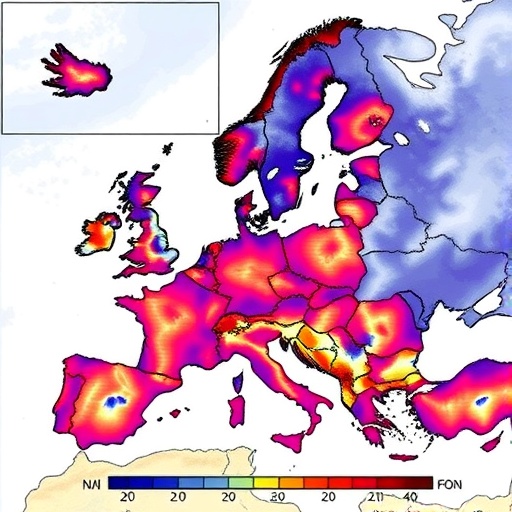
In an era marked by escalating climate extremes, a groundbreaking study published in Communications Earth & Environment has brought unprecedented insight into the potential worst-case heat scenarios that Europe might face in the near future. The research, led by Suarez-Gutierrez, Beyerle, Mittermeier, and colleagues, explores how extreme heat events could unfold across the continent under changing climatic conditions. Utilizing an advanced ensemble boosting technique, the study pioneers new methods for projecting heat extremes with enhanced precision, offering an essential tool for climate scientists, policymakers, and urban planners working to mitigate heat-related risks.
The European continent has witnessed a notable rise in the frequency, intensity, and duration of heatwaves over recent decades. These events have resulted in severe societal, economic, and environmental consequences, including increased mortality rates, agricultural losses, and critical strain on energy and water resources. Traditional climate models often struggle to explicitly capture the tail end of extreme heat distributions, leading to potential underestimations of the severest heat risks. Recognizing this limitation, the authors turned to ensemble boosting—a statistical approach designed to amplify rare and extreme climate simulations, thus allowing scientists to better quantify the most severe heat episodes that could realistically strike Europe.
Ensemble boosting leverages an array of climate model runs, systematically enhancing the representation of rare extreme events by perturbing initial conditions and emphasizing scenarios that exhibit stronger heatwave characteristics. This technique effectively generates “storylines” or plausible narrative pathways that delineate how extreme heatwaves could evolve. Unlike conventional probabilistic risk assessments, these storylines provide detailed spatial and temporal maps of heat extremities, enhancing the granularity of risk projections and supporting more targeted adaptation strategies.
The study’s results reveal alarming possibilities: European regions, particularly Southern and Central Europe, face an increasingly volatile heat future, with record-breaking heatwave episodes potentially exceeding any historical precedent. These storylines demonstrate not only intensifying peak temperatures but also extended durations of extreme heat, conditions that amplify the detrimental impacts on public health and critical infrastructure. The study details heat episodes surpassing 50°C in localized areas under severe scenario conditions, a benchmark previously unimaginable for many parts of Europe.
One significant strength of the research lies in its multidimensional analysis, incorporating variables such as soil moisture deficits, atmospheric blocking patterns, and heatwave clustering. Atmospheric blocking, a phenomenon where high-pressure systems stall over a region, was shown to play a critical role in enhancing heat severity and persistence. By identifying how these physical drivers interact and compound heat extremes, the research provides a nuanced understanding that extends beyond simple temperature metrics.
Additionally, the study underscores the interconnectedness of heatwaves with hydrological extremes, illustrating how prolonged heat can exacerbate drought risk, diminish water availability, and weaken ecosystem resilience. This intersectionality underscores the urgency of integrated climate risk assessments, where heatwaves are not isolated events but part of a complex system of climatic stressors.
In terms of methodology, the authors applied ensemble boosting to output from climate models participating in the Coupled Model Intercomparison Project phase 6 (CMIP6). This alignment with the latest generation of climate simulations ensures that the study’s projections are rooted in up-to-date climate science while pushing the boundaries of what such models can reveal about extreme heat outcomes. The method also enhances the exploration of tail risks by focusing computational resources on those simulations that represent severe deviations, providing a richer dataset for risk analysis.
Beyond data generation, the study also addresses the critical challenge of communicating extreme heat risks. By framing the amplified heat events as storylines rather than abstract model outputs, the research translates complex climate data into understandable scenarios. These narratives are instrumental in engaging policymakers and the public, fostering a greater sense of urgency and encouraging proactive measures to cope with impending heat threats.
The implications of these worst-case storylines extend to various sectors. Urban centers, which already suffer from the urban heat island effect, could face intensified heatwaves without adequate adaptation. Infrastructure sensitive to thermal extremes, including transportation networks, energy grids, and public health systems, may be pushed beyond their operational thresholds, leading to cascading failures. Furthermore, vulnerable populations—such as the elderly, outdoor laborers, and marginalized communities—would likely endure disproportionate hardships, emphasizing the need for equitable climate resilience strategies.
In response to these findings, the authors advocate for the incorporation of boosted ensemble storylines into climate risk management frameworks. Such integration would facilitate more robust contingency planning and resource allocation, enabling governments and industries to prepare for plausible, albeit extreme, heat scenarios rather than relying solely on median projections. This approach also supports the design of adaptive infrastructure and emergency response protocols grounded in scientifically robust future conditions.
The study’s innovative use of ensemble boosting sets a precedent for future climate research. As climate models continue to evolve, techniques that enhance the detection and characterization of tail risks will be indispensable for anticipating worst-case environmental threats. By improving the resolution and reliability of extreme heat projections, scientists can better inform global mitigation and adaptation efforts, ultimately safeguarding communities and ecosystems.
The research further highlights the importance of collaborative efforts across disciplines, blending atmospheric science, statistics, climatology, and risk assessment. Such interdisciplinarity is crucial to unravel the multifaceted drivers of heat extremes and to develop practical solutions. As heatwaves represent one of the most immediate and tangible consequences of global warming, studies like this one serve as critical beacons for directing scientific inquiry and policy focus.
Finally, while the study focuses on Europe, its methodological advances have broad applicability. Regions worldwide facing heightened heat risks—from North America to parts of Asia and Australia—could benefit from ensemble boosting applications tailored to their climatic contexts. This global relevance amplifies the study’s contribution to the wider climate resilience discourse.
In sum, the research by Suarez-Gutierrez and colleagues presents a vital leap forward in understanding and preparing for extreme heatwaves in Europe. By harnessing the power of ensemble boosting, the study delineates clear, scientifically grounded worst-case heat storylines that challenge prevailing perceptions of climate risk. These findings not only deepen our comprehension of heat extremes but also compel urgent action to mitigate the socioeconomic and environmental toll of a warming planet’s most severe heat threats.
Cite Scienmag News
Violet Maxwell. (June 6, 2026). Worst-case European Heatwaves Revealed by Ensemble Boosting. Scienmag. https://scienmag.com/worst-case-european-heatwaves-revealed-by-ensemble-boosting/
Violet Maxwell. "Worst-case European Heatwaves Revealed by Ensemble Boosting." Scienmag, 6 June 2026, https://scienmag.com/worst-case-european-heatwaves-revealed-by-ensemble-boosting/. Accessed 3 September 2026.
Violet Maxwell. "Worst-case European Heatwaves Revealed by Ensemble Boosting." Scienmag. June 6, 2026. https://scienmag.com/worst-case-european-heatwaves-revealed-by-ensemble-boosting/


