


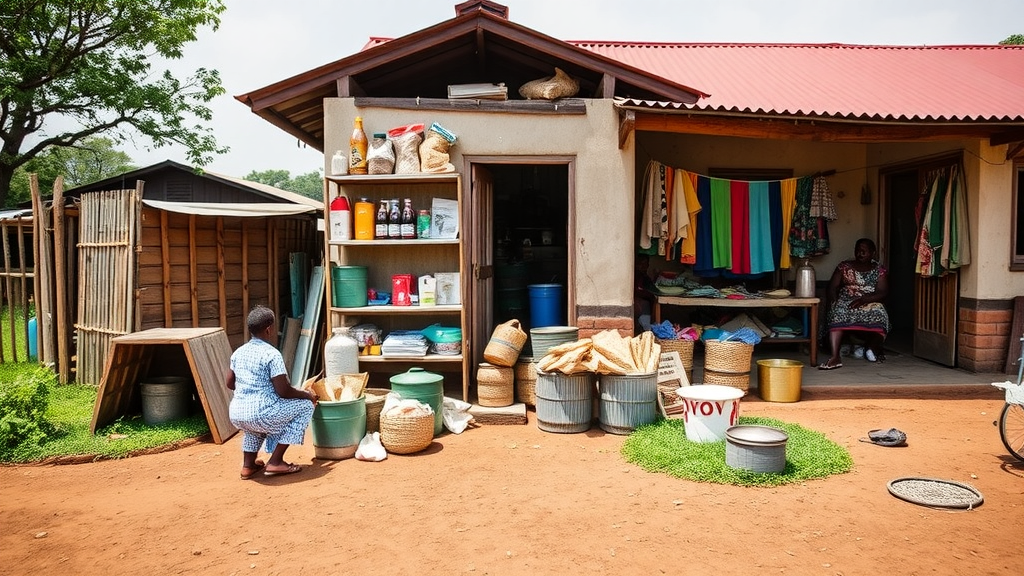
In the drought-prone districts of central Zimbabwe, the difference between a small business that thrives and one that quietly disappears often comes down to a quality that is notoriously hard to measure: resilience. A new study of nearly five hundred rural enterprises has now put that intuition on firm statistical footing, showing that resilience is not just a buzzword in development circles but a quantifiable driver of income for the agricultural and retail businesses that anchor rural economies. The research, published in BMC Agriculture, surveyed 492 micro, small and medium enterprises across four districts of Midlands Province and found that firms scoring higher on a composite resilience index earned significantly more each year than their less adaptable counterparts.
The scale of Zimbabwe’s small business sector makes the question more than academic. The country counts roughly 3.4 million micro, small and medium enterprises, yet only about 14 percent of them are formally registered. Together these businesses employ around three million adults and contribute approximately 8.6 billion US dollars to the gross domestic product. More than three quarters of them operate in just two sectors: agriculture, which accounts for about 39 percent, and retail, which accounts for roughly 38 percent. Midlands Province alone is home to an estimated 432,000 such enterprises, making it an ideal natural laboratory for asking what allows small firms to survive and grow amid chronic macroeconomic instability, currency turbulence and recurring climate shocks.
The research team, led by Felix Tete of Midlands State University together with Conrad Murendo and Laurine Chikoko, designed their survey to capture resilience as a measurable, multidimensional property rather than an abstract virtue. Drawing on established frameworks in the entrepreneurship literature, they defined resilience as the capacity of an enterprise to absorb, adapt to and recover from economic, environmental and institutional shocks while maintaining or improving performance over time. Because such a capacity cannot be observed directly, the researchers administered twelve survey items covering attributes such as adaptability, coping, problem-solving under stress, the ability to face setbacks, functional continuity and recovery capacity. Each item was rated on a seven-point scale and then converted into a binary indicator, with agreement coded as one and everything else as zero.
To distill these twelve indicators into a single usable number, the team turned to principal component analysis, a statistical technique that compresses correlated variables into a smaller set of components while preserving as much of the original variance as possible. The first principal component, with an eigenvalue of 5.6, explained a substantial share of the total variance and was retained as the resilience index. The diagnostic statistics were unusually strong: the Kaiser-Meyer-Olkin measure of sampling adequacy reached 0.90, well above the 0.80 threshold generally considered suitable, and Cronbach’s alpha came in at 0.90, indicating high internal consistency among the items. A scree plot showed a clean inflection point after the first eigenvalue, supporting the choice of a single resilience construct. A parallel procedure produced an entrepreneurship index from seven indicators, including business registration, asset accumulation, engagement with value chain actors, business development training and market linkages.
Data collection took place in May 2023 using interviewer-administered questionnaires delivered through the KOBO Collect platform, with research assistants working in English and Shona. The sampling followed a multi-stage design: four districts, Chirumanzu, Gweru, Shurugwi and Mberengwa, were purposively selected to span urban commercial influence and predominantly rural agricultural settings with differing exposure to climatic and market shocks, and enterprises were then randomly sampled from ward-level business registers compiled with the help of agricultural extension officers. A standard sample-size calculation pointed to 384 respondents; the team enlarged the sample to about 492 to offset non-response. The analysis was framed around four hypotheses, positing that resilience, internal financial resources, entrepreneurship and a conducive external environment would each independently boost performance, measured by annual income.
The headline result is striking in its clarity. In an ordinary least squares regression of log annual income, resilience carried a positive and statistically significant coefficient, with an exponentiated estimate of 1.09 at p less than 0.01. Interpreted in percentage terms, each one-unit increase in the resilience index was associated with roughly a nine percent rise in annual income, holding all other factors constant. The model explained about 22.5 percent of the variation in enterprise performance and was highly significant overall. Before settling on that specification, the researchers ran a battery of diagnostic checks: variance inflation factors stayed well below the threshold of 10, ruling out problematic multicollinearity, and a Breusch-Pagan/Cook-Weisberg test flagged heteroscedasticity in raw income that a logarithmic transformation cured, dropping the test’s p-value to a comfortable 0.27. A Ramsey RESET test found no evidence of omitted variables.
Two other factors proved nearly as important as resilience itself. Enterprises that described their operating environment as conducive, a composite of institutional, infrastructural, locational and macroeconomic conditions, earned about 26 percent more than those facing hostile conditions, an effect significant at the five percent level. Financial resources mattered even more directly: an increase in asset value, the study’s proxy for internal capital, was associated with a 21 percent gain in annual income. These findings echo a substantial international literature linking working capital to small-firm growth, and they carry particular weight in a country where collateral requirements, thin credit information systems and weak financial infrastructure routinely lock small businesses out of formal lending. Intriguingly, business age showed a weak negative association with income, hinting that older firms may drift toward stagnation without continued innovation.
Equally telling were the results that failed to materialize. The owner’s age, gender, education, marital status, ownership structure, employee count, licensing status and the composite entrepreneurship index all showed no statistically significant effect on income once resilience, environment and capital were accounted for. The predominant shock of the preceding two years, COVID-19, likewise did not register as an independent predictor in the final model. This pattern suggests that in a volatile rural economy, structural adaptability and liquid resources may swamp individual demographic characteristics: what a business can do when the ground shifts matters more than who owns it on paper. The authors caution, however, that their cross-sectional design captures a single moment in time, that income alone is a narrow measure of performance, and that self-reported, recall-based data carry inherent bias risks.
The policy implications are concrete. The researchers call for deliberate resilience-building interventions that strengthen adaptive capacity and shock recovery, alongside financial literacy training, business advisory services and expanded access to appropriate financing, with Zimbabwe’s Ministry of Women Affairs, Community, Small and Medium Enterprises Development positioned as a key actor alongside private and civil-society partners. Just as critical, they argue, is a stable and predictable macroeconomic environment, since regulatory certainty and policy coherence are preconditions for small enterprises to plan and invest at all. Future work, they note, should include comparative analyses across provinces and, crucially, panel studies that can disentangle cause from effect and track how resilience translates into income over time. For the millions of Zimbabweans whose livelihoods hang on the survival of a farm-supply shop or rural trading kiosk, the study offers a data-driven answer to an old question: the businesses that bend without breaking are the ones that earn.
Subject of Research: The effect of enterprise resilience on the performance of rural agricultural and retail micro, small and medium enterprises in Zimbabwe
Article Title: Impact of resilience on performance of agricultural and retail micro, small and medium enterprises in Midlands Province, Zimbabwe
Article References: Tete, F., Murendo, C., & Chikoko, L. (2026). Impact of resilience on performance of agricultural and retail micro, small and medium enterprises in Midlands Province, Zimbabwe. BMC Agriculture, 2(1), Article 10. https://doi.org/10.1186/s44399-026-00033-1
Image Credits: AI Generated
DOI: 10.1186/s44399-026-00033-1
Keywords: resilience, MSMEs, Zimbabwe, rural enterprises, agriculture, retail, enterprise performance, principal component analysis, financial access, business environment, entrepreneurship, Midlands Province
Cite Scienmag News
Alan Morgan. (September 23, 2026). Resilience Powers Rural Small Businesses in Zimbabwe, Landmark Survey Finds. Scienmag. https://scienmag.com/resilience-powers-rural-small-businesses-in-zimbabwe-landmark-survey-finds/
Alan Morgan. "Resilience Powers Rural Small Businesses in Zimbabwe, Landmark Survey Finds." Scienmag, 23 September 2026, https://scienmag.com/resilience-powers-rural-small-businesses-in-zimbabwe-landmark-survey-finds/. Accessed 4 October 2026.
Alan Morgan. "Resilience Powers Rural Small Businesses in Zimbabwe, Landmark Survey Finds." Scienmag. September 23, 2026. https://scienmag.com/resilience-powers-rural-small-businesses-in-zimbabwe-landmark-survey-finds/


