


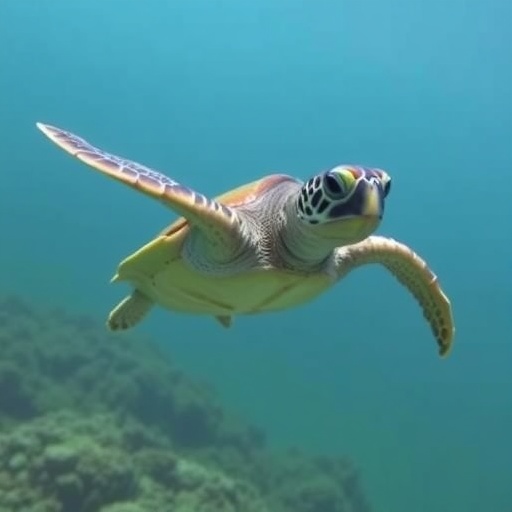
As global temperatures relentlessly climb, the fate of sea turtles—iconic marine reptiles that have traversed oceans for millions of years—has become increasingly precarious. The thermal environment of nesting beaches profoundly influences hatchling outcomes, with excessive heat known to skew sex ratios toward females, impair survival rates, retard growth, and exacerbate morphological abnormalities. Yet, an essential and understudied facet remains: does incubation temperature also impact the cognitive faculties of sea turtle hatchlings? Understanding how thermal stress influences learning, memory, and behavioral flexibility from the earliest life stages is crucial for grasping how these animals might cope with a changing world.
Researchers from Florida Atlantic University’s Charles E. Schmidt College of Science have ventured into this largely uncharted territory by probing how incubation temperature affects the cognitive abilities of loggerhead sea turtle hatchlings (Caretta caretta). While cognition in mammals and birds has been extensively examined, reptiles—and particularly marine turtles—have remained enigmatic subjects in this regard. This groundbreaking study harnessed a sophisticated experimental design employing a Y-maze visual discrimination task to evaluate learning capacity and behavioral adaptability in hatchlings incubated at two distinct female-biased temperatures: 88 °F and a notably warmer 91 °F.
Eggs were collected from nesting sites in Palm Beach County over two consecutive breeding seasons (2019 and 2020), ensuring robust sample sizes and replicability. Approximately one month post-hatching, the juveniles underwent an initial training phase where they learned to associate a food reward with a specific monochromatic pattern, such as stripes or bullseyes, displayed at maze termini. This conditioned learning phase assessed their ability to form a stable stimulus-reward link, a prerequisite for subsequent behavioral tests.
Following mastery of the initial association, hatchlings entered a reversal learning phase wherein the reward contingency was deliberately switched to a different pattern. This reversal paradigm serves as a litmus test for cognitive flexibility—the capacity to inhibit a previously rewarded behavior and adapt to new rules, a trait critical for survival in dynamic marine ecosystems. The researchers meticulously recorded trial numbers to criterion and learning rates, thereby quantifying the hatchlings’ behavioral plasticity.
Remarkably, the findings—published in the journal Endangered Species Research—demonstrated that hatchlings incubated at both temperatures exhibited comparable cognitive performance. No statistically significant deficits emerged in learning or reversal abilities attributable to the elevated 91 °F incubation condition. Intriguingly, the 2020 cohort displayed enhanced reversal learning efficiency compared to initial acquisition, suggesting rapid adaptability despite thermal developmental stress.
Sarah L. Milton, Ph.D., senior author and chair of FAU’s Department of Biological Sciences, emphasized the implications: “The behavioral flexibility displayed by these post-hatchling turtles indicates a heretofore unappreciated capacity to modify learned behaviors swiftly, a critical evolutionary asset for navigating shifting environmental landscapes.” Such findings challenge prior assumptions that developmental heat stress necessarily impairs neurological function or cognitive potential in sea turtles.
While cognitive abilities appeared resilient to moderate thermal elevation, the study corroborated well-documented physical detriments linked to higher incubation temperatures. Hatchlings from 91 °F nests experienced abbreviated incubation periods, diminished hatching success, slower somatic growth post-emergence, and increased incidence of scute anomalies—structural deformities of the carapace scales that could impair swimming and predator evasion. Additionally, these hatchlings were notably smaller, raising concerns about their ecological fitness and long-term viability.
Corresponding author Ivana J. Lezcano highlighted the duality of these outcomes: “Despite the severe morphological and survival challenges posed by elevated sand temperatures, our data suggest that cognitive faculties may remain largely intact, at least under sublethal temperature conditions.” However, she cautioned against complacency, noting that ambient nest temperatures in South Florida frequently surpass 93 °F, reaching nearly 96 °F—a range not tested in this study but known to drastically compromise hatchling viability and potentially affect neural development.
The implications of these results extend beyond the academic sphere, raising critical considerations for conservation biology and population management. Traditional metrics of nest success often focus solely on emergence rates, yet this research underscores the necessity of evaluating hatchling quality in a holistic manner—accounting for both physical health and behavioral competence—to gauge true adaptive potential.
Importantly, the ability of young turtles to rapidly suppress previously established associations and embrace new learning paradigms may provide a behavioral buffer against the unpredictable challenges wrought by climate change. Such cognitive resilience might enhance navigation, foraging efficiency, and predator avoidance, directly influencing individual fitness and population robustness.
Nevertheless, the authors advocate for continued research to unravel long-term cognitive trajectories and the impacts of extreme temperature exposures beyond those examined. Integrating neurodevelopmental studies with ecological monitoring will be vital to fully comprehend how thermal stress shapes survival strategies over the lifespan of these endangered reptiles.
This pioneering investigation charts a new course in marine reptile biology, merging behavioral ecology with conservation science. As global warming escalates, uncovering the interplay between physical development and brain function in sea turtles may inform adaptive management strategies that prioritize not only the quantity but also the quality of hatchlings entering increasingly inhospitable oceans.
Supported by FAU’s School of Environmental, Coastal, and Ocean Sustainability, this work exemplifies the interdisciplinary approach required to address complex conservation challenges, offering a cautiously optimistic outlook for one of the ocean’s most vulnerable yet resilient ambassadors.
News Publication Date: 11-Sep-2025
Web References:
References:
Milton, S.L., Lezcano, I.J., et al. (2025). Assessing the effects of incubation temperature on the cognitive ability of post-hatchling loggerhead sea turtles Caretta caretta. Endangered Species Research, 58. DOI: 10.3354/esr01433
Cite Scienmag News
Violet Maxwell. (September 30, 2025). Researchers Investigate Whether Nesting Temperature Influences Sea Turtle Hatchling Intelligence. Scienmag. https://scienmag.com/researchers-investigate-whether-nesting-temperature-influences-sea-turtle-hatchling-intelligence/
Violet Maxwell. "Researchers Investigate Whether Nesting Temperature Influences Sea Turtle Hatchling Intelligence." Scienmag, 30 September 2025, https://scienmag.com/researchers-investigate-whether-nesting-temperature-influences-sea-turtle-hatchling-intelligence/. Accessed 4 September 2026.
Violet Maxwell. "Researchers Investigate Whether Nesting Temperature Influences Sea Turtle Hatchling Intelligence." Scienmag. September 30, 2025. https://scienmag.com/researchers-investigate-whether-nesting-temperature-influences-sea-turtle-hatchling-intelligence/


