


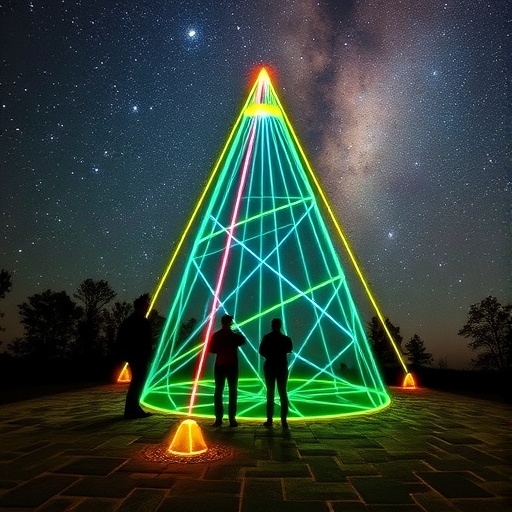
A new study is turning one of the strangest ideas in relativity into a powerful bridge between spacetime physics and modern contact geometry. In research published in General Relativity and Gravitation, mathematician Jakob Hedicke investigates the “space of cone geodesics”—the collection of all possible lightlike trajectories in a generalized spacetime—and shows how it can be understood through positive paths of contactomorphisms, special transformations that preserve the essential structure of a contact manifold. The result extends ideas originally developed for the space of light rays in Lorentzian spacetimes and suggests that the motion of light can be translated into a language normally associated with geometry, dynamical systems and symplectic topology. More than a change of notation, the framework offers a way to reconstruct broad features of a spacetime from the behavior of families of trajectories living in a lower-dimensional geometric space.
In ordinary general relativity, light travels along null geodesics: curves whose tangent vectors lie on the boundary of the light cones determined by a Lorentzian metric. These paths represent the possible histories of photons, although the theory itself treats them geometrically rather than as individual particles. Penrose recognized that the totality of light rays can sometimes form a smooth manifold in its own right. Instead of studying each light ray inside spacetime, one studies the space whose points are entire unparametrized rays. That space naturally carries a contact structure, a geometric condition that describes how hyperplanes twist and fail to fit together into ordinary surfaces. Hedicke’s work replaces the metric-dependent language of Lorentzian geometry with the broader setting of strongly convex cone structures, where the allowed future-directed causal directions are specified directly by cones in each tangent space.
A cone structure can be imagined as assigning a future-pointing cone to every point of a manifold. Vectors inside the cone represent timelike or causal directions, while vectors on its smooth boundary represent null directions. Strong convexity imposes a crucial form of regularity: the cone is convex, its boundary is smooth, and its curvature behaves positively in directions transverse to the rays generated by scaling. This condition ensures that the boundary resembles a well-behaved light cone even when no quadratic metric is available. The framework therefore includes Lorentzian spacetimes but also more flexible Lorentz-Finsler geometries, in which the “speed of light” may depend asymmetrically on direction. Cone geodesics are defined without selecting a particular metric: they are curves that remain locally on the boundary of the causal relation, meaning that nearby points along the curve are connected by null, or horismotic, propagation.
The central geometric object is constructed from the dual cone in the cotangent bundle. Every cone of allowed tangent vectors determines a dual cone consisting of covectors that evaluate non-negatively on all causal directions. The boundary of this dual cone carries the canonical Liouville one-form from cotangent geometry. When the null or cone-geodesic flow is factored out, this form produces a natural contact structure on the space of cone geodesics. In practical terms, the construction compresses the full dynamics of null propagation into a manifold whose dimension is typically two less than that of the spacetime’s cotangent bundle. The resulting contact structure is not an arbitrary decoration: it records which infinitesimal variations of a cone geodesic remain geometrically compatible with the lightlike condition. Its coorientation is inherited from the Liouville form, although the paper emphasizes that a specific contact form depends on a choice of section, while the underlying cooriented contact structure is canonical.
Global hyperbolicity makes this abstract space especially manageable. If a cone spacetime has a Cauchy hypersurface, every inextendible causal curve intersects that hypersurface exactly once. Consequently, every cone geodesic can be represented by the point where it crosses a chosen spatial slice together with its direction there. Hedicke proves that the space of cone geodesics is then contactomorphic to the spherical cotangent bundle of the Cauchy hypersurface, denoted (ST^{*}\Sigma). This bundle consists of nonzero covectors at points of (\Sigma), considered up to positive scaling, and carries the standard contact structure obtained by restricting the Liouville form. The identification is explicit: a covector along a null geodesic is restricted to the tangent space of the Cauchy slice. A warning about orientation is important here—the natural coorientation inherited from the cone construction is reversed under this contactomorphism, a sign convention that becomes essential when interpreting causal motion as positive motion.
Once all Cauchy slices are identified with a fixed manifold (\Sigma), the changing light-ray geometry becomes a time-dependent family of contact transformations. Hedicke shows that a globally hyperbolic, strongly convex cone structure on (\mathbb{R}\times\Sigma) generates a path ((\varphi_t)) of contactomorphisms of (ST^{*}\Sigma). The path is positive: its velocity points consistently through the chosen cooriented contact hyperplanes. The meaning is physical and geometric at once. If (v) labels an initial cone geodesic, its spatial position at time (t) is obtained by projecting (\varphi_t(v)) to (\Sigma), producing a curve of the form (t\mapsto (t,\pi(\varphi_t(v)))). Thus the entire family of null trajectories is encoded by a positive contact evolution. In this picture, causality in spacetime is transformed into an order-like property in the contactomorphism group.
The reverse construction is even more striking. Starting with any positive path of contactomorphisms on (ST^{*}\Sigma), the paper defines a cone structure on (\mathbb{R}\times\Sigma). The infinitesimal generator (X_t^f) of the contact path determines a time-dependent contact form (\alpha_t^f), normalized so that (\alpha_t^f(X_t^f)=1). At each point (p\in\Sigma), the contact form on the cotangent fibre determines a star-shaped set (K_t^f(p)). The allowed spacetime directions are then obtained from the polar body of this set. In formula form, the cone is generated by vectors (\partialt+w) satisfying (\max{v\in K_t^f(p)}v(w)\leq 1). Equivalently, the associated function is (G_f(w_0,w)=w0-\max{v\in K_t^f(p)}v(w)). Convex duality guarantees that these are proper closed cones, even when their boundaries are not smooth or strictly convex.
This reverse correspondence also reveals why generalized Lorentz-Finsler geometry is needed. The maximum over a cotangent fibre is typically only Lipschitz or nonsmooth when the underlying star-shaped body has corners or flat portions. The resulting cone structure may therefore fail to be strongly convex, yet it remains sufficiently regular to define a locally Lipschitz Lorentz-Finsler space. The function (G_f) is positively homogeneous and concave, properties that replace the smooth quadratic behavior of a classical Lorentzian metric. Hedicke proves that the cone family varies locally Lipschitz-continuously and that its causal geometry can still be studied. When the normalized contact forms arise from genuine Finsler metrics, the construction simplifies to the familiar expression (G_f=dt-H_t), where (H_t) is a time-dependent Finsler norm on (\Sigma), and the cone is the usual future region described by (dt\geq H_t).
The study establishes a complete agreement in the strongly convex case. If a cone structure produces a positive path (\varphi_t), reconstructing a cone structure from that path returns the original cones and the original Lorentz-Finsler function. Conversely, if a positive contactomorphism path is generated by a family of Finsler metrics, the induced cone structure is globally hyperbolic and strongly convex, and the contact path recovered from its cone geodesics is the one with which researchers began. The infinitesimal generator has an especially elegant interpretation: at each fixed time it is the Reeb vector field of the contact form determined by the instantaneous Finsler metric. In familiar Riemannian examples, this is the cogeodesic flow, whose projections are ordinary geodesics. The theorem therefore links light propagation, Reeb dynamics and Finsler geodesic flow within one unified mechanism.
The broader implications reach beyond a technical correspondence. In the space of cone geodesics, the set of all rays passing through a spacetime point forms a Legendrian sphere called its sky. Timelike motion of the point produces a positive Legendrian isotopy, while causal motion produces a non-negative one. This translates the distinction between timelike and lightlike travel into the language of contact topology, where positivity can be studied using linking, orderability and dynamical invariants. The work also points toward a major open question: whether every positive path of contactomorphisms, even one producing nonsmooth cone boundaries, necessarily defines a globally hyperbolic cone structure. Hedicke conjectures that it does. If confirmed, the result would establish a remarkably broad dictionary in which complete positive contact dynamics automatically encode a globally well-behaved causal spacetime, offering a new route for studying relativity through the topology of transformations rather than through metrics alone.
Cite Scienmag News
Grant Pearson. (August 26, 2026). Researchers Explore Cone Geodesics and Positive Contactomorphism Paths. Scienmag. https://scienmag.com/researchers-explore-cone-geodesics-and-positive-contactomorphism-paths/
Grant Pearson. "Researchers Explore Cone Geodesics and Positive Contactomorphism Paths." Scienmag, 26 August 2026, https://scienmag.com/researchers-explore-cone-geodesics-and-positive-contactomorphism-paths/. Accessed 3 September 2026.
Grant Pearson. "Researchers Explore Cone Geodesics and Positive Contactomorphism Paths." Scienmag. August 26, 2026. https://scienmag.com/researchers-explore-cone-geodesics-and-positive-contactomorphism-paths/


