


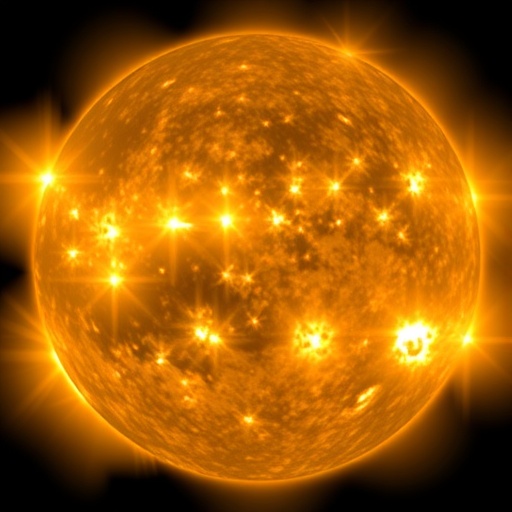
For nearly two decades, a small instrument orbiting the Sun has been quietly hunting one of the most chemically bizarre phenomena in the solar system: bursts of energetic particles enriched in the rare helium isotope helium-3. Now, researchers have produced the most complete catalogue yet of these unusual particle-rich intervals observed by the Suprathermal Ion Telescope, or SIT, aboard NASA’s Solar Terrestrial Relations Observatory Ahead spacecraft. Covering the years 2007 to 2020 and the entirety of Solar Cycle 24, the study identifies 144 periods in which helium-3 enhancements could be statistically resolved. The results provide an unprecedented view of when these events occurred, how long they lasted, how their intensity changed with energy, and how frequently they appeared during the Sun’s changing activity.
Helium-3-rich solar energetic particle periods are among the strangest particle phenomena generated by the Sun. In ordinary solar material, helium-4 overwhelmingly dominates helium isotopes, while helium-3 is comparatively scarce. Yet during certain impulsive solar energetic particle episodes, helium-3 can become enhanced by factors of up to 10,000 above typical solar-wind or coronal abundances. These episodes are generally associated with compact solar flares, magnetic reconnection, and jet-like eruptions that hurl particles along open magnetic-field lines into interplanetary space. The same events can also enrich heavier elements, including iron, creating a distinctive chemical fingerprint that differs from the composition of large gradual particle storms driven by coronal mass ejections and their shock waves.
The physical mechanism responsible for this extreme isotope selection remains an active scientific mystery. One leading explanation involves the unusual charge-to-mass ratio of helium-3. Plasma waves generated during magnetic reconnection may interact preferentially with ions whose charge and mass place them in a special resonance with the waves. Under the right conditions, helium-3 could therefore be accelerated far more efficiently than helium-4, despite the two isotopes having nearly identical chemical properties. Earlier ideas proposed that helium-3 might be produced through nuclear reactions inside the Sun or by spallation processes similar to those that generate isotopes in cosmic-ray interactions, but those explanations were weakened by the absence of expected by-products such as deuterium and tritium. The current picture instead points toward selective acceleration in transient solar environments.
Detecting this signature is not easy. SIT measures ions from helium through iron across energies ranging from roughly 20 kiloelectron volts per nucleon to several megaelectron volts per nucleon. It identifies particles using a time-of-flight system combined with a solid-state detector that measures residual energy. In simplified form, the measured ion mass depends on the residual energy and the square of the particle’s flight time divided by the instrument’s flight path. SIT’s flight path is only about 10 centimeters, and its geometric factor is approximately 0.29 square centimeters steradian. Although its nominal mass resolution is close to 10 percent, helium-3 and helium-4 frequently overlap in the instrument’s mass distributions, particularly when the helium-3 enhancement is weak or the particle counts are low.
To overcome that limitation, the research team developed a data-driven detection procedure rather than relying on a simple visual inspection of mass spectra. For each period being examined, SIT measurements were compared with a reference distribution obtained from data collected within approximately 60 days of that period. The reference was selected to represent helium-4-rich conditions without a measurable helium-3 enhancement. The researchers then applied the two-sample Epps-Singleton statistical test to determine whether the particle-mass distributions were likely drawn from the same underlying population. A candidate interval had to show statistically significant differences in at least two energy channels, with more than ten counts in each relevant channel. The team also required the excess to occur specifically in the expected helium-3 mass range rather than elsewhere in the spectrum.
The search was performed over several time windows—0.05, 0.1, 0.2, 0.5, and one day—to capture both brief injections and longer-lived periods. This was important because helium-3 enhancements do not always appear as isolated, cleanly bounded events. Several injections can occur in rapid succession, while a later particle population rich in helium-4 can dilute the measured ratio. Data gaps created another challenge, especially during the solar-conjunction interval from August 2014 through January 2016, when STEREO-A was behind the Sun from Earth’s perspective and data transmission was severely limited. Automated detections were therefore reviewed manually, with start and end times adjusted using particle flux profiles, velocity dispersion, magnetic-field behavior, and the possibility of overlapping events.
The 144 identified periods reveal a strong connection between helium-3 activity and the solar cycle. The number of detections rose and fell broadly with the 10.7-centimeter solar radio flux, a standard indicator of solar activity. A first concentration appeared in late 2011, followed by a decline in 2012. The largest number of periods occurred in 2014, during the secondary maximum of Solar Cycle 24. Eighty of the 144 periods were recorded between 2012 and 2014, although the researchers caution that the missing observations around solar conjunction mean the true number was probably higher. In 2014, helium-3 was detected during about 20 percent of available observing time, compared with less than 1 percent during the quietest phases of the cycle and approximately 5 percent during more active intervals. Comparisons with the more sensitive ACE/ULEIS instrument suggest that more than half of all helium-3 enhancements during Solar Cycle 24 may have been too weak for SIT to resolve.
The catalogue also shows that these periods are generally short-lived. Their median duration was approximately 0.9 day, although some lasted longer and others were visible for only a few hours. The duration did not correlate significantly with either the maximum helium-3-to-helium-4 ratio or the helium-3 fluence, meaning that a long-lasting interval was not necessarily the most chemically extreme or particle-rich. The most intense ratio reported by SIT was 7.81 at an energy of 546 kiloelectron volts per nucleon, during a period in 2011. At the opposite end of detectability, the instrument could resolve ratios down to roughly 7 percent under favorable counting conditions. This threshold was not fixed: it became higher when fluences were low because statistical uncertainty and instrumental overlap made small helium-3 excesses impossible to distinguish confidently.
One of the study’s most striking findings is that the average helium-3-to-helium-4 fluence ratio increased with particle energy. Across six energy channels spanning approximately 160 to 1280 kiloelectron volts per nucleon, the mean ratio rose from about 0.34 near 193 kiloelectron volts per nucleon to 1.09 near 772 kiloelectron volts per nucleon. The median ratio began at approximately 0.21 at the lower energy end and reached about 0.7 at 772 kiloelectron volts per nucleon. Above roughly 546 to 772 kiloelectron volts per nucleon, the ratio appeared to level off. The researchers interpret this behavior as a broad reflection of the different energy spectra of helium-3 and helium-4. Most intervals resemble so-called class 2 helium-3-rich events, in which helium-3 has a curved spectrum while helium-4 follows a more nearly power-law distribution. Because the helium-3 population declines less steeply over part of the measured range, its relative abundance becomes more prominent at higher energies.
The catalogue is more than a list of unusual solar particle episodes. It is a foundation for comparing measurements from spacecraft separated across the heliosphere, including ACE near the Sun-Earth Lagrange point, Parker Solar Probe, and Solar Orbiter. Earlier multi-spacecraft observations have shown that helium-3-rich particles can spread across unexpectedly broad heliographic longitudes, challenging the assumption that impulsive particles escape through a narrow magnetic channel connected to a single solar location. Some events have also been linked to recurring solar source regions, extreme-ultraviolet waves, and jets near the boundaries of active regions and coronal holes. With 144 consistently analysed periods now available from STEREO-A, scientists can investigate whether the same injection can be observed at different longitudes, how particle populations evolve with distance from the Sun, and why some source regions repeatedly generate helium-3-rich material.
The study also demonstrates how statistical methods can extract meaningful physical information from imperfect instruments. SIT was not designed to provide effortless isotope separation in every event, and its measurements are affected by changing helium-4 response functions, energy-dependent mass broadening, proton spillover, background coincidences, and periods of instrument saturation. Rather than treating those limitations as reasons to discard marginal data, the researchers built a reference-based procedure that identifies distribution changes and then estimates helium-3 and helium-4 fluences through a spillover calculation. A cleaned helium-4 reference distribution was used to determine what fraction of helium-4 should appear above a selected mass cut; counts above that cut during a candidate period then provided an estimate of the total helium-4 population. The remaining counts were attributed to helium-3, with systematic and statistical uncertainties propagated into the resulting fluences and ratios. The authors describe the outcome as a robust, near-complete survey of all Solar Cycle 24 helium-3-rich periods that SIT could resolve—an achievement that turns a difficult measurement problem into a powerful new resource for understanding how the Sun selectively accelerates matter.
Cite Scienmag News
Grant Pearson. (August 26, 2026). STEREO-A Telescope Identifies 3He-Rich Periods During Solar Cycle 24. Scienmag. https://scienmag.com/stereo-a-telescope-identifies-3he-rich-periods-during-solar-cycle-24/
Grant Pearson. "STEREO-A Telescope Identifies 3He-Rich Periods During Solar Cycle 24." Scienmag, 26 August 2026, https://scienmag.com/stereo-a-telescope-identifies-3he-rich-periods-during-solar-cycle-24/. Accessed 4 September 2026.
Grant Pearson. "STEREO-A Telescope Identifies 3He-Rich Periods During Solar Cycle 24." Scienmag. August 26, 2026. https://scienmag.com/stereo-a-telescope-identifies-3he-rich-periods-during-solar-cycle-24/


