


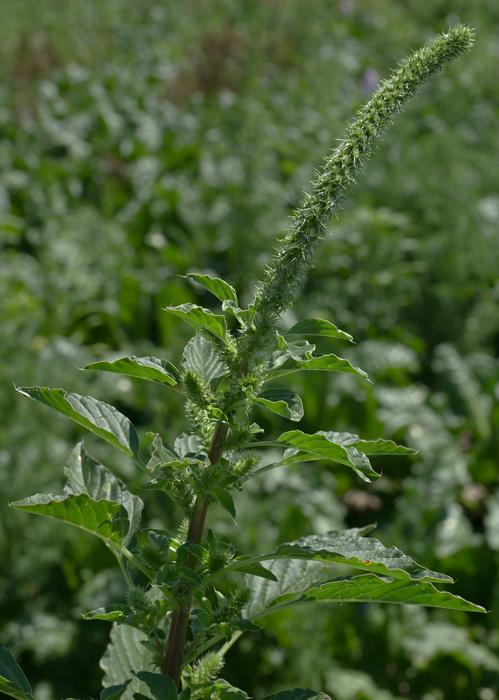
Colorado State University researchers are developing a novel biological herbicide that would specifically target Palmer amaranth – one of the most challenging weeds for agricultural producers to deal with today.

Credit: Please credit Phil Westra, Colorado State University
Colorado State University researchers are developing a novel biological herbicide that would specifically target Palmer amaranth – one of the most challenging weeds for agricultural producers to deal with today.
The newly funded $650,000 research project is sponsored by the U.S. Department of Agriculture. It aims to use synthetic biology techniques to develop a biological herbicide that would replace the common chemical herbicides that have become less effective over time and have an outsized negative environmental impact. The work – jointly led by researchers in the Departments of Biology and Agricultural Biology – is an effort to curb one of the most problematic weeds in Colorado and across the country.
Difficult weeds annually cost the agricultural industry roughly $33 billion in losses in the U.S. The fast growing, chemical herbicide resistant Palmer amaranth is a key example of the problem. It has been shown to decrease crop yields by up to 91% in corn and 79% in soybeans.
Biological herbicides like the ones the researchers will try to develop may provide a solution. These would be engineered to be highly effective and selective – limiting their risk to nearby crops when applied. To do this, the researchers will develop RNA molecules known as Ribozymes that can influence specific gene expression. In this case, those would be genes that support the weed’s immune system or regulate its metabolism. This approach eliminates the weed through a specific infection, as opposed to a combination of natural or synthetic chemical compounds that can broadly kill or inhibit plant growth.
Over the next four years, the CSU team will work with an already well-known plant virus to that end. Assistant Professor Arjun Khakhar said that this is a developing area of research.
“Using RNA-based tools like this is an emerging technology, and this is one of the first instances where it is being applied in an agricultural context,” he said. “We will be creating experiments in the project to validate an inability to infect plants other than the weed and to also understand how transferable this approach may be to control other weeds in the future and support agricultural production goals.”
Professor Todd Gaines has been studying weeds within the College of Agricultural Sciences for years and is a key partner on this new project. He said this work could prove to be beneficial and fits the university’s land grant mission perfectly.
“The CSU weed research lab partners with producers and farmers to create solutions for sustainable management. Herbicide resistance is an increasingly important issue and could threaten the global food supply,” he said. “This work supports our efforts as a land grant university to develop innovations to improve the quality of life for people in Colorado and around the world and train the next generation of researchers and producers to use them.”
Cite Scienmag News
Alan Morgan. (August 15, 2024). Researchers earn USDA funding to develop biological weed herbicide for stubborn Palmer amaranth. Scienmag. https://scienmag.com/researchers-earn-usda-funding-to-develop-biological-weed-herbicide-for-stubborn-palmer-amaranth/
Alan Morgan. "Researchers earn USDA funding to develop biological weed herbicide for stubborn Palmer amaranth." Scienmag, 15 August 2024, https://scienmag.com/researchers-earn-usda-funding-to-develop-biological-weed-herbicide-for-stubborn-palmer-amaranth/. Accessed 4 September 2026.
Alan Morgan. "Researchers earn USDA funding to develop biological weed herbicide for stubborn Palmer amaranth." Scienmag. August 15, 2024. https://scienmag.com/researchers-earn-usda-funding-to-develop-biological-weed-herbicide-for-stubborn-palmer-amaranth/

