


Since its invention in the 1970s, the luminescent solar concentrator (LSC) has aimed to enhance solar energy capture by using luminescent materials to convert and concentrate sunlight onto photovoltaic (PV) cells. Unlike traditional concentrators that rely on mirrors and lenses, LSCs can harvest diffuse light and have been used in applications such as building-integrated photovoltaics, where their semitransparent and colorful nature offers aesthetic benefits. However, scaling up LSCs to cover large areas has been challenging due to issues like self-absorption of photoluminescent (PL) photons within the waveguide. Researchers at Ritsumeikan University (Japan) have proposed an innovative “leaf LSC” model that promises to overcome such limitations by enhancing the collection and transfer of light to photovoltaic cells.

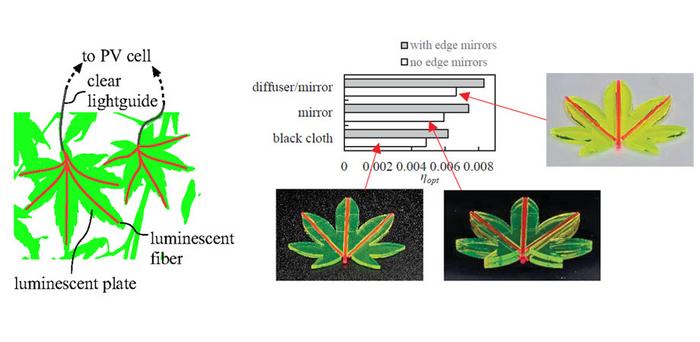
Credit: Nishimura et al., doi 10.1117/1.JPE.14.035501.
Since its invention in the 1970s, the luminescent solar concentrator (LSC) has aimed to enhance solar energy capture by using luminescent materials to convert and concentrate sunlight onto photovoltaic (PV) cells. Unlike traditional concentrators that rely on mirrors and lenses, LSCs can harvest diffuse light and have been used in applications such as building-integrated photovoltaics, where their semitransparent and colorful nature offers aesthetic benefits. However, scaling up LSCs to cover large areas has been challenging due to issues like self-absorption of photoluminescent (PL) photons within the waveguide. Researchers at Ritsumeikan University (Japan) have proposed an innovative “leaf LSC” model that promises to overcome such limitations by enhancing the collection and transfer of light to photovoltaic cells.
The leaf LSC design addresses the scalability problem by using smaller, interconnected luminescent components that function like leaves on a tree. As reported in the Journal of Photonics for Energy (JPE), this innovative setup involves placing luminescent plates around a central luminescent fiber, with the plates’ sides facing the fiber. This arrangement allows incident photons to be converted into PL photons by the plates, which then travel through the fiber and are collected at its tip by a PV cell. To enhance efficiency, clear lightguides connect multiple fibers to a single PV cell, effectively increasing the incident area of the LSC while reducing photon losses due to self-absorption and scattering.
This modular approach to LSC design offers several advantages. By reducing the lateral size of individual modules, researchers have found that the efficiency of photon collection improves. For instance, reducing the side length of a square leaf LSC from 50 mm to 10 mm increased photon collection efficiency significantly. The modular design also allows for easy replacement of damaged units and integration of advanced luminescent materials as they become available.
Further enhancing the system’s efficiency, researchers have incorporated techniques from traditional planar LSCs, such as edge mirrors and tandem structures, into the leaf LSC design. Their experiments demonstrated that the optical efficiency of these leaf-like structures can be calculated analytically based on the spectrum and intensity of incident light, using a single-spot excitation technique.
According to JPE Editor-in-Chief Sean Shaheen, professor of engineering and physics at University of Colorado Boulder, and fellow of the Renewable and Sustainable Energy Institute, “These findings demonstrate a creative approach that advances the concept of luminescent solar concentrators to effectively guide sunlight toward adjacent photovoltaic devices. By combining scalable, bio-inspired designs with enhancements in optical engineering, the authors have increased the efficiency of their devices toward what is needed for practical use.”
Optimizing photon collection in LSCs may light the way for more flexible and scalable solar energy solutions. This approach to energy harvesting could revolutionize the application of solar concentrators, making them more efficient and adaptable for various uses, from large-scale installations to building-integrated systems. As the technology advances, it holds the promise of significantly enhancing the performance of solar energy systems and contributing to more sustainable energy solutions.
For details, see the Gold Open Access article, “Enhanced photon collection in leaf-inspired luminescent solar concentrators,” J. Photon. Energ. 14(3), 035501 (2024) doi 10.1117/1.JPE.14.035501.
Journal
Journal of Photonics for Energy
Article Title
Enhanced photon collection in leaf-inspired luminescent solar concentrators
Article Publication Date
19-Jul-2024
Cite Scienmag News
Denise Maddox. (August 15, 2024). Leaf-like solar concentrators promise major boost in solar efficiency. Scienmag. https://scienmag.com/leaf-like-solar-concentrators-promise-major-boost-in-solar-efficiency/
Denise Maddox. "Leaf-like solar concentrators promise major boost in solar efficiency." Scienmag, 15 August 2024, https://scienmag.com/leaf-like-solar-concentrators-promise-major-boost-in-solar-efficiency/. Accessed 3 September 2026.
Denise Maddox. "Leaf-like solar concentrators promise major boost in solar efficiency." Scienmag. August 15, 2024. https://scienmag.com/leaf-like-solar-concentrators-promise-major-boost-in-solar-efficiency/

