


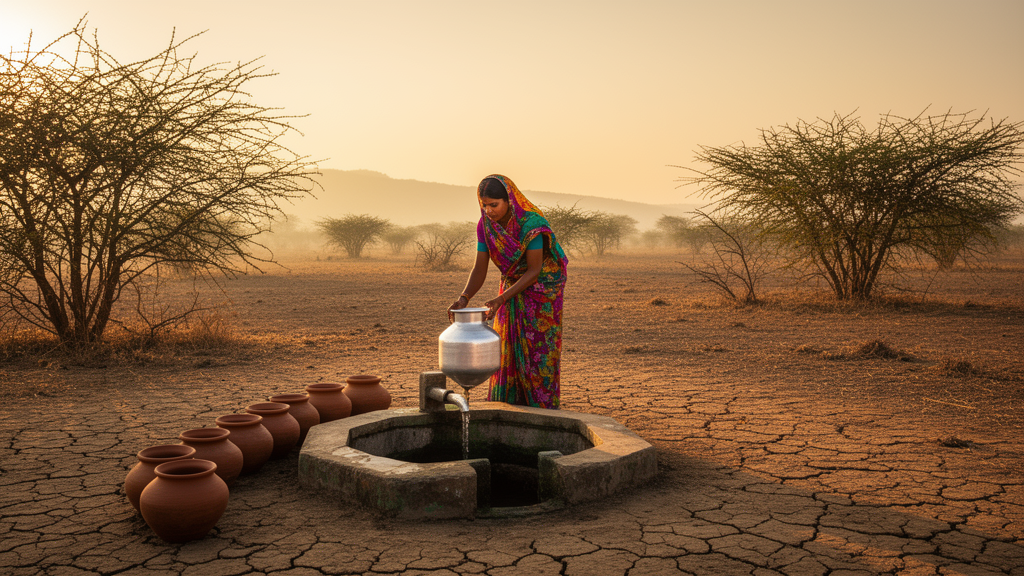
More than two-thirds of households in a drought-prone region of central India experience multidimensional water poverty during the summer months, rising from just under half during the rest of the year, according to a new household survey from the Bundelkhand region of Uttar Pradesh. The study, published in Environmental and Sustainability Indicators, applied a Multidimensional Water Poverty Index to 1,597 households across 37 villages in Tahrauli tehsil of Jhansi district, and found that the index rose from 0.233 in the normal season to 0.300 in summer, an increase driven almost entirely by shorter supply durations and longer water-collection times rather than by a lack of physical infrastructure.
Households were selected through multistage stratified random sampling across the Bangra, Chirgaon and Gursarai blocks, stratified by landholding size. The sample was deliberately enlarged beyond the statistical minimum of roughly 385 households to support village-level estimates, since water conditions among neighbours sharing the same sources are correlated and a clustered sample carries less information than a simple random sample of the same size.
The index was built using the Alkire-Foster method, the same dual-cutoff framework underlying the global Multidimensional Poverty Index. A household was classified as water-poor if its weighted deprivation score reached 0.30, meaning that deprivation in one Access indicator plus any other indicator, or in both Stress indicators, was sufficient to cross the threshold.
The results show a sharply seasonal pattern. In summer, 1,076 of 1,589 households, or 67.7 percent, were multidimensionally water-poor, compared with 773 of 1,597 households, or 48.4 percent, in the normal season, an increase of 19.3 percentage points. Interestingly, the intensity of deprivation among those classified as poor was slightly higher in the normal season, at 48.1 percent versus 44.3 percent, suggesting that households remaining poor after the monsoon face deprivation across more indicators, while many of the additional households pushed into poverty in summer sit just above the cutoff. Roughly a quarter of households were severely poor in both seasons, indicating a persistent core of deep deprivation that does not recede when rains return.
Decomposition of the index revealed that the Stress dimension was the dominant driver of water poverty in both seasons. Despite carrying only 30 percent of the total weight, Stress contributed 56.0 percent of the summer MWPI and 46.1 percent of the normal-season MWPI, contributing 1.87 and 1.54 times their assigned weights respectively. In summer, 81.4 percent of all households received water for fewer than four hours a day, and about 60 percent of water-poor households were both supply-deprived and poor. Collection time contributed 1.75 times its weight in summer. By contrast, the Access dimension, though contributing 37.7 percent in summer and 45.2 percent in the normal season, remained below its assigned weight and barely changed between seasons, with roughly a quarter of households lacking piped access or an improved toilet in both periods, pointing to structural gaps that rainfall cannot fix.
Perhaps the most striking finding concerns water sources. Households using piped or private supply were considerably more likely to be water-poor than those relying on other sources, mainly hand pumps: the headcount ratio was 0.917 versus 0.536 in summer, and 0.866 versus 0.260 in the normal season. The authors attribute this not to piped access itself but to the way the connections function, with most located outside the dwelling and delivering water for fewer than four hours a day. In the normal season, when hand-pump yields recover after the monsoon, the gap was widest, since piped supply remained intermittent. The findings suggest that expanding connections will reduce water poverty only if they are located on premises and provide adequate duration throughout the year, consistent with the functional household connection definition under India’s Jal Jeevan Mission.
The hydroclimatic context compounds these service failures. Using gridded rainfall data from the India Meteorological Department from 1993 to 2023, the researchers computed a 12-month Standardized Precipitation Index for the region, which falls within a single rainfall grid cell. The Mann-Kendall test indicated a statistically significant decreasing trend, with Sen’s slope of minus 0.0051 per year, and the most intense drought was recorded in 2020, with an SPI of minus 1.93, classified as severe. The region experienced a sequence of severe drought years from 2017 to 2022. Domestic supplies in the area depend heavily on hand pumps and shallow wells tapping a hard-rock aquifer with limited storage, recharged almost entirely by monsoon rainfall, so successive deficits lower the pre-monsoon water table and deepen summer shortages. The authors note that the SPI analysis was used only to describe the hydroclimatic setting, not to establish statistical relationships between drought and household water poverty.
Village-level estimates revealed substantial spatial heterogeneity. In summer, 15 of the 37 villages fell into the very high MWPI category, above 0.30, while only one village, Luhargaon, was in the low category. After the monsoon, the number of very high villages fell to eight, and the number with low or zero MWPI rose from one to nine. Yet seven villages, including Berwai, Basari, Dhurwai, Khiriya, Sujwan, Tahrauli Khas and Tahrauli Kila, remained in the very high category in both seasons, and in some villages the index actually rose in the normal season, with Lathesra moving from 0.248 to 0.359. The rank correlation between seasonal village MWPI values was 0.798, indicating that villages most affected in summer tend to remain among the most deprived year-round. The persistence in these villages appears to reflect inadequate functioning of supply systems rather than scarcity of the resource itself.
The results proved robust to alternative analytical choices. Across poverty cutoffs from 5 percent to 50 percent, the summer MWPI consistently exceeded the normal-season value, though the two converged at higher cutoffs, suggesting that the most severely deprived households remain vulnerable regardless of season. Under an equal-weighting scheme, the headcount ratio fell to 42.2 percent in summer and 37.3 percent in the normal season, but village rankings remained stable, with Spearman rank correlations of 0.844 in summer and 0.763 in the normal season, and the same three villages, Sujwan, Khiriya and Basari, ranking as the most water-poor under both schemes and in both seasons.
The authors argue that their findings point to a shift in water policy from infrastructure provision towards reliable service delivery. Coverage-based indicators, they contend, can conceal intermittent supply, seasonal deterioration and persistent local deprivation. They recommend that programmes such as the Jal Jeevan Mission complement connection counts with measures of hours of supply, seasonal reliability, collection time and adequacy, and that policy responses distinguish between villages facing sharp summer deterioration, which need pre-summer source maintenance, groundwater recharge and storage, and villages deprived year-round, which need improvements in distribution networks and sanitation. In semi-arid hard-rock regions where supplies depend on monsoon-recharged groundwater, they conclude, reliable service cannot be sustained through distribution infrastructure alone, and a seasonally updated index could help identify vulnerable villages before the summer stress period arrives.
Subject of Research: Seasonal multidimensional water poverty among rural households in the semi-arid Bundelkhand region of Uttar Pradesh, India
Article Title: Seasonal dynamics of multidimensional water poverty in a semi-arid region of India
Article References: Padhan, N., KH, A., Akuraju, V. R., Garg, K. K., Dey, A., Shukla, A., Sahoo, D. P., Roy, S., Reddy, N. N., Majeed, I., Madheswaran, S., & Singh, R. (2026). Seasonal dynamics of multidimensional water poverty in a semi-arid region of India. Environmental and Sustainability Indicators, 32, Article 101575. https://doi.org/10.1016/j.indic.2026.101575
Image Credits: AI Generated
DOI: 10.1016/j.indic.2026.101575
Keywords: water poverty, Multidimensional Water Poverty Index, Bundelkhand, Uttar Pradesh, Alkire-Foster method, Jal Jeevan Mission, seasonal water scarcity, groundwater, piped water supply, drought, SPI, rural households
Cite Scienmag News
Sloane Callahan. (October 27, 2026). Research report: Seasonal dynamics of multidimensional water poverty in a semi-arid region of India. Scienmag. https://scienmag.com/research-report-seasonal-dynamics-of-multidimensional-water-poverty-in-a-semi-arid-region-of-india/
Sloane Callahan. "Research report: Seasonal dynamics of multidimensional water poverty in a semi-arid region of India." Scienmag, 27 October 2026, https://scienmag.com/research-report-seasonal-dynamics-of-multidimensional-water-poverty-in-a-semi-arid-region-of-india/. Accessed 27 October 2026.
Sloane Callahan. "Research report: Seasonal dynamics of multidimensional water poverty in a semi-arid region of India." Scienmag. October 27, 2026. https://scienmag.com/research-report-seasonal-dynamics-of-multidimensional-water-poverty-in-a-semi-arid-region-of-india/


