

Tuesday, October 27, 2026
Science
No Result
View All Result
  • Login
  • HOME
  • SCIENCE NEWS
  • CONTACT US
  • HOME
  • SCIENCE NEWS
  • CONTACT US
No Result
View All Result
Scienmag
No Result
View All Result
Home Science News Space

Blade-End Riblets Cut Compressor Cascade Losses by About Six Percent

October 27, 2026
in Space
Grant Pearson
By Grant Pearson Scienmag Editorial Profile - Observational Astronomy
Reading Time: 2 mins read
0
Blade-End Riblets Cut Compressor Cascade Losses by About Six Percent

Blade-End Riblets Cut Compressor Cascade Losses by About Six Percent

65
SHARES
587
VIEWS
Share on FacebookShare on Twitter
ADVERTISEMENT

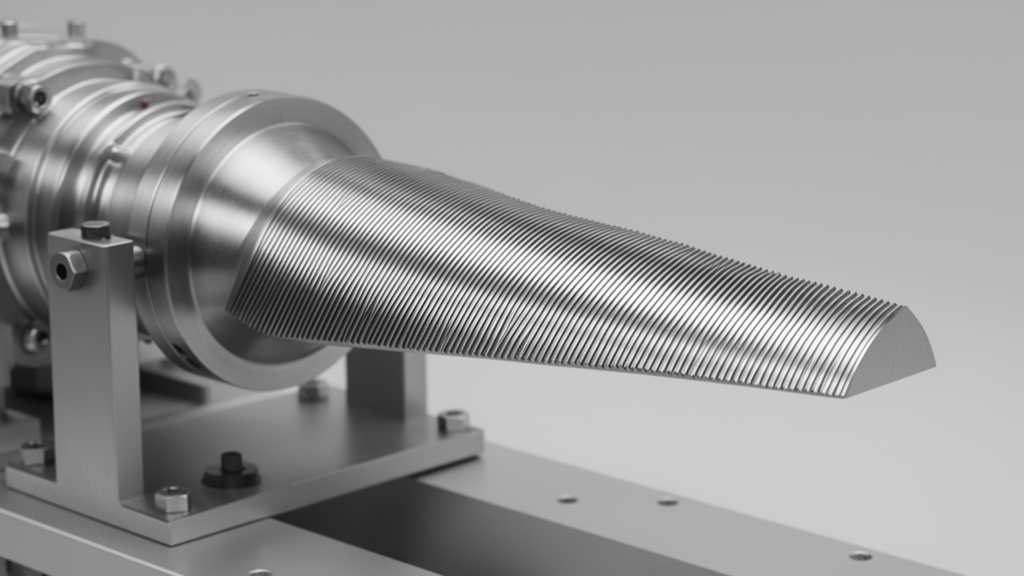
In a study published in the International Journal of Aeronautical and Space Sciences, researchers led by Kai Liu, Jinmiao Guo, Timothy Craft and Shan Zhong tested small riblets placed near the root of the blade suction surface in a linear compressor cascade, and found they could cut total pressure loss by roughly six percent at a Reynolds number of 150,000.

The team’s approach was to apply riblets close to the blade’s suction surface at its root, a location where the suction-surface boundary layer and the hub boundary layer interact and give rise to the separation.

The work combined experiment and computation. Experimental studies were carried out first to determine the optimal geometric parameters of the riblets, but the paper concentrates mainly on numerical analysis to reveal how the device works.

The simulations showed that the riblets induce spanwise fluid motion within the boundary layer on the blade’s suction side. This cross-flow component, although it increases losses in the immediate vicinity of the hub, weakens the interaction between the suction-surface and hub boundary layers.

A second mechanism emerged from the turbulent kinetic energy fields. Above the riblets, the turbulent kinetic energy in the suction-surface boundary layer increases, which delays separation and suppresses the concentrated shedding vortex in the cascade.

The loss accounting in the study points to where the savings come from. The riblets reduce both the suction-surface boundary layer loss and the secondary flow loss, and it is the reduction in secondary flow loss that the authors identify as the primary reason for the decrease in corner separation losses.

The benefit is not uniform across all operating conditions. The effectiveness of the riblets varies with incidence angle, because incidence influences the location and size of the corner separation and thereby changes the proportion of the different loss types present in the cascade.

Subject of Research: Passive blade-end riblets for suppressing corner separation and reducing total pressure loss in a linear compressor cascade

Article Title: Investigation of Blade-End Riblets to Suppress Corner Separation in a Linear Compressor Cascade

Article References: Liu, K., Guo, J., Craft, T., & Zhong, S. (2026). Investigation of Blade-End Riblets to Suppress Corner Separation in a Linear Compressor Cascade. International Journal of Aeronautical and Space Sciences. https://doi.org/10.1007/s42405-026-01306-4

Image Credits: AI Generated

DOI: 10.1007/s42405-026-01306-4

Keywords: compressor cascade, corner separation, riblets, total pressure loss, secondary flow, boundary layer, turbulent kinetic energy, incidence angle, aerodynamics, turbomachinery, Investigation, Blade-End

Cite Scienmag News

Grant Pearson. (October 27, 2026). Blade-End Riblets Cut Compressor Cascade Losses by About Six Percent. Scienmag. https://scienmag.com/blade-end-riblets-cut-compressor-cascade-losses-by-about-six-percent/

Grant Pearson. "Blade-End Riblets Cut Compressor Cascade Losses by About Six Percent." Scienmag, 27 October 2026, https://scienmag.com/blade-end-riblets-cut-compressor-cascade-losses-by-about-six-percent/. Accessed 27 October 2026.

Grant Pearson. "Blade-End Riblets Cut Compressor Cascade Losses by About Six Percent." Scienmag. October 27, 2026. https://scienmag.com/blade-end-riblets-cut-compressor-cascade-losses-by-about-six-percent/


Tags: aerodynamic drag reductionaerodynamicsaeronautical engineering advancementsBlade-EndBlade-end ribletsboundary layerboundary layer controlcompressor cascadecompressor cascade efficiencycorner separationflow separation delayfluid dynamics simulationincidence angleInvestigationlinear compressor cascade optimizationpressure loss reductionReynolds number effectsribletssecondary flowtotal pressure lossturbine blade surface modificationturbomachineryturbulent kinetic energyturbulent kinetic energy management
Share26Tweet16
Previous Post

Research report: Seasonal dynamics of multidimensional water poverty in a semi-arid region of India

Next Post

Intermediate Acoustic Pressures Maximize Targeted Microbubble Adhesion

Related Posts

Deep Reinforcement Learning Tracks Drag While Attention-Based BiLSTM Speeds Projectile Trajectory Prediction
Space

Deep Reinforcement Learning Tracks Drag While Attention-Based BiLSTM Speeds Projectile Trajectory Prediction

October 27, 2026
UMD-led team wins $7.5 million to shape intense laser light and control matter
Space

UMD-led team wins $7.5 million to shape intense laser light and control matter

October 27, 2026
Indiana University Partners with Semiconductor Research Hub imec on Trusted Electronics
Space

Indiana University Partners with Semiconductor Research Hub imec on Trusted Electronics

October 27, 2026
Computational method predicts thousands of new exfoliable 2D materials from ordinary crystals
Space

Computational method predicts thousands of new exfoliable 2D materials from ordinary crystals

October 27, 2026
Double debris disc around dead star hints at our Solar System’s fate
Space

Double debris disc around dead star hints at our Solar System’s fate

October 27, 2026
Light-Braked Molecular Rotor Slows Random Motion 300,000-Fold
Space

Light-Braked Molecular Rotor Slows Random Motion 300,000-Fold

October 27, 2026
Next Post
Intermediate Acoustic Pressures Maximize Targeted Microbubble Adhesion

Intermediate Acoustic Pressures Maximize Targeted Microbubble Adhesion

  • Mothers who receive childcare support from maternal grandparents show more optimized

    Mothers who receive childcare support from maternal grandparents show more parental warmth, finds NTU Singapore study

    27656 shares
    Share 11059 Tweet 6912
  • University of Seville Breaks 120-Year-Old Mystery, Revises a Key Einstein Concept

    1061 shares
    Share 424 Tweet 265
  • Bee body mass, pathogens and local climate influence heat tolerance

    682 shares
    Share 273 Tweet 171
  • Researchers record first-ever images and data of a shark experiencing a boat strike

    546 shares
    Share 218 Tweet 137
  • Groundbreaking Clinical Trial Reveals Lubiprostone Enhances Kidney Function

    531 shares
    Share 212 Tweet 133
Science

Embark on a thrilling journey of discovery with Scienmag.com—your ultimate source for cutting-edge breakthroughs. Immerse yourself in a world where curiosity knows no limits and tomorrow’s possibilities become today’s reality!

RECENT NEWS

  • Spider Mite Genus Demoted as New Species Joins Saudi Arabia’s Grass Fauna
  • Intermediate Acoustic Pressures Maximize Targeted Microbubble Adhesion
  • Blade-End Riblets Cut Compressor Cascade Losses by About Six Percent
  • Research report: Seasonal dynamics of multidimensional water poverty in a semi-arid region of India

Categories

  • Agriculture
  • Anthropology
  • Archaeology
  • Athmospheric
  • Biology
  • Biotechnology
  • Blog
  • Bussines
  • Cancer
  • Chemistry
  • Climate
  • Earth Science
  • Editorial Policy
  • Marine
  • Mathematics
  • Medicine
  • Pediatry
  • Policy
  • Psychology & Psychiatry
  • Science Education
  • Science News
  • Social Science
  • Space
  • Technology and Engineering

Subscribe to Blog via Email

Enter your email address to subscribe to this blog and receive notifications of new posts by email.

Join 5,151 other subscribers

© 2025 Scienmag - Science Magazine

Welcome Back!

Login to your account below

Forgotten Password?

Retrieve your password

Please enter your username or email address to reset your password.

Log In
No Result
View All Result
  • HOME
  • SCIENCE NEWS
  • CONTACT US

© 2025 Scienmag - Science Magazine

Discover more from Science

Subscribe now to keep reading and get access to the full archive.

Continue reading