


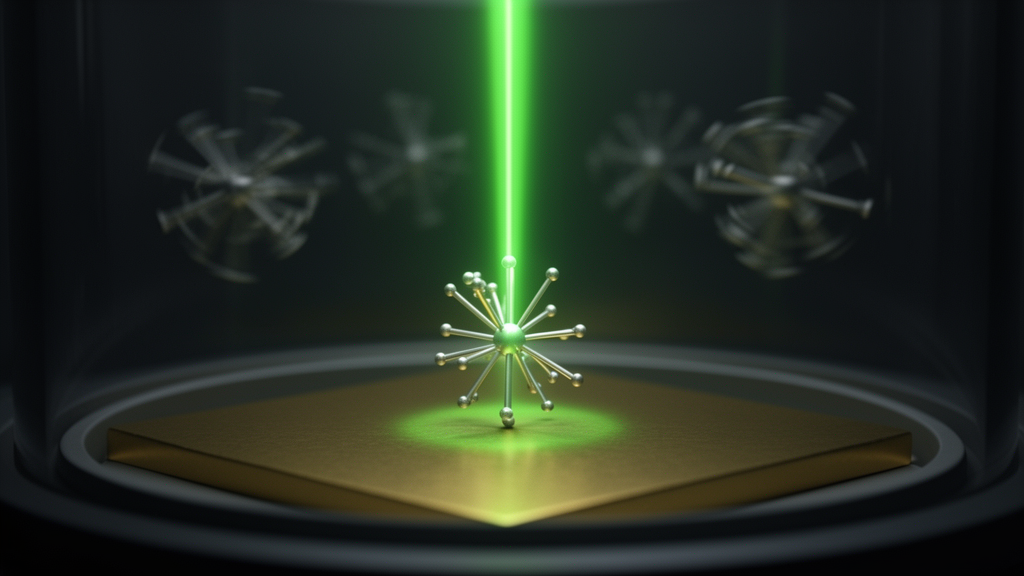
Chemists at the Institute of Organic Chemistry and Biochemistry of the Czech Academy of Sciences (IOCB Prague) have built a molecular system in which a beam of light can act as a brake on the random thermal motion of a molecule’s own parts, slowing rotation by roughly a factor of 300,000. The work, published in Angewandte Chemie, demonstrates a way to regulate the motion of one component of a molecule by controlling another, a capability the researchers describe as essential for constructing more complex molecular machines.
Driven by thermal energy, the individual parts of molecules are constantly vibrating, rotating and changing their positions, a phenomenon known as Brownian motion. Unlike conventional engineers, scientists building molecular machines therefore work with components that are perpetually in motion. To assemble such components into a functioning mechanism, they need ways to control that motion, and this is precisely what the team of Jiří Kaleta at IOCB Prague set out to achieve.
The molecular system incorporates two key components: a light-controlled molecular motor and a rotor that rotates freely around its axis because of thermal motion. According to Lukáš Severa, first author of the study, shining light on the molecule changes the motor’s spatial arrangement, which in turn affects the motion of the rotor. In the unbraked state, the rotor can rotate easily; in the braked state, the motor physically obstructs its motion and significantly increases the energy barrier the rotor must overcome to turn.
The principle can be pictured as a hand freely mounted on an axis and constantly jostled by tiny vibrations. If nothing stands in its way, it rotates easily. But when an obstacle is placed in its path, its rotation slows dramatically. In the molecule, that obstacle is created by the moving part of the molecular motor, which swings into the rotor’s path when the light-driven motor changes its configuration.
The difference between the two states is striking. Kaleta notes that in previous similar systems it was possible to change the rotation rate by no more than a factor of one hundred, whereas the new approach achieves a slowdown of approximately 300,000-fold, which he describes as a major breakthrough. The comparison places the new system far beyond earlier light-gated designs in the degree of control it can exert over Brownian rotation.
The contrast becomes even more dramatic as the temperature decreases. The researchers calculate that if, at a very low temperature, the unbraked rotor completed one rotation per second, the braked rotor would take approximately 350 billion years to complete a single rotation under the same conditions, about twenty-five times the current age of the universe. The figure illustrates how strongly the motor raises the energy barrier to rotation when it is in its obstructing state.
The ability to control the motion of individual components is essential for constructing more complex molecular machines. Kaleta emphasizes that having a motor alone is not enough if the goal is to build a more elaborate mechanism; one also needs elements that can regulate and coordinate the motion of individual components. The new system demonstrates one principle for achieving this at the molecular level, using light as the external control signal.
The study, titled “Light-Gated Control of Brownian Rotation by a Molecular Motor,” was published on 21 September 2026 and is described as an experimental study. Jiří Kaleta and Lukáš Severa of IOCB Prague are shown in the release imagery demonstrating how light can slow the rotation of one part of a molecule relative to another, work the institute says contributes to the development of more complex molecular machines.
By coupling a light-driven motor to a thermally driven rotor, the Prague team has shown that the ceaseless random motion inside a molecule can be tamed on demand, switched between a freely spinning and a nearly frozen state with nothing more than illumination. That degree of control over Brownian motion, the researchers suggest, is a step toward molecular machines whose moving parts can be coordinated rather than left to the mercy of thermal energy.
Subject of Research: Light-controlled braking of Brownian rotation in a molecular motor-rotor system
Article Title: How to tame random motion inside a molecule? Scientists can do it with light
Article References: How to tame random motion inside a molecule? Scientists can do it with light. Original publication (Bibliographic details unavailable.)
Image Credits: AI Generated
DOI: Not provided
Keywords: molecular machines, molecular motor, Brownian motion, rotor, light-gated control, photochemistry, Angewandte Chemie, IOCB Prague, energy barrier, nanotechnology, tame, random
Cite Scienmag News
Grant Pearson. (October 27, 2026). Light-Braked Molecular Rotor Slows Random Motion 300,000-Fold. Scienmag. https://scienmag.com/light-braked-molecular-rotor-slows-random-motion-300000-fold/
Grant Pearson. "Light-Braked Molecular Rotor Slows Random Motion 300,000-Fold." Scienmag, 27 October 2026, https://scienmag.com/light-braked-molecular-rotor-slows-random-motion-300000-fold/. Accessed 27 October 2026.
Grant Pearson. "Light-Braked Molecular Rotor Slows Random Motion 300,000-Fold." Scienmag. October 27, 2026. https://scienmag.com/light-braked-molecular-rotor-slows-random-motion-300000-fold/


