


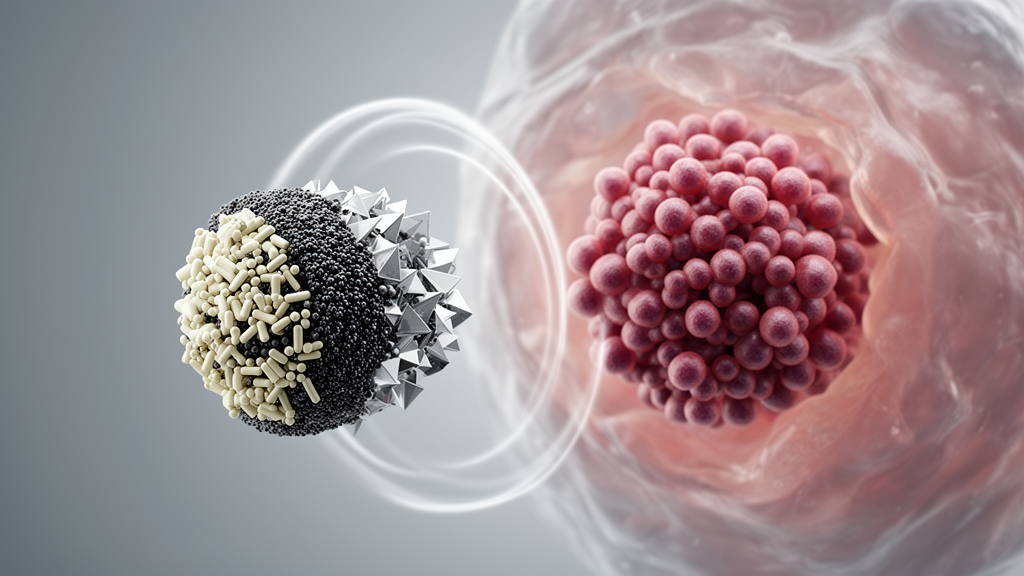
A magnetic nanoparticle system carrying paclitaxel and psoralen produced stronger activity than free drugs or separate carrier formulations against paclitaxel-resistant triple-negative breast cancer cells in laboratory tests and mouse xenografts. The researchers combined superparamagnetic iron oxide nanoparticles with a PLGA-lecithin carrier and functionalized the particles with Pluronic F-127. In resistant SUM159/TXR cells, the dual-drug ternary formulation had a half-maximal inhibitory concentration of 3.050 micrograms per milliliter, compared with 35.61 micrograms per milliliter for free paclitaxel.
Its medium dose also produced an 80.6% tumor inhibition rate in mice, outperforming the free combination and other nanoparticle formulations. These preclinical findings do not establish clinical efficacy or safety in people. Triple-negative breast cancer lacks detectable estrogen receptors, progesterone receptors and human epidermal growth factor receptor 2, leaving few molecular targets for selective treatment.
Paclitaxel is an important chemotherapy used in this setting because it binds tubulin, stabilizes microtubules and disrupts mitotic spindle formation. Its effectiveness, however, can be undermined by primary or acquired drug resistance. In the study’s paclitaxel-resistant SUM159/TXR cell model, the paclitaxel half-maximal inhibitory concentration was 35.61 micrograms per milliliter, 13.01 times the value measured in the sensitive SUM159PT line.
Psoralen showed similar inhibitory concentrations in the two cell lines, suggesting that resistance to paclitaxel did not extend to psoralen. Psoralen also improved cellular sensitivity to paclitaxel when the drugs were administered together. In resistant cells, co-treatment reduced the paclitaxel half-maximal inhibitory concentration from 35.61 to 24.83 micrograms per milliliter.
The proposed mechanism includes reversal of drug resistance, but the authors note that the study did not directly establish the molecular pathways responsible. The nanoparticle approach sought to address several separate problems: poor aqueous solubility and low bioavailability for both drugs, limited accumulation in tumors and the tendency of resistant cells to transport chemotherapeutic agents out of the cell. Psoralen was included as a resistance-sensitizing agent, while the magnetic component was intended to support tumor accumulation under an external magnetic field.
To build the carrier, the team first prepared oleic-acid-coated superparamagnetic iron oxide nanoparticles and then incorporated them with paclitaxel, psoralen and poly(lactic-co-glycolic acid), or PLGA, in a phospholipid matrix containing soybean lecithin and DSPE-PEG2000. Pluronic F-127 was used to functionalize the magnetic particles. The resulting particles were spherical and dispersed without visible aggregation.
Dynamic light scattering placed the three dual-drug formulations between 69.07 and 166.5 nanometres in size, while their polydispersity indices ranged from 0.153 to 0.235. Zeta potentials ranged from −30.2 to −37.7 millivolts, a surface charge the researchers associated with colloidal stability during circulation. The investigators optimized phospholipid, PLGA and Tween-80 concentrations with a 15-run, three-factor Box–Behnken design.
The fitted models explained 99.48% of the variation in particle size and 99.81% of the variation in psoralen encapsulation efficiency, although these values describe performance within the tested experimental range. The optimized ternary particles had an average size of 117.2 ± 0.62 nanometres and a polydispersity index of 0.225 ± 0.012. They encapsulated 86.3% ± 1.36% of psoralen and 98.7% ± 0.94% of paclitaxel.
Drug loadings were 1.93% ± 0.03% for psoralen and 1.97% ± 0.04% for paclitaxel. The researchers found no significant difference between the ternary and non-magnetic polymer-lipid formulation in these two loading measures. Spectroscopic and thermal analyses indicated that the drugs were dispersed within the carrier rather than remaining as separate crystals.
Fourier-transform infrared spectroscopy showed attenuation or loss of characteristic paclitaxel and psoralen carbonyl signals after loading, consistent with restrictions on molecular vibration and interactions with carrier components. Differential scanning calorimetry detected melting peaks of approximately 155 °C and 250 °C in the free psoralen-paclitaxel mixture, but not the corresponding drug peaks in the nanoparticle formulations. X-ray diffraction likewise showed no obvious crystalline peaks from either drug in the loaded particles, and polarizing microscopy found no visible crystals.
Together, these observations were consistent with amorphous or disordered drug dispersion, although the authors cautioned that infrared spectroscopy alone could not verify encapsulation. The ternary carrier retained superparamagnetic behavior. Magnetic hysteresis loops passed through the origin and showed nearly zero coercivity, while saturation magnetization fell from 57.44 emu per gram for oleic-acid-coated iron oxide particles to 0.74 emu per gram for the ternary formulation.
The authors attributed this reduction to dilution by non-magnetic carrier materials. Drug-release testing at physiological pH showed a more sustained profile for the ternary particles: over 36 hours, they released 74.76% of psoralen and 55.53% of paclitaxel, compared with 81.71% and 69.37% from the polymer-lipid formulation and 95.12% and 84.47% from the magnetic-only formulation. These in vitro measurements describe release into buffered medium containing Tween-80 and do not by themselves establish release behavior inside a tumor.
Cellular studies showed that the ternary formulation was the most potent of the three dual-drug carriers against resistant SUM159/TXR cells. Its half-maximal inhibitory concentration was 3.050 micrograms per milliliter, compared with 7.960 for the magnetic-only formulation and 14.99 for the polymer-lipid formulation. Fluorescence-labelled particles showed an uptake hierarchy of ternary nanoparticles greater than polymer-lipid nanoparticles, magnetic-only nanoparticles and free dye.
Flow-cytometric cell-cycle analysis indicated that psoralen mainly produced G0/G1 arrest, whereas paclitaxel produced G2/M arrest. Dual-drug nanoparticles combined these effects, with the ternary formulation producing especially strong G2/M arrest at higher concentrations. Apoptosis measurements ranked the high-, medium- and low-dose ternary particles above the other treated groups, with higher concentrations generally producing greater early apoptosis.
Blank carriers showed no obvious cytotoxicity under the tested conditions. Quantitative reverse-transcription PCR supplied a partial molecular clue to the resistance effect. Paclitaxel-resistant cells had high basal expression of ABCB1 messenger RNA, the gene encoding the transporter P-glycoprotein.
Free paclitaxel further increased its transcription, whereas psoralen alone produced only a slight reduction and the free combination only a mild reduction. In contrast, the psoralen-paclitaxel ternary nanoparticles downregulated ABCB1 expression in a dose-dependent manner. The authors interpreted this as evidence that the carrier suppressed ABCB1 transcription and contributed to resistance reversal, but they explicitly described the mechanism as incomplete because protein measurements and pathway-inhibition experiments were not performed.
In female nude mice carrying SUM159/TXR xenografts, fluorescent imaging showed longer circulation and slower clearance for nanoparticle formulations than for free indocyanine green. Magnetic particles exposed to an external field accumulated in tumors earlier and produced stronger intratumoral fluorescence than non-magnetic controls. In a separate efficacy experiment, seven intravenous doses were administered at three-day intervals.
Tumor inhibition followed the order of ternary nanoparticles, then the polymer-lipid and magnetic-only nanoparticles, and then verapamil. The medium-dose ternary formulation inhibited tumor growth by 80.6%, compared with 42.0% for paclitaxel alone and 48.0% for the free paclitaxel-psoralen combination. Histopathology of major organs did not reveal notable treatment-related changes, but the safety assessment was limited to these observations: pharmacokinetics, detailed tissue distribution, blood measures and biochemical toxicity tests were not reported.
The results position the ternary system as a promising preclinical tool for delivering chemotherapy alongside a resistance-sensitizing compound while retaining magnetic responsiveness. Its principal advantage is not simply the combination of two drugs, but the integration of drug loading, amorphous stabilization, cellular delivery and externally guided accumulation in one formulation. The experiments nevertheless leave major questions unresolved.
Most importantly, the reported benefits came from cell cultures and a mouse xenograft model rather than patients with triple-negative breast cancer. The animal tumors were implanted subcutaneously, the treatment was delivered by tail-vein injection, and the mechanism of resistance reversal was inferred partly from messenger RNA measurements. The authors identify molecular verification, pharmacokinetic and targeting studies, and broader biosafety evaluation as priorities for follow-up work.
Within the reported preclinical scope, the findings support further investigation of dual-drug magnetic delivery for paclitaxel-resistant tumors, but they do not demonstrate a clinical benefit in people.
Subject of Research: Magnetic co-delivery of paclitaxel and psoralen in preclinical paclitaxel-resistant triple-negative breast cancer models
Article Title: Pluronic F-127-functionalized magnetic ternary hybrid nanoparticles for co-delivery of paclitaxel and psoralen: a synergistic strategy to overcome multidrug resistance in triple-negative breast cancer
Article References: Liu, Q., Liu, F., Wang, P., Aharodnikau, U. E., Asim, M. H., Du, M., Li, Q., Xie, M., Yang, Z., Hu, H., & Cai, Y. (2026). Pluronic F-127-functionalized magnetic ternary hybrid nanoparticles for co-delivery of paclitaxel and psoralen: a synergistic strategy to overcome multidrug resistance in triple-negative breast cancer. Frontiers in Pharmacology, 17, Article 1952492. https://doi.org/10.3389/fphar.2026.1952492
Image Credits: AI Generated
DOI: 10.3389/fphar.2026.1952492
Keywords: triple-negative breast cancer, paclitaxel resistance, magnetic nanoparticles, drug co-delivery, psoralen, paclitaxel, nanomedicine, mouse xenografts, ABCB1, PLGA nanoparticles, Pluronic, F-127-functionalized
Cite Scienmag News
Nathaniel Bowman. (October 22, 2026). Research report: Pluronic F-127-functionalized magnetic ternary hybrid nanoparticles for co-delivery of paclitaxel and psoralen: a synergistic strategy to overcome multidrug resistance in triple-negative breast cancer. Scienmag. https://scienmag.com/research-report-pluronic-f-127-functionalized-magnetic-ternary-hybrid-nanoparticles-for-co-delivery-of-paclitaxel-and-psoralen-a-synergistic-strategy-to-overcome-multidrug-resistance-in-triple-negat/
Nathaniel Bowman. "Research report: Pluronic F-127-functionalized magnetic ternary hybrid nanoparticles for co-delivery of paclitaxel and psoralen: a synergistic strategy to overcome multidrug resistance in triple-negative breast cancer." Scienmag, 22 October 2026, https://scienmag.com/research-report-pluronic-f-127-functionalized-magnetic-ternary-hybrid-nanoparticles-for-co-delivery-of-paclitaxel-and-psoralen-a-synergistic-strategy-to-overcome-multidrug-resistance-in-triple-negat/. Accessed 22 October 2026.
Nathaniel Bowman. "Research report: Pluronic F-127-functionalized magnetic ternary hybrid nanoparticles for co-delivery of paclitaxel and psoralen: a synergistic strategy to overcome multidrug resistance in triple-negative breast cancer." Scienmag. October 22, 2026. https://scienmag.com/research-report-pluronic-f-127-functionalized-magnetic-ternary-hybrid-nanoparticles-for-co-delivery-of-paclitaxel-and-psoralen-a-synergistic-strategy-to-overcome-multidrug-resistance-in-triple-negat/


