


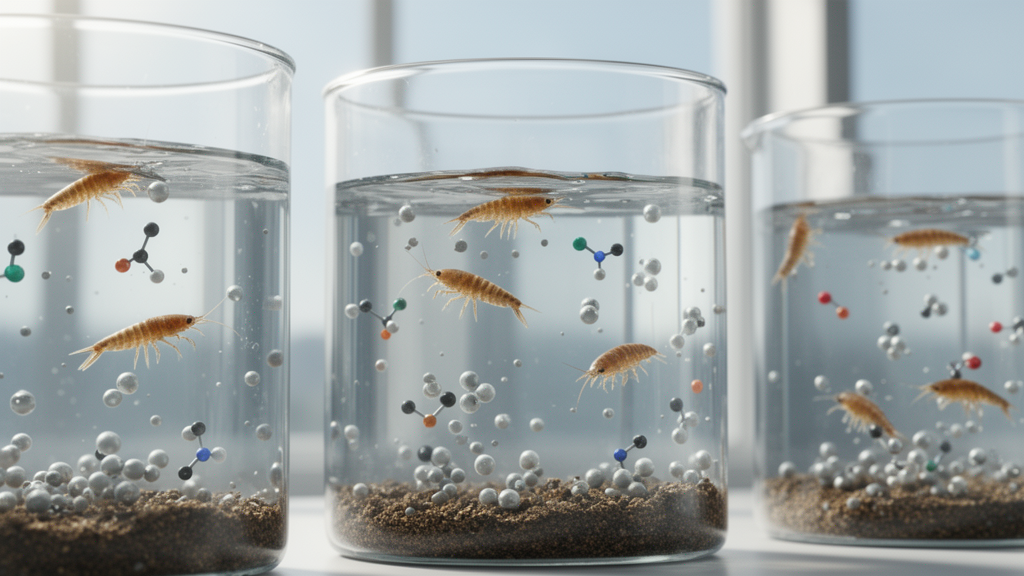
A 96-hour laboratory study found that polyethylene nanoplastics changed the acute toxicity of chlorpyrifos in the marine amphipod Parhyale hawaiensis, with the mixture containing 100 micrograms per litre of polyethylene nanoplastics producing lower median lethal and effective concentrations than the mixture containing 1,000 micrograms per litre. Researchers exposed neonate amphipods to chlorpyrifos alone and to the two mixture conditions, then measured mortality and immobility. The lower-concentration mixture had a median lethal concentration (LC50) of 0.25 micrograms per litre for mortality and a median effective concentration (EC50) of 0.06 micrograms per litre for immobility.
For the mixture containing 1,000 micrograms per litre of polyethylene nanoplastics, the LC50 was 0.57 micrograms per litre and the EC50 was 0.11 micrograms per litre. Chlorpyrifos alone produced an LC50 of 0.32 micrograms per litre and an EC50 of 0.1 microgram per litre. These measurements show that co-exposure to polyethylene nanoplastics modified the acute toxicity estimates under the tested conditions. The results were not monotonic across the two nanoparticle concentrations: the 100-microgram-per-litre mixture was more toxic than the 1,000-microgram-per-litre mixture, while the higher-concentration mixture also differed from chlorpyrifos alone.
Beyond the amphipod experiment, the research team compiled acute chlorpyrifos toxicity data for marine organisms originating in Latin America. The researchers used this regional dataset to develop a species sensitivity distribution and a preliminary ecological risk assessment, then compared it with a broader dataset from outside Latin America. The regional species sensitivity analysis yielded lower HC5 values, the fifth-percentile hazard concentration used in this type of assessment, than the broader comparison. The authors emphasized, however, that substantial uncertainty remained across the estimates because of gaps in the quantity, quality and representativeness of regional ecotoxicological data.
The study also reports that P. hawaiensis was highly sensitive to chlorpyrifos and that chlorpyrifos induced toxicity within the environmental concentration range considered in the risk-assessment context. The findings indicate that assessments based only on chlorpyrifos alone may not capture the acute effects observed in a mixture scenario. They also show why a regional analysis cannot be treated as a complete account of coastal risk when the underlying data remain sparse or unevenly representative. The authors’ conclusion was that marine ecotoxicological data gaps in Latin America should be addressed and that mixture effects should be considered in chlorpyrifos ecological risk assessments for Latin American coastal ecosystems.
The results apply directly to acute laboratory exposure of neonate P. hawaiensis over 96 hours, rather than to chronic exposure, field mortality, population-level effects or entire coastal ecosystems. The ecological risk assessment was preliminary and depended on the completeness and representativeness of the available regional toxicity data. In addition, the experiment tested two polyethylene-nanoplastic concentrations under specified laboratory conditions, so it does not establish how chlorpyrifos toxicity changes across all possible environmental mixtures. Within those limits, the study provides a measured combination of mixture-toxicity evidence and regional data analysis, identifying both the importance of nanoplastics as a co-exposure factor and the uncertainty that remains in Latin American marine risk assessment.
Subject of Research: Acute chlorpyrifos and polyethylene-nanoplastic mixture toxicity in the marine amphipod Parhyale hawaiensis and implications for Latin American coastal ecological risk assessment
Article Title: Combined toxicity of chlorpyrifos and nanoplastics in the marine amphipod Parhyale hawaiensis: implications for chlorpyrifos risk assessment in Latin American coasts
Article References: Fonseca-Peña, S. V. D., de Jesús Chi-Domínguez, J., Arreguin-Rebolledo, U., Cabrera, M., & Capparelli, M. V. (2026). Combined toxicity of chlorpyrifos and nanoplastics in the marine amphipod Parhyale hawaiensis: implications for chlorpyrifos risk assessment in Latin American coasts. Ecotoxicology, 35(9), Article 186. https://doi.org/10.1007/s10646-026-03182-w
Image Credits: AI Generated
DOI: 10.1007/s10646-026-03182-w
Keywords: chlorpyrifos, polyethylene nanoplastics, mixture toxicity, marine amphipod, Parhyale hawaiensis, acute ecotoxicity, species sensitivity distribution, ecological risk assessment, Latin America, coastal ecosystems, Combined, toxicity
Cite Scienmag News
Sloane Callahan. (October 22, 2026). Nanoplastics shift acute chlorpyrifos toxicity in marine amphipods. Scienmag. https://scienmag.com/nanoplastics-shift-acute-chlorpyrifos-toxicity-in-marine-amphipods/
Sloane Callahan. "Nanoplastics shift acute chlorpyrifos toxicity in marine amphipods." Scienmag, 22 October 2026, https://scienmag.com/nanoplastics-shift-acute-chlorpyrifos-toxicity-in-marine-amphipods/. Accessed 22 October 2026.
Sloane Callahan. "Nanoplastics shift acute chlorpyrifos toxicity in marine amphipods." Scienmag. October 22, 2026. https://scienmag.com/nanoplastics-shift-acute-chlorpyrifos-toxicity-in-marine-amphipods/


