


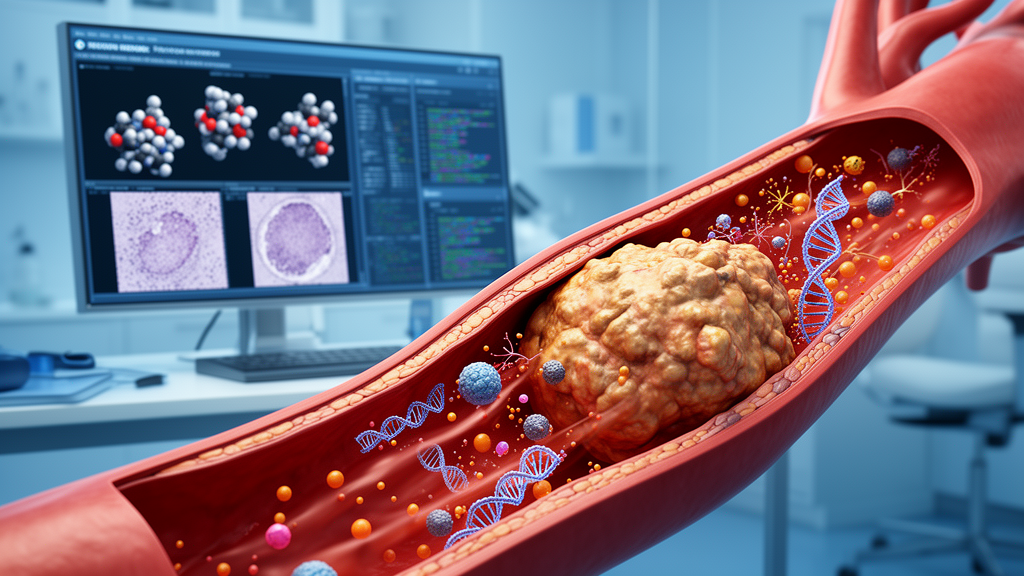
A narrative review concludes that integrating genetic, epigenetic, transcriptomic, proteomic, metabolic, lipidomic and gut-microbial data can connect inherited susceptibility with cellular remodeling, circulating molecular signatures and coronary plaque phenotypes. The evidence supports a potential framework for earlier risk assessment, mechanistic discovery and treatment-response monitoring, but most findings remain investigational. Candidate biomarkers and models with strong discrimination in development cohorts do not yet demonstrate that they improve clinical decisions or patient outcomes.
Coronary atherosclerosis develops through the interplay of disturbed lipid metabolism and chronic inflammation within arterial walls. In the PROSPECT cohort of patients after acute coronary syndrome, nearly half of subsequent composite cardiovascular events were attributed to previously untreated nonculprit lesions that appeared mild on baseline angiography. Most of those events were rehospitalizations for angina rather than myocardial infarction or death.
Coronary angiography is the conventional diagnostic reference standard, but it is invasive and primarily measures luminal narrowing rather than plaque biology or coronary microcirculatory injury. Traditional risk factors, including low-density lipoprotein cholesterol, hypertension and diabetes, likewise provide broad estimates of disease probability rather than precise, individualized screening. The review therefore presents multi-omics as a possible route toward earlier molecular assessment, not as a replacement for imaging or an established clinical test.
Each omics layer interrogates a different biological level and has a distinct time scale. Genome-wide association studies have identified hundreds of single-nucleotide polymorphisms associated with coronary atherosclerosis in pathways involving lipid metabolism, inflammation and cell proliferation. Because DNA is stable throughout life, these variants can indicate inherited susceptibility, but they do not report real-time plaque progression, and the functions of many noncoding variants remain difficult to interpret.
Whole-exome sequencing complements common-variant studies by detecting rare, high-effect variants, including pathogenic genes in families with familial hypercholesterolemia, although it is less able to explain complex disease driven by many small polygenic effects. Epigenomics, including DNA methylation and histone modifications, captures changes in gene regulation without altering DNA sequence. These layers can nominate mechanisms, but evidence from cell lines, mouse models, peripheral blood or noncoronary vascular tissue cannot automatically be treated as evidence of a human coronary plaque mechanism.
Transcriptomic analysis provides a dynamic view of gene-expression states in endothelial cells, macrophages and vascular smooth-muscle cells. It has implicated molecular events ranging from altered messenger RNA stability in endothelial dysfunction to a multipotent intermediate state through which vascular smooth-muscle cells pass during atherogenesis before adopting different downstream fates. Proteomics adds the functional layer by measuring disease-associated proteins, including apolipoproteins, inflammatory proteins and calcification-related proteins.
A nested analysis of the PACMAN-AMI trial found plasma apolipoprotein and lipid changes after PCSK9-antibody treatment on a background of high-intensity statins, illustrating how molecular responses can be measured during treatment. These findings support treatment-response monitoring as a research strategy, but they do not provide a validated multi-omics rule for identifying nonresponders, switching therapy or preventing adverse effects. Metabolomics and lipidomics capture relatively rapid physiological changes that may be measured repeatedly in blood.
In a cohort of patients undergoing elective coronary angiography, higher circulating trimethylamine N-oxide was associated with subsequent major adverse cardiovascular events. In another angiography cohort, imidazole propionate was associated with prevalent coronary artery disease; cell and mouse experiments linked the metabolite to endothelial dysfunction and increased atherosclerosis. Panels containing cholesterol sulfate and other lipid-related compounds have shown diagnostic or prognostic promise in research cohorts.
A score combining selected ceramides and phosphatidylcholines predicted residual event risk across independent cohorts among patients with established coronary artery disease. Such observations generate risk hypotheses and refine mechanistic understanding, but they do not show that assigning lipid-lowering treatment according to a lipidomic profile reduces clinical events. Metabolite levels can also vary with diet, medication, activity and sampling conditions.
Gut metagenomics adds a host-microbe dimension to these profiles. Gut microbes convert dietary choline into trimethylamine, which host enzymes oxidize to trimethylamine N-oxide. Higher circulating concentrations of the latter were associated with later cardiovascular events in an angiography cohort, while experimental work has linked it to vascular inflammation and platelet hyperreactivity.
Combining microbial genes with measured metabolites can help test gut-heart pathways, including those involving trimethylamine N-oxide, imidazole propionate and 3-hydroxybutyrate. An observational acute coronary syndrome study associated prior statin use with differences in gut microbiota, circulating metabolites and adverse cardiovascular events. However, these findings do not establish that manipulating the microbiome prevents human coronary events, and geography, diet and medication can affect observed microbial associations.
Integrated multi-omics can reveal cross-layer relationships that are difficult to detect in isolation. Metabolome-transcriptome analysis in a coronary artery disease cohort associated an LPCAT1 haplotype and several glycerophospholipid metabolites with disease status, nominating lipid remodeling as a pathway without establishing a complete causal chain from the genetic variant to endothelial injury. Proteome-transcriptome integration can identify discordance between transcription and protein production.
One study linked inflammatory activation of mast cells to increased CALB2 transcription and secretion, followed by changes in macrophage calcium dynamics, foam-cell formation and erosion of the plaque fibrous cap. A separate proteome-metabolome study in Apoe-deficient mice found that a high-protein diet increased amino acids, activated macrophage mTORC1, suppressed mitophagy and increased macrophage apoptosis and necrotic-core formation. That experiment provides mechanistic evidence in a mouse aortic atherosclerosis model; it does not establish the same dietary response in human coronary arteries.
Cross-omics associations therefore remain hypotheses until supported by perturbation, replication and appropriately designed causal analyses. Single-cell and spatial methods are beginning to resolve the heterogeneity hidden by bulk measurements. Spatial transcriptomic analysis of autopsy-derived human coronary arteries from 10 individuals with histologically classified stable or unstable plaques identified region- and cell-specific transcriptional programs while retaining plaque architecture.
Unstable plaques were enriched for inflammatory and prothrombotic signaling. Other studies combined regional profiling with single-cell spatial transcriptomics to map immune-cell distributions, microvascular endothelial activity and smooth-muscle-cell transitions toward fibromyocyte-like states across human arterial specimens. A study of 27 human coronary arteries localized FAP-positive modulated smooth-muscle cells within macrophage-rich neointimal niches.
These atlases can connect molecular cell states with plaque microarchitecture, but some studies include carotid or femoral plaques, while others focus on mouse aortic roots. A state found in another vascular bed or species requires confirmation in human coronary tissue before it can support coronary-specific diagnostic or therapeutic claims. Artificial intelligence can combine molecular measurements, clinical information and coronary imaging.
In a histology-referenced ex vivo study of 10 cadaveric human hearts, deep learning on hybrid intravascular ultrasound and optical coherence tomography images improved plaque-component classification compared with single-modality models and human readers. Separate pilots have combined whole-blood transcriptomics with clinical data to predict coronary calcification and integrated proteomic, metabolomic and clinical variables for research-stage risk prediction. Such systems are vulnerable to overfitting when features outnumber participants, as well as to information leakage, batch effects, missing modalities and dataset shift.
Preprocessing, imputation, feature selection and hyperparameter tuning must therefore remain within training folds, with repeated samples from one participant kept together. External institutional or temporal validation, calibration, uncertainty estimates, performance at prespecified thresholds, incremental value and net benefit remain necessary before a model can guide treatment. Liquid biopsy offers a less invasive route for measuring circulating proteomic, metabolomic, lipidomic and transcriptomic signals, while extracellular vesicles are being investigated as carriers of tissue-derived markers.
Research models have addressed different clinical questions, so their performance figures cannot be compared directly. A three-protein model combined with age, sex and prior percutaneous coronary intervention reported areas under the curve of 0.85 internally and 0.86 in an external emergency-department cohort for angiographically defined coronary disease, although the endpoints and thresholds differed between datasets. A separate metagenomic model in 42 participants reported an AUC of 0.89 when bacterial features and predicted metabolites were combined, compared with 0.79 and 0.78 for the individual feature sets, but the small study lacked external validation.
Other models have addressed coronary calcification, angiographic severity, ischemia, plaque classification and incident cardiovascular outcomes. No cited study has yet prospectively demonstrated population screening or subtype-guided treatment selection using a liquid-biopsy multi-omics signature. The review’s central conclusion is that multi-omics could support a closed loop spanning risk-factor discovery, mechanistic investigation, plaque subtyping, prognosis and therapeutic-response monitoring.
Mendelian randomization may help evaluate specific causal questions when its instrument-validity, independence and exclusion-restriction assumptions are met, but even concordant estimates do not prove that a molecule drives disease or is safe to target. Clinical implementation requires an evidence chain beyond association or discrimination. Specimen type, fasting, collection time, medication exposure, processing delay, hemolysis, storage duration and freeze-thaw cycles must be standardized.
Assays must be locked, analytically reproducible and supported by quality controls. Models must then show incremental value and net benefit over established biomarkers, imaging and clinical care, while multicenter prospective cohorts test whether using their results changes decisions or improves outcomes. The review’s message is therefore both promising and cautionary: integrated molecular profiling is reshaping the understanding of coronary atherosclerosis, but standardized, independently validated and clinically tested systems are still required before precision medicine becomes routine.
Subject of Research: Integrated multi-omics research for mechanisms, diagnosis and prognosis in coronary atherosclerosis.
Article Title: Multi-omics in coronary atherosclerosis: mechanistic insights and advances in precision diagnosis and treatment
Article References: Chen, J., Duan, F., Zhu, G., Liu, H., Wang, X., Cui, Y., Luo, Y., & Zhang, H. (2026). Multi-omics in coronary atherosclerosis: mechanistic insights and advances in precision diagnosis and treatment. Frontiers in Endocrinology, 17, Article 1974206. https://doi.org/10.3389/fendo.2026.1974206
Image Credits: AI Generated
DOI: 10.3389/fendo.2026.1974206
Keywords: coronary atherosclerosis, multi-omics, plaque biology, liquid biopsy, spatial transcriptomics, gut-heart axis, risk prediction, precision medicine, causal inference, clinical validation, coronary, atherosclerosis
Cite Scienmag News
Ophelia Keating. (October 21, 2026). Research report: Multi-omics in coronary atherosclerosis: mechanistic insights and advances in precision diagnosis and treatment. Scienmag. https://scienmag.com/research-report-multi-omics-in-coronary-atherosclerosis-mechanistic-insights-and-advances-in-precision-diagnosis-and-treatment/
Ophelia Keating. "Research report: Multi-omics in coronary atherosclerosis: mechanistic insights and advances in precision diagnosis and treatment." Scienmag, 21 October 2026, https://scienmag.com/research-report-multi-omics-in-coronary-atherosclerosis-mechanistic-insights-and-advances-in-precision-diagnosis-and-treatment/. Accessed 21 October 2026.
Ophelia Keating. "Research report: Multi-omics in coronary atherosclerosis: mechanistic insights and advances in precision diagnosis and treatment." Scienmag. October 21, 2026. https://scienmag.com/research-report-multi-omics-in-coronary-atherosclerosis-mechanistic-insights-and-advances-in-precision-diagnosis-and-treatment/


