


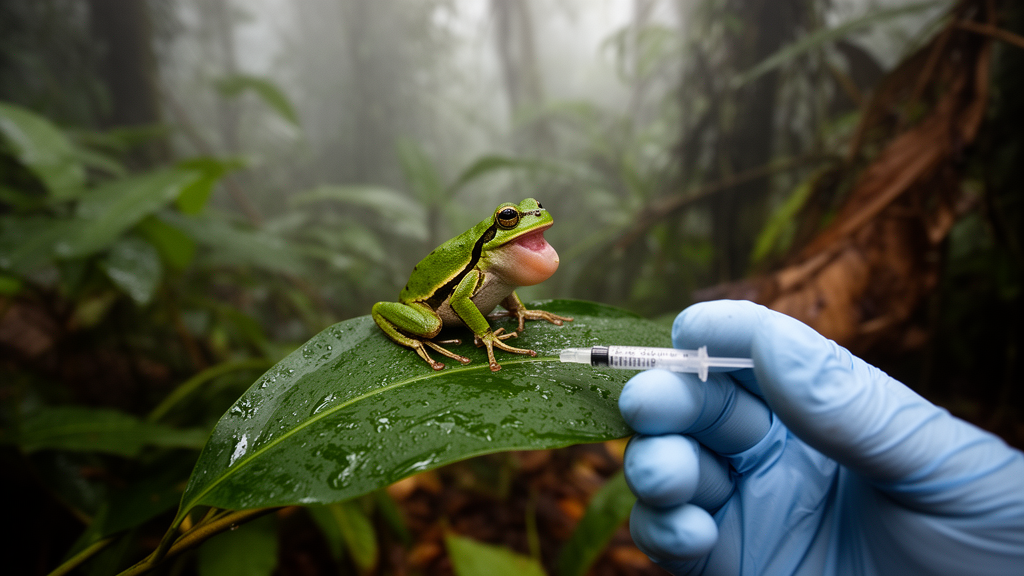
An integrative taxonomic study combining mitochondrial DNA and advertisement-call evidence identified 369 molecular operational taxonomic units for frogs across New Guinea and neighbouring islands. Of these, 179 corresponded to species recognised by current taxonomy and 190 could not be assigned to a named taxon, indicating that regional frog diversity is substantially underestimated. Adding the candidate species to the 560 species currently recognised as resident produced a minimum estimate of 750 frog species, while a separate extrapolation estimated 1,176 species under three explicit assumptions.
The study examined the New Guinea region from the northern and central Moluccas across New Guinea to the Bismarck and Solomon archipelagos. Researchers compiled 2,301 mitochondrial DNA sequences from six frog families, representing 1,537 specimens and 226 localities; 1,380 specimens had georeferenced locations. The dataset included 1,767 sequences obtained from public repositories and 534 newly generated sequences from specimens collected in western New Guinea during fieldwork conducted over the previous 20 years.
Because coverage differed among mitochondrial loci, the researchers used the 16Sb region of the mitochondrial 16S rRNA gene for species delimitation. They applied Automatic Barcode Gap Discovery, Poisson Tree Processes and the Generalised Mixed Yule Coalescent approach. An operational taxonomic unit was defined by majority-rule consensus across the three partitions.
The individual methods delimited between 263 and 386 units, while consensus produced 372. Integration with acoustic evidence reduced the final total to 369. Acoustic data were available for 38 units arranged in 19 pairs.
The researchers compared published and newly acquired recordings using eight call features, including note duration, inter-note duration, repetition rate, notes per call, pulses per note, dominant frequency, amplitude modulation and frequency modulation. They did not treat slight differences in dominant frequency or note timing between allopatric units as diagnostic, but non-overlapping values for notes per call, amplitude modulation and frequency modulation supported the molecular delimitations. Thirty of the 38 units were supported as distinct, comprising 11 recognised species and 19 candidate species.
The 190 candidate species were not all treated as confirmed species. Mitochondrial DNA can cause either oversplitting or lumping, and the study did not include morphological analysis. Available acoustic data nevertheless strengthened the case for 19 candidate species.
Mean 16S genetic distance among units supported as distinct by acoustic evidence was 4.0% for Microhylidae, with a range of 1.0% to 13.0%, and 2.7% for Ceratobatrachidae, with a range of 2.0% to 3.0%. Limited call data prevented comparable acoustic tests in other families. Most candidates, 123 of 190, occurred in western New Guinea, where 215 species are currently recognised, compared with 416 in the eastern half.
The study’s higher extrapolation of 1,176 species was based on the ratio of 190 candidate species to 179 recognised species in the molecular dataset. It assumes that every candidate is valid, that the dataset represents taxonomic diversity evenly and that taxonomic gaps occur evenly across the region. The authors described the estimate as uncertain because mitochondrial oversplitting could inflate it, while missed lineages or overlooked high beta diversity could reduce it.
Sampling was uneven. Among georeferenced mitochondrial sequences available before the study, 81% originated in eastern New Guinea. In the complete compiled dataset, the Papuan Peninsula contained 367 sequences from 32 localities and the eastern central range 274 sequences from 37 localities.
Western New Guinea and its surrounding islands accounted for 963 sequences, including 393 from the Bird’s Neck and 312 from the Bird’s Head. The western central range had no 16Sb sequences, although it was represented by one 12S, two 16Sa and three cytb sequences. Comparisons with International Union for Conservation of Nature distribution data showed that the molecular inventory omitted many recognised species from the Papuan Peninsula and eastern central range, where 151 and 126 recognised species, respectively, were missing from the operational-unit dataset.
Bird’s Head, by contrast, contained 18 units more than the number of taxonomically known species in the IUCN data. Average estimated endemism was 85% for the molecular units, compared with 35% for recognised species in the IUCN dataset, although sparse sampling may inflate the molecular estimate, particularly for families whose members tend to have wider ranges. The study also compared its western New Guinea candidates with roughly 200 candidates identified in an earlier expert-based assessment by Oliver and colleagues.
Six of the 123 western New Guinea candidates from this study overlapped with that earlier set. Combining the two incomplete and patchily overlapping datasets produced a minimum estimate of 800 species, including about 240 currently undescribed. The authors considered a twofold increase in species diversity plausible in western New Guinea, where most of the study’s candidates occurred, but stressed that the regional total remains uncertain and that major areas, particularly parts of the central range, remain poorly sampled.
Subject of Research: Integrative assessment of frog diversity and taxonomic gaps across New Guinea and neighbouring islands
Article Title: Molecular and acoustic evidence for large-scale underestimation of frog species diversity on New Guinea
Article References: Ferreira, F., Oliver, P., Kraus, F., Günther, R., Richards, S., Tjaturadi, B., Arida, E., Hamidy, A., Riyanto, A., Trilaksono, W., Thébaud, C., & Fouquet, A. (2025). Molecular and acoustic evidence for large-scale underestimation of frog species diversity on New Guinea. Frontiers of Biogeography, 18, Article e137988. https://doi.org/10.21425/fob.18.137988
Image Credits: AI Generated
Keywords: frog diversity, New Guinea, mitochondrial DNA, bioacoustics, species delimitation, taxonomic impediment, Microhylidae, biodiversity, candidate species, integrative taxonomy, Molecular, acoustic
Cite Scienmag News
Margaret Porter. (October 20, 2026). Research report: Molecular and acoustic evidence for large-scale underestimation of frog species diversity on New Guinea. Scienmag. https://scienmag.com/research-report-molecular-and-acoustic-evidence-for-large-scale-underestimation-of-frog-species-diversity-on-new-guinea/
Margaret Porter. "Research report: Molecular and acoustic evidence for large-scale underestimation of frog species diversity on New Guinea." Scienmag, 20 October 2026, https://scienmag.com/research-report-molecular-and-acoustic-evidence-for-large-scale-underestimation-of-frog-species-diversity-on-new-guinea/. Accessed 20 October 2026.
Margaret Porter. "Research report: Molecular and acoustic evidence for large-scale underestimation of frog species diversity on New Guinea." Scienmag. October 20, 2026. https://scienmag.com/research-report-molecular-and-acoustic-evidence-for-large-scale-underestimation-of-frog-species-diversity-on-new-guinea/


