


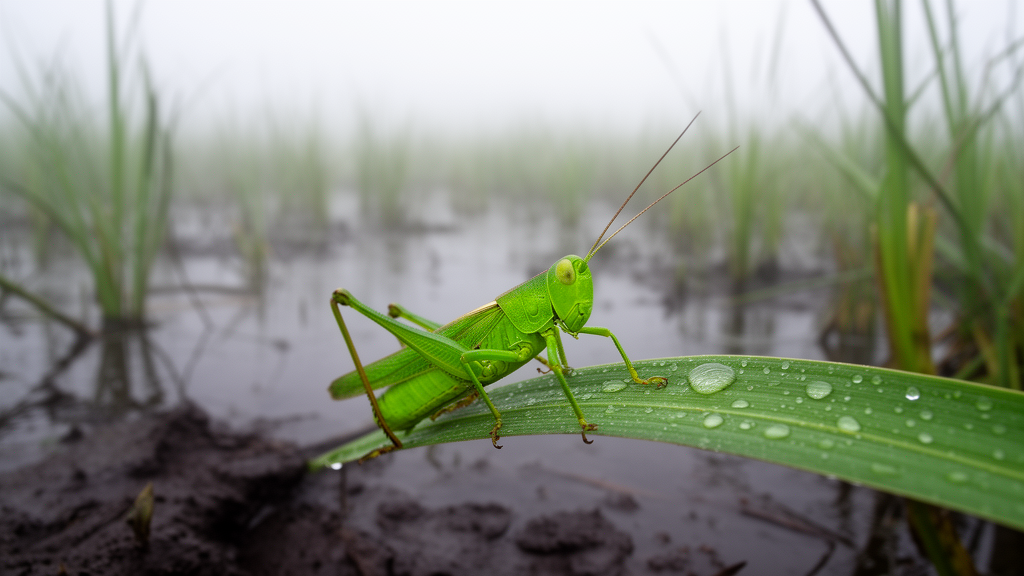
A morphological and taxonomic review of the African grasshopper genus Digentia recognized five species after describing Digentia viridissima as a new species from humid forests in southern Cameroon. The review also redescribed three previously known species, reassessed the evidence surrounding Digentia punctatissima and Digentia karnyi, and provided a key for identifying the five species.
Digentia belongs to the subfamily Oxyinae within the grasshopper family Acrididae. Members of the subfamily have a subconical head, short fastigium, sulcate frontal ridge, conical prosternal process, open mesosternal interspace, spined lower genicular lobe of the hind femur, tufts of short hairs on distal abdominal sternites and, in males, an epiphallus that is usually divided at the bridge. Oxyinae contains 37 recognized genera, 19 of which are assigned to the tribes Oxyini and Praxibulini, while Digentia and 17 other wet-forest genera remain outside those tribes.
The genus had four known species before this review: Digentia punctatissima, Digentia rufogeniculata, Digentia fasciata and Digentia karnyi. Digentia is confined to West Central Africa and appears morphologically close to Oxya, the type genus of Oxyini. The two genera share a pentagonal fastigium that is wider than long, complete lateral facial keels and a prosternal process with a subacute or rounded apex, whereas Oxya also occurs across the old-world tropics and warm temperate zones.
Field collections for the study were made from 27 April 2019 to 7 April 2023 at Ngoyla in Nki National Park, Haut-Nyong division, and Ngutadjap in the Vallée du Ntem division. The authors examined specimens with a stereomicroscope, prepared illustrations at magnifications of 6–50 times, and took measurements with a graticule eyepiece and a digital stage reading to 0.01 mm. Measurements covered the pronotum, overall body length, antennae, eyes, elytra, hind femora, hind tibiae and tarsal segments. Ratios normalized by pronotum length were used to compare animals of different sizes, while foot formulas and sexual-dimorphism ratios were calculated from sample averages rather than individual measurements.
The new species was represented by 23 specimens, including 14 males and nine females, from Ngoyla and Ngutadjap. Digentia viridissima has an average male body length of 19.61 mm and an average female length of 24.18 mm. Its male cerci are flat, compressed, inwardly curved and excised apically, while the phallic complex is medium-sized, with an undivided epiphallus bridge, long conical outer lophi curving upward with rounded tips, a robust endophallus, a wide ventral aedeagal sclerite with a rounded apex and a slender, pointed gonopore process. Females have conical, incurved cerci with acute apices.
Live and freshly examined material of Digentia fasciata showed a predominantly green-yellow body with black or green-black longitudinal bands extending from the vertex across the pronotum, mesothorax, metathorax and abdomen in some specimens. The authors’ redescription differs from Ramme’s 1929 account of dried museum specimens, which described the species as yellow-brown. Digentia viridissima was similarly green-yellow, with green-blue tibiae and green tarsi; its name derives from the Latin viridissima, meaning “greenest,” referring to its unusually green external appearance.
The revision supports two external-morphology subgroups within Digentia. Digentia punctatissima, Digentia fasciata and Digentia viridissima have extremely reduced tegmina, a short and medially notched metazona, hind tibiae that are not or only slightly expanded apically, and dark longitudinal body bands. Digentia rufogeniculata and Digentia karnyi instead have longer, oval, strongly reticulate tegmina, relatively massive hind tibiae expanded apically, and no corresponding black longitudinal bands. This division corresponds to the historical treatment of Digentia and Genditia as separate genera, but the authors found that the available male and female genitalia did not justify retaining both generic names.
Several material limitations constrain the comparison. The holotype of Digentia punctatissima, originally preserved in fluid before being pinned, is in poor condition, and the authors could not borrow it from Stockholm; they instead relied on published descriptions, drawings and a photograph of the specimen. Digentia karnyi remains known only from its female holotype from Tolo in the Democratic Republic of Congo, with its antennae, hind femur, hind tibiae and tarsi missing. The authors also could not examine the types of Digentia fasciata. As a result, they stated that the available material was too meager for extensive comparisons and said the generic identities of Digentia and Genditia should be reconsidered after broader collections include both sexes of all species.
At Ngoyla and Ngutadjap, Digentia viridissima and Digentia fasciata occurred in humid, often swampy forest alongside Pterotiltus and several catantopine grasshoppers. At Ngutadjap, Pteridium aquilinum covered more than 75% of the referenced ground surface, Palisota hirsuta covered 25–50%, and several Marantaceae species covered 5–25%. The grasshoppers were usually collected on ferns, but the researchers did not observe either Digentia species feeding on a particular plant. They associated the lack of feeding observations with the rarity of the specimens and their rapid capture rather than with a demonstrated host-plant preference.
Subject of Research: Morphological taxonomy and distribution of the African grasshopper genus Digentia
Article Title: Review of the African genus Digentia Stål, 1878 ( Orthoptera , Acrididae , Oxyinae )
Article References: Oumarou Ngoute, C., & Rowell, C. H. F. (2025). Review of the African genus Digentia Stål, 1878 (Orthoptera, Acrididae, Oxyinae). Journal of Orthoptera Research, 34(1), 11-30. https://doi.org/10.3897/jor.34.126949
Image Credits: AI Generated
Keywords: Digentia, Oxyinae, Acrididae, Orthoptera, taxonomic revision, new species, Cameroon, grasshopper morphology, West Central Africa, Review, African, genus
Cite Scienmag News
Gavin Prescott. (October 20, 2026). Taxonomic review describes new Digentia grasshopper species from Cameroon. Scienmag. https://scienmag.com/taxonomic-review-describes-new-digentia-grasshopper-species-from-cameroon/
Gavin Prescott. "Taxonomic review describes new Digentia grasshopper species from Cameroon." Scienmag, 20 October 2026, https://scienmag.com/taxonomic-review-describes-new-digentia-grasshopper-species-from-cameroon/. Accessed 20 October 2026.
Gavin Prescott. "Taxonomic review describes new Digentia grasshopper species from Cameroon." Scienmag. October 20, 2026. https://scienmag.com/taxonomic-review-describes-new-digentia-grasshopper-species-from-cameroon/


