

Tuesday, October 20, 2026
Science
No Result
View All Result
  • Login
  • HOME
  • SCIENCE NEWS
  • CONTACT US
  • HOME
  • SCIENCE NEWS
  • CONTACT US
No Result
View All Result
Scienmag
No Result
View All Result
Home Science News Technology and Engineering

Hybrid heel-strike harvester reaches 8.5 milliwatts in laboratory testing

October 20, 2026
in Technology and Engineering
Denise Maddox
By Denise Maddox Scienmag Editorial Profile - Mechanical Engineering
Reading Time: 2 mins read
0
Hybrid heel-strike harvester reaches 8.5 milliwatts in laboratory testing

Hybrid heel-strike harvester reaches 8.5 milliwatts in laboratory testing

65
SHARES
587
VIEWS
Share on FacebookShare on Twitter
ADVERTISEMENT

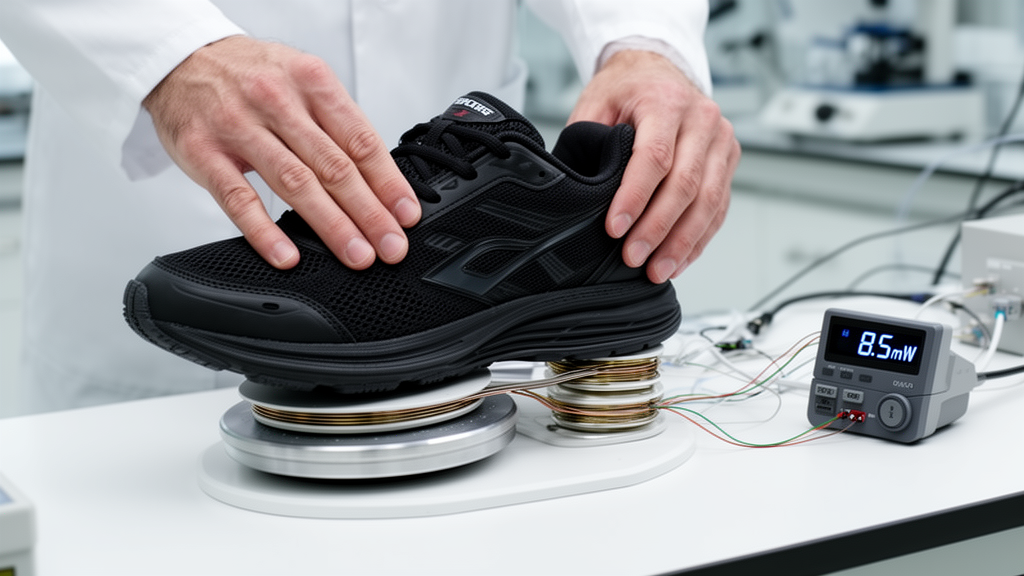
A hybrid electromagnetic and piezoelectric energy harvester designed to capture human heel-strike movement produced a maximum average output of 8.5 milliwatts from its electromagnetic branch in laboratory tests at an excitation frequency of 1.5 hertz. The prototype also reached an electromagnetic output power density of 23.3 microwatts per cubic centimetre under the same test condition. The device, described by its developers as an electromagnetic-piezoelectric hybrid energy harvester with frequency up-conversion performance, combines bearings, a gear transmission and ratchet mechanisms.

Its mechanical transmission converts the up-and-down stroke of heel movement into rotation of a rotor. As the rotor turns, its magnets move within the electromagnetic generating system, producing voltage through electromagnetic induction. A second conversion mechanism operates alongside the electromagnetic branch.

A driven magnet and a tip magnet couple the device’s motion into vibration of a piezoelectric cantilever beam, allowing the piezoelectric component to generate electrical voltage. The design therefore uses two energy-conversion approaches within a single heel-strike harvester rather than relying on only one physical effect. Researchers built the EPHEH prototype and performed detailed performance tests.

The reported maximum average output power of 8.5 milliwatts applied specifically to the electromagnetic branch at a pressing frequency of 1.5 hertz. At that same excitation frequency, the measured electromagnetic output power density was 23.3 microwatts per cubic centimetre. The supplied study abstract does not report a combined output value for the electromagnetic and piezoelectric branches.

The investigators also evaluated how the electrical output could be stored and used. Under excitation at 1.5 hertz, a 0.22-farad capacitor charged from 0 to 3.3 volts in four minutes. They then incorporated the harvester into an energy-harvesting shoe and carried out application experiments in which a microcontroller controlled the lighting state of an LED, while another configuration powered a thermohygrometer.

These demonstrations show that the prototype’s electrical output can operate low-power electronic components. They do not establish how much power the shoe would recover from unrestricted human walking, because the reported maximum output and power density came from tests conducted at a specified pressing frequency. The frequency-up-conversion design is central to the prototype’s operation.

Mechanical movement associated with heel strike is transferred into rotor rotation for electromagnetic generation, while magnet coupling excites the piezoelectric cantilever. These two branches are intended to make use of the same movement through distinct conversion pathways, although the reported headline performance figure concerns only the electromagnetic component. The capacitor-charging measurement and the operation of the LED and thermohygrometer move beyond instrument-only output tests, while the reported laboratory values quantify the prototype’s performance under controlled excitation.

The study’s scope remains centered on a constructed prototype and shoe-based demonstrations, and the available evidence does not quantify longer-term operation or harvesting from continuous, unconstrained walking.

Subject of Research: Electromagnetic and piezoelectric energy harvesting from human heel-strike movement

Article Title: Design and analysis of a frequency up-conversion electromagnetic-piezoelectric hybrid energy harvester for human heel strike movement energy harvesting

Article References: Xie, Z., Zhang, S., Zhu, Y., Fu, B., & Huang, W. (2026). Design and analysis of a frequency up-conversion electromagnetic-piezoelectric hybrid energy harvester for human heel strike movement energy harvesting. Journal of Materials Science. https://doi.org/10.1007/s10853-026-13926-y

Image Credits: AI Generated

DOI: 10.1007/s10853-026-13926-y

Keywords: energy harvesting, heel strike, piezoelectricity, electromagnetic induction, frequency up-conversion, wearable electronics, prototype testing, energy storage, Design, analysis, frequency, up-conversion

Cite Scienmag News

Denise Maddox. (October 20, 2026). Hybrid heel-strike harvester reaches 8.5 milliwatts in laboratory testing. Scienmag. https://scienmag.com/hybrid-heel-strike-harvester-reaches-8-5-milliwatts-in-laboratory-testing/

Denise Maddox. "Hybrid heel-strike harvester reaches 8.5 milliwatts in laboratory testing." Scienmag, 20 October 2026, https://scienmag.com/hybrid-heel-strike-harvester-reaches-8-5-milliwatts-in-laboratory-testing/. Accessed 20 October 2026.

Denise Maddox. "Hybrid heel-strike harvester reaches 8.5 milliwatts in laboratory testing." Scienmag. October 20, 2026. https://scienmag.com/hybrid-heel-strike-harvester-reaches-8-5-milliwatts-in-laboratory-testing/


Tags: analysisbiomechanical energy conversionDesignelectromagnetic and piezoelectric energy harvesterelectromagnetic inductionelectromagnetic induction in energy harvestingenergy harvestingenergy storageFrequencyfrequency up-conversionfrequency up-conversion energy harvestingHeel-Strikeheel-strike energy harvestinghuman motion energy conversionhybrid energy harvesting devicelow-frequency energy harvestingpiezoelectric cantilever vibrationpiezoelectricityprototype performance testingprototype testingup-conversionwearable electronicswearable energy harvesting technologywearable power generation devices
Share26Tweet16
Previous Post

Case report links lung cancer leptomeningeal metastasis to bilateral vestibulopathy

Next Post

Case report links prolonged VZV DNA detection to herpes zoster ophthalmicus in a 77-year-old woman after COVID-19

Related Posts

First census of hidden seafloor life reveals 80 species around Greece’s Chrysi Island
Biology

2023 data paper establishes soft-bottom macrobenthos baseline for Chrysi and Mikronisi

October 20, 2026
Observational Study Finds Freelance Hiring Signal Backfired
Technology and Engineering

Observational Study Finds Freelance Hiring Signal Backfired

October 20, 2026
Dairy Waste Turned Into Peptide Nanocellulose That Cleans Dairy Wastewater
Technology and Engineering

Peptide-modified nanocellulose achieves high organic-load removal in laboratory dairy-wastewater study

October 20, 2026
Mitochondria‐Targeted Nanotherapeutics: A Promising Strategy in Modulating Mitochondrial Function, Transfer, and Transplantation
Technology and Engineering

Mitochondria‐Targeted Nanotherapeutics: A Promising Strategy in Modulating Mitochondrial Function, Transfer, and Transplantation

October 20, 2026
New moth species discovered in Saudi Arabia’s mountain forests
Biology

Research report: Taxonomic and distributional updates on the Arabian species of the genus Palpita Hübner, 1808 ( Lepidoptera , Crambidae , Spilomelinae )

October 20, 2026
Enhanced TOGI Control Framework Powers Bidirectional Solar EV Charging
Technology and Engineering

Simulation and real-time tests assess enhanced TOGI control for grid-connected solar PV–EV charging

October 20, 2026
Next Post
Prolonged Viral Shedding After COVID-19 Seen in Severe Shingles Case

Case report links prolonged VZV DNA detection to herpes zoster ophthalmicus in a 77-year-old woman after COVID-19

  • Mothers who receive childcare support from maternal grandparents show more optimized

    Mothers who receive childcare support from maternal grandparents show more parental warmth, finds NTU Singapore study

    27656 shares
    Share 11059 Tweet 6912
  • University of Seville Breaks 120-Year-Old Mystery, Revises a Key Einstein Concept

    1061 shares
    Share 424 Tweet 265
  • Bee body mass, pathogens and local climate influence heat tolerance

    682 shares
    Share 273 Tweet 171
  • Researchers record first-ever images and data of a shark experiencing a boat strike

    546 shares
    Share 218 Tweet 137
  • Groundbreaking Clinical Trial Reveals Lubiprostone Enhances Kidney Function

    531 shares
    Share 212 Tweet 133
Science

Embark on a thrilling journey of discovery with Scienmag.com—your ultimate source for cutting-edge breakthroughs. Immerse yourself in a world where curiosity knows no limits and tomorrow’s possibilities become today’s reality!

RECENT NEWS

  • Arable Weed Surveys Diverge: Vegetation Science Reports Less Methodological Detail Than Weed Science
  • New palate-infecting Myxobolus species identified in yellow catfish from China’s Xiangjiang River
  • Case report links prolonged VZV DNA detection to herpes zoster ophthalmicus in a 77-year-old woman after COVID-19
  • Hybrid heel-strike harvester reaches 8.5 milliwatts in laboratory testing

Categories

  • Agriculture
  • Anthropology
  • Archaeology
  • Athmospheric
  • Biology
  • Biotechnology
  • Blog
  • Bussines
  • Cancer
  • Chemistry
  • Climate
  • Earth Science
  • Editorial Policy
  • Marine
  • Mathematics
  • Medicine
  • Pediatry
  • Policy
  • Psychology & Psychiatry
  • Science Education
  • Science News
  • Social Science
  • Space
  • Technology and Engineering

Subscribe to Blog via Email

Enter your email address to subscribe to this blog and receive notifications of new posts by email.

Join 5,150 other subscribers

© 2025 Scienmag - Science Magazine

Welcome Back!

Login to your account below

Forgotten Password?

Retrieve your password

Please enter your username or email address to reset your password.

Log In
No Result
View All Result
  • HOME
  • SCIENCE NEWS
  • CONTACT US

© 2025 Scienmag - Science Magazine

Discover more from Science

Subscribe now to keep reading and get access to the full archive.

Continue reading