


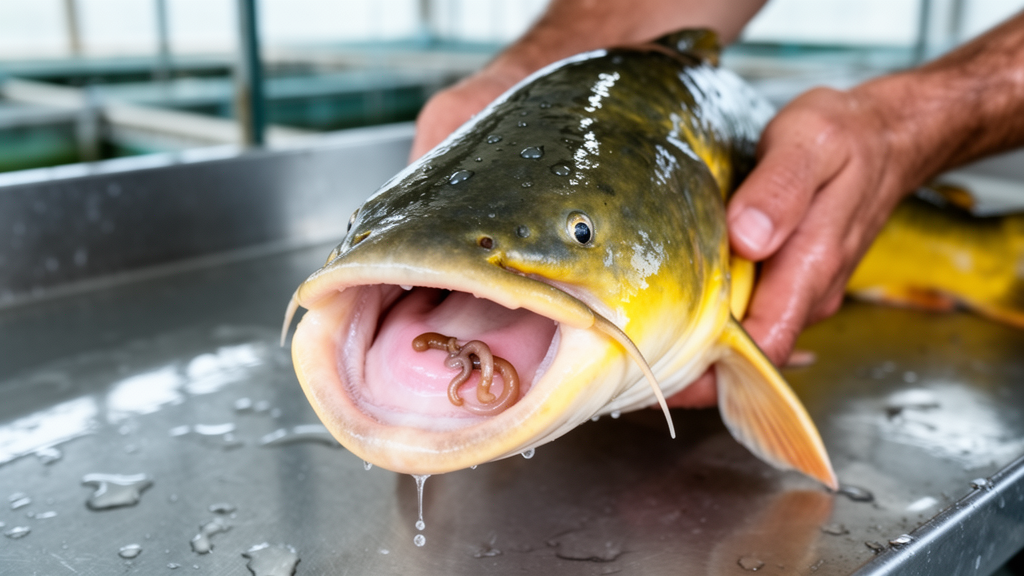
An observational taxonomic study of yellow catfish from the Xiangjiang River in China identified and described a new myxosporean species, Myxobolus tachysurus sp. nov., infecting the palate of Tachysurus fulvidraco. Researchers characterized the parasite through morphological examination, histopathology, DNA sequencing and phylogenetic analysis of partial nuclear 18S ribosomal DNA. The species was found in 8 of 44 examined fish, corresponding to a prevalence of 18.18%.
From June 2020 to July 2023, the researchers randomly collected 44 yellow catfish weighing 90.8–110.4 g with a gill net in the Xiangjiang River at Changsha City, Hunan Province. They examined the gills, skin, fins, liver, gallbladder and other organs for suspected plasmodia. Infected tissues and isolated plasmodia were preserved separately for histological and molecular analyses, with histological sections cut at 5–6 μm and stained with hematoxylin and eosin. Partial 18S rDNA sequences were amplified, cloned and sequenced bidirectionally.
Numerous whitish plasmodia occurred exclusively in the palate, with none detected in the intestine, kidney, spleen, skin, liver or other examined organs. The plasmodia were ellipsoidal and measured 2.2–3.2 mm in length and 1.1–1.3 mm in width. Histologically, the parasite occurred within the muscle layer of the palate and was surrounded by connective tissue. Immature myxospores were located peripherally, while mature spores were found centrally. No inflammatory response was observed, and the infected fish showed no abnormal symptoms compared with healthy individuals.
Fresh myxospores were pyriform in valvular view and fusiform in sutural view. Their mean dimensions were 11.4 ± 0.3 μm in length, 7.0 ± 0.2 μm in width and 5.2 ± 0.3 μm in thickness, based on 30 spores; the reported ranges were 10.8–12.1, 6.6–7.4 and 4.6–5.8 μm, respectively. The spore surface was smooth and the valves were symmetrical. Two pyriform polar capsules were slightly unequal: the larger measured 6.0 ± 0.3 by 2.3 ± 0.1 μm and the smaller 5.4 ± 0.2 by 2.2 ± 0.1 μm. The polar tube had six to seven coils, and three to four posterior folds were occasionally observed. No mucous envelope, iodinophilous vacuole or intercapsular appendix was present, although some spores had Henneguya-like caudal appendages.
Morphological comparisons focused on eight Myxobolus species reported from Tachysurus hosts that most closely resembled the new species. The researchers distinguished M. tachysurus sp. nov. using combinations of spore dimensions, polar-capsule size and shape, polar-tube coiling, posterior folds, plasmodial size, host and infection site. For example, M. pseudowulii and M. jialingensis have more polar-tube turns, while M. physophilus has more posterior folds, broader and thicker spores and a different infection site. The new species also differed from the two previously reported palate-infecting Myxobolus species in spore dimensions, capsule proportions, spore shape and host.
The generated 18S rDNA sequence did not match any sequence then available in GenBank. Its highest sequence similarity was 95.82% with Myxobolus separatus, a species infecting the gill filaments of T. fulvidraco. Other relatively similar sequences included M. nagaraensis at 89.82%, M. lentisuturalis at 89.62%, an unidentified Myxobolus sequence at 89.59%, M. branchiopectin at 89.48% and M. cultus at 89.50%. Kimura two-parameter genetic distances and sequence similarities for the compared taxa ranged from 0.114 and 95.82% to 0.286 and 82%, respectively.
Phylogenetic analyses using 40 selected sequences produced four major clades and relied on both Bayesian inference and maximum-likelihood methods. The new species did not group with the other T. fulvidraco-infecting Myxobolus species in clade D. Instead, it formed a sister clade with moderate support to M. separatus and M. nagaraensis in clade A. Across the selected taxa, clustering was mainly associated with host affinity, with some exceptions, rather than infection site or geographic locality. This pattern was derived from the selected sequences and partial 18S rDNA analysis, rather than a comprehensive test of all ecological and geographic influences.
The findings add a species to the recorded diversity of myxosporeans infecting yellow catfish, an economically important freshwater fish farmed across China. More than 30 myxosporean species had previously been identified from various organs of this host, while the palate was an uncommon infection site. The study was bounded by its sample of 44 fish collected from one location in the Xiangjiang River over a three-year sampling period. It described infection and parasite characteristics rather than experimentally testing effects on host health, so the absence of observed symptoms in the sampled fish does not establish that the parasite lacks effects under other conditions.
Type material for Myxobolus tachysurus sp. nov. was deposited at the Museum of Hydrobiological Sciences, Institute of Hydrobiology, Chinese Academy of Sciences, with additional paratypes and histological material held at Hunan Agricultural University. The species name derives from the generic name of its host. On the basis of the measured morphological traits, tissue distribution, histopathology, 18S rDNA sequence and phylogenetic placement, the authors concluded that the palate-infecting parasite represented a new species distinct from the previously described taxa they compared.
Subject of Research: Taxonomic characterization of a new palate-infecting Myxobolus species in yellow catfish
Article Title: Morphological and molecular characterizations of Myxobolus tachysurus sp. nov. ( Myxozoa , Myxosporea ) infecting the palate of yellow catfish Tachysurus fulvidraco in China
Article References: Yuan, S., Dai, W., Pan, F., Zhao, X., Liu, Y., Li, D., Xiang, J., Ren, S., & Liu, X. (2026). Morphological and molecular characterizations of Myxobolus tachysurus sp. nov. (Myxozoa, Myxosporea) infecting the palate of yellow catfish Tachysurus fulvidraco in China. Zoosystematics and Evolution, 102(1), 347-356. https://doi.org/10.3897/zse.102.182245
Image Credits: AI Generated
Keywords: Myxobolus tachysurus, yellow catfish, myxosporean parasites, Xiangjiang River, 18S rDNA, phylogenetic analysis, histopathology, species description, China, Morphological, molecular, characterizations
Cite Scienmag News
Drew Townsend. (October 20, 2026). New palate-infecting Myxobolus species identified in yellow catfish from China’s Xiangjiang River. Scienmag. https://scienmag.com/new-palate-infecting-myxobolus-species-identified-in-yellow-catfish-from-chinas-xiangjiang-river/
Drew Townsend. "New palate-infecting Myxobolus species identified in yellow catfish from China’s Xiangjiang River." Scienmag, 20 October 2026, https://scienmag.com/new-palate-infecting-myxobolus-species-identified-in-yellow-catfish-from-chinas-xiangjiang-river/. Accessed 20 October 2026.
Drew Townsend. "New palate-infecting Myxobolus species identified in yellow catfish from China’s Xiangjiang River." Scienmag. October 20, 2026. https://scienmag.com/new-palate-infecting-myxobolus-species-identified-in-yellow-catfish-from-chinas-xiangjiang-river/


