


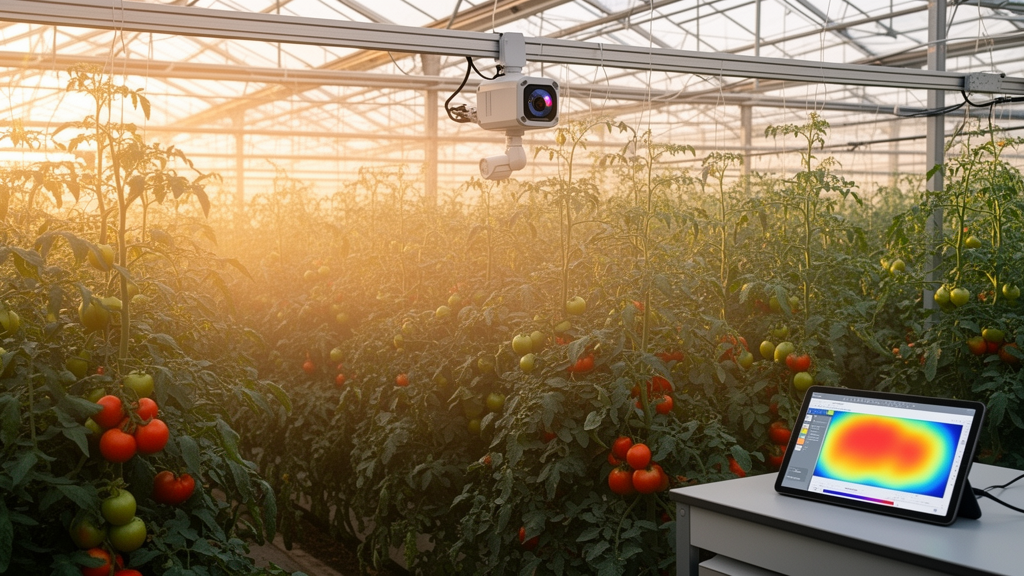
In a retrospective evaluation using data from a multi-span Venlo-type greenhouse in Pyeongchang, Republic of Korea, forecasts issued 30 minutes ahead detected 44 of 51 below-setpoint thermal events with an average warning lead time of 28.5 minutes, while 60-minute forecasts caught 46 of 51 events with a mean lead time of 56.6 minutes. Reactive monitoring, which raises an alarm only after the temperature has already crossed the threshold, provided no advance warning at all.
The modelling dataset contained 138,239 five-minute records spanning 30 November 2022 to 10 September 2024. The authors are careful to note that this is not a continuous two-year record: six temporal gaps longer than ten minutes were identified, including an extended monitoring interruption from 26 September 2023 to 8 March 2024, so the data comprise seven distinct monitoring periods collected under real commercial conditions rather than an unbroken multi-year campaign.
The research team focused on two thermal variables that behave very differently inside a greenhouse canopy: low-canopy air temperature and upper-canopy leaf temperature. Air temperature reflects the bulk thermal state of the greenhouse air, whereas leaf temperature is more closely tied to plant-level processes such as transpiration and radiative heat exchange, and consequently shows higher variability and sharper transitions. Sensors included temperature-humidity units installed at lower, middle, and upper positions between ground level and the four-meter eave height, plus an additional unit below the roof vent at roughly six meters, with data logged at five-minute intervals alongside external meteorological measurements.
Three modelling approaches were compared: a persistence baseline, Random Forest, and XGBoost, with the best model for each task selected on validation-set root mean square error and final performance assessed on an independent chronological test set comprising 15 percent of the data. For virtual sensing, the task of reconstructing the current value of a sensor that may have failed or drifted, the results were strikingly variable-dependent. For low-canopy air temperature, a simple persistence rule using a physically related proxy sensor, the upper-canopy air temperature, actually beat both machine-learning models, achieving an RMSE of 1.5615 degrees Celsius and an R-squared of 0.7768, while Random Forest and XGBoost produced larger errors of 2.4712 and 2.1888 degrees respectively.
The authors attribute that counterintuitive result largely to degradation of the mid-canopy air-temperature sensor during the later test period, which forced the machine-learning pipelines to rely on median imputation for 4,680 missing observations. Before that degradation began, Random Forest and XGBoost had achieved R-squared values of 0.9924 and 0.9916. For upper-canopy leaf temperature, the picture reversed completely: persistence performed poorly with an RMSE of 1.7507 degrees, while XGBoost achieved the best result at 0.2843 degrees with an R-squared of 0.9924, followed closely by Random Forest at 0.2905 degrees. The team cautions that such very high within-site accuracy may partly reflect redundant microclimatic information among co-located sensors and does not by itself establish transferability to other greenhouse layouts, cultivars, seasons, or climatic regions.
Short-term forecasting told a different story. Unlike the estimation tasks, machine learning consistently outperformed persistence for both variables and at both horizons. For low-canopy air temperature, XGBoost cut the 30-minute RMSE to 0.4697 degrees Celsius, roughly 21 percent below the persistence baseline of 0.5961 degrees, and at 60 minutes it reached 0.6360 degrees against 0.9987 degrees for persistence, an approximately 36 percent reduction. For upper-canopy leaf temperature, XGBoost again led with RMSE values of 0.6404 degrees at 30 minutes and 0.7907 degrees at 60 minutes, compared with 0.7684 and 1.1148 degrees for persistence. Errors grew as the horizon lengthened for all models, but the increase was smaller for the machine-learning approaches.
SHAP analysis of the 30-minute XGBoost forecasting models revealed distinct predictor structures for the two variables. Air-temperature prediction was dominated by the current low-canopy air temperature itself, followed by mid-canopy and upper-canopy leaf temperatures, indicating that short-term air-temperature dynamics are governed mainly by the current thermal state and vertical thermal coupling between canopy layers. Leaf-temperature forecasting was instead strongly dominated by the current upper-canopy leaf temperature and mid-canopy leaf temperature, with lagged and rolling-mean leaf-temperature features contributing notably, suggesting that leaf temperature depends on the accumulated thermal history of the canopy rather than instantaneous external forcing alone. Solar radiation and time-related variables played secondary roles in both cases.
The practical payoff came when the forecasts were translated into an operator-facing early-warning layer. The team defined daytime and night-time operational setpoints of 22 and 17 degrees Celsius, treated as monitoring thresholds for this particular greenhouse rather than universal physiological limits for tomato, and classified thermal risk from the maximum temperature deficit among current and forecast temperatures. During the common evaluation period, 51 distinct below-setpoint violation events were identified, with a mean duration of 82.2 minutes and a range of 5 to 485 minutes; 46 began during daytime and 25 occurred in July. The 30-minute forecasting strategy achieved a point-level precision of 90.74 percent, recall of 93.56 percent, and F1-score of 92.13 percent, with a false alarm ratio of 9.26 percent, while the 60-minute strategy yielded 87.12 percent precision, 88.78 percent recall, and a 12.88 percent false alarm ratio.
Day-block bootstrap resampling with 2,000 repetitions confirmed that the performance gap between horizons was robust, with 95 percent confidence intervals of 87.1 to 93.4 percent for 30-minute precision and 81.6 to 91.3 percent for 60-minute precision. The results also expose a genuine trade-off: the 30-minute horizon delivered higher classification reliability, while the 60-minute horizon offered longer lead times and slightly greater event coverage. A sensitivity analysis showed that warning performance depended on the chosen setpoints, as expected. Lowering the threshold combination to 21/16 degrees Celsius reduced identified events from 51 to 25, while raising it to 23/18 degrees increased them to 89, yet the 30-minute strategy’s F1-score stayed within a narrow band of 90.7 to 92.1 percent across the tested range, and its precision rose from 89.8 to 94.7 percent as the threshold increased while recall fell from 94.2 to 87.1 percent.
The authors stress that the framework is a prototype decision-support layer evaluated retrospectively on historical sensor data, not a validated autonomous control system. No real-time deployment, operator response, control action, crop response, or energy-saving effect was assessed, and the analysis rests on a single greenhouse dataset, which may limit generalisability. The dataset also represents a multi-period record rather than continuous monitoring, and crop growth, yield, and fruit-quality responses were not evaluated. Nevertheless, the study demonstrates that modelling strategy should be matched to both the target variable and the prediction objective: simple proxy-based estimation suffices for low-canopy air temperature, machine learning is essential for leaf temperature and for forecasting, and short-term predictions can be converted into interpretable risk signals that give tomato growers meaningful advance notice of canopy-level thermal stress.
Subject of Research: Machine-learning-based virtual sensing and short-term forecasting of canopy-level air and leaf temperatures for thermal-risk early warning in a commercial tomato greenhouse
Article Title: Forecast-based virtual sensing and early-warning decision support for canopy-level thermal risk monitoring in tomato greenhouses
Article References: Park, S., Kang, K. S., Kim, S. Y., Cho, L., Oh, K., & Kim, D. (2026). Forecast-based virtual sensing and early-warning decision support for canopy-level thermal risk monitoring in tomato greenhouses. Smart Agricultural Technology, 15, Article 102665. https://doi.org/10.1016/j.atech.2026.102665
Image Credits: AI Generated
DOI: 10.1016/j.atech.2026.102665
Keywords: greenhouse, tomato, XGBoost, machine learning, virtual sensing, temperature forecasting, leaf temperature, early warning, decision support, thermal risk, SHAP, precision agriculture
Cite Scienmag News
Alan Morgan. (October 27, 2026). Research report: Forecast-based virtual sensing and early-warning decision support for canopy-level thermal risk monitoring in tomato greenhouses. Scienmag. https://scienmag.com/research-report-forecast-based-virtual-sensing-and-early-warning-decision-support-for-canopy-level-thermal-risk-monitoring-in-tomato-greenhouses/
Alan Morgan. "Research report: Forecast-based virtual sensing and early-warning decision support for canopy-level thermal risk monitoring in tomato greenhouses." Scienmag, 27 October 2026, https://scienmag.com/research-report-forecast-based-virtual-sensing-and-early-warning-decision-support-for-canopy-level-thermal-risk-monitoring-in-tomato-greenhouses/. Accessed 27 October 2026.
Alan Morgan. "Research report: Forecast-based virtual sensing and early-warning decision support for canopy-level thermal risk monitoring in tomato greenhouses." Scienmag. October 27, 2026. https://scienmag.com/research-report-forecast-based-virtual-sensing-and-early-warning-decision-support-for-canopy-level-thermal-risk-monitoring-in-tomato-greenhouses/


