


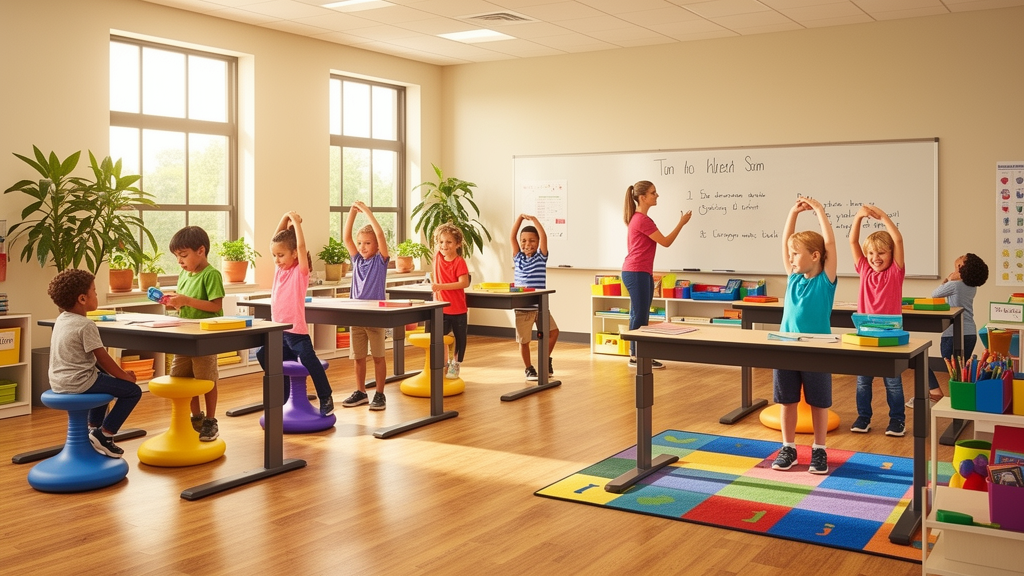
Children spend some of their longest stretches of the day sitting in classrooms, and a comprehensive scoping review now suggests that rethinking how those classrooms work can meaningfully change that pattern. The review, published in the Journal of Activity, Sedentary and Sleep Behaviors by David Larose of Université Laval and colleagues, examined ninety-two articles on three classroom strategies: flexible learning spaces that transform furniture and layout, short active breaks, and active lessons that weave physical activity directly into academic content. Across the evidence, most interventions reduced sedentary behavior and increased physical activity, and no study reported harmful effects on any of the outcomes measured.
The research team searched six databases, including EDUCATION SOURCE, ERIC, SPORTDiscus, MEDLINE, EMBASE, and Web of Science, in April 2021 and updated the search in June 2022, following PRISMA-ScR guidelines. From an initial pool of 1,858 articles, twenty-four studies met the inclusion criteria in the first screening, thirty-two more in the update, and thirty-six were added manually from reference lists. The studies ranged in size from 8 to 4,905 participants, covering 47,502 students in total. Of these, 12,175 were assessed for sedentary behaviors, 28,313 for physical activity, 6,686 for learning outcomes, and only 328 for musculoskeletal health, a disparity that shaped the strength of the conclusions the authors could draw.
The three intervention types differed in design. Twenty-five studies implemented flexible learning spaces, in which classrooms were reconfigured with sit-stand desks, standing desks, stools, Swiss balls, mats, fidget bars, or height-adjustable bicycle desks, sometimes paired with teaching approaches such as rotation systems and collaborative workstations. Twenty-seven studies used active breaks, typically five to twenty minutes of teacher-led or research-team-designed physical activity, most often at moderate-to-vigorous intensity, inserted into the school day. Thirty-six studies used active lessons, in which movement was integrated into the curriculum itself, most commonly in mathematics and language classes, with lesson durations ranging from five minutes to twenty minutes or more. Eight studies combined two strategies, most often flexible learning spaces with active breaks or active breaks with active lessons; no study combined all three.
On sedentary behavior, the review found positive changes in thirty-two of the forty articles that measured it, including reductions in sitting time, more sit-to-stand transitions, and more fragmented sitting periods. Flexible learning spaces emerged as the most effective strategy for reducing sedentary behavior throughout the day. In eighteen studies that modified classroom environments with flexible furniture, seven of the ten studies evaluating sedentary behavior across the entire day reported positive outcomes. However, the authors noted a recurring caveat: in six of eight studies that separately measured behavior across the whole day, including time at home, children compensated for classroom changes by sitting more outside school. Only one intervention, described by Sherry and colleagues in 2020, which combined posture training, adjustable sit-stand desks, and teacher instruction to stand during the first twenty minutes of each lesson, improved sitting and standing patterns both in class and across the full day without such compensation.
Active breaks showed more modest but consistent effects on sedentary time. Among six studies measuring sedentary behavior, three reported significant reductions at school, and these successful interventions tended to be short, five to ten minutes, held once or twice daily, several times a week, and built around locomotor skill games. Active lessons performed strongly as well: seven of ten studies that assessed sedentary behavior reported significant positive changes within the classroom. Only three studies, by Bartholomew, Norris, and Seljebotn and their colleagues, reported significant reductions in sedentary time specifically, suggesting that lesson duration alone did not determine success. Two studies by Riley and colleagues, which integrated movement-based mathematics lessons three times a week for sixty minutes per session, reduced sedentary behavior both in the classroom and throughout the entire school day.
Physical activity outcomes were even more broadly favorable, with positive changes in fifty-two of seventy-four articles. For flexible learning spaces, nine of twenty-two interventions led to significant increases in students’ physical activity, though the changes were primarily in light-intensity activity rather than moderate-to-vigorous movement. Active breaks raised step counts in eight of ten studies measuring school steps and increased moderate-to-vigorous physical activity in most studies that measured it during classes or at school, with three studies also observing positive changes across the whole day. Active lessons had what the authors called the most potential to increase all types of physical activity throughout the school day, with increases in step counts, light activity, and moderate-to-vigorous activity reported in fourteen and thirteen studies respectively, particularly when lessons lasted ten to fifteen minutes at moderate-to-vigorous intensity.
Learning outcomes received less attention but offered reassurance. Positive effects on learning were reported in thirteen of twenty-six articles that measured them, and no study found that the interventions harmed academic achievement. For active breaks, four studies reported improvements in mathematics and one in English, and the authors noted that breaks incorporating jumping, walking, running in place, squats, and burpees for five, ten, or fifteen minutes could positively influence academic performance even when they reduced time spent on formal instruction. Active lessons similarly showed potential, with five of eleven studies assessing mathematics and six of seven assessing literature performance reporting positive changes. For musculoskeletal health, only three of eight studies reported favorable outcomes, all involving reductions in neck, shoulder, or knee discomfort in studies that also observed positive changes in sedentary behavior, and the authors concluded that adding flexible furniture at minimum appears to have no negative effects on discomfort or ergonomics.
From the patterns across studies, the review distilled practical recommendations. For flexible learning spaces, the authors suggested a complete overhaul of furniture, large spaces allowing stations and teamwork, standing desks to maximize physical activity effects, furniture adapted to children’s ergonomics, teacher training, and educational strategies such as rotation systems. For active breaks, they recommended limiting breaks to five to ten minutes, implementing them two to three times daily, and choosing activities suited to available space and resources. For active lessons, they advised limiting lessons to ten to thirty minutes at moderate-to-vigorous intensity, with ten to fifteen minutes appearing most effective, providing teacher training, and extending the approach through active homework or active recess. Combined interventions frequently extended beyond the classroom into physical education, recess, and home settings.
The authors acknowledged important limitations. Consistent with the descriptive aims of a scoping review, the quality of the included studies was not formally assessed, meaning randomized controlled trials were compared alongside quasi-experimental designs without control groups. Few studies measured learning and musculoskeletal outcomes, few tested combined interventions, and none integrated all three strategies, limiting the conclusions in those areas. The review also noted that while flexible learning spaces showed the greatest potential to influence sedentary behavior throughout the day, active breaks and active lessons lacked sufficient whole-day measurements to draw firm conclusions. The authors called for future research on the combined effects of these interventions, both within and outside school, and on their impact on academic achievement and musculoskeletal health, particularly discomfort and pain, to build a fuller picture of how classrooms might be redesigned to keep children moving without compromising their education.
Subject of Research: The effects of flexible learning spaces, active breaks, and active lessons on sedentary behavior, physical activity, learning, and musculoskeletal health in school-aged children.
Article Title: Effects of flexible learning spaces, active breaks, and active lessons on sedentary behaviors, physical activity, learning, and musculoskeletal health in school-aged children: a scoping review
Article References: Larose, D., Massie, C.-L., St-Aubin, A., Boulay-Pelletier, V., Boulanger, E., Lavoie, M. D., Yessis, J., Tremblay, A., & Drapeau, V. (2024). Effects of flexible learning spaces, active breaks, and active lessons on sedentary behaviors, physical activity, learning, and musculoskeletal health in school-aged children: a scoping review. Journal of Activity, Sedentary and Sleep Behaviors, 3(1), Article 30. https://doi.org/10.1186/s44167-024-00068-2
Image Credits: AI Generated
DOI: 10.1186/s44167-024-00068-2
Keywords: scoping review, flexible learning spaces, active breaks, active lessons, sedentary behavior, physical activity, school-aged children, classroom interventions, academic achievement, musculoskeletal health, sit-stand desks, teacher training
Cite Scienmag News
Glenn Wilkins. (October 27, 2026). Classroom redesigns, active breaks, and active lessons cut children’s sitting time, review finds. Scienmag. https://scienmag.com/classroom-redesigns-active-breaks-and-active-lessons-cut-childrens-sitting-time-review-finds/
Glenn Wilkins. "Classroom redesigns, active breaks, and active lessons cut children’s sitting time, review finds." Scienmag, 27 October 2026, https://scienmag.com/classroom-redesigns-active-breaks-and-active-lessons-cut-childrens-sitting-time-review-finds/. Accessed 27 October 2026.
Glenn Wilkins. "Classroom redesigns, active breaks, and active lessons cut children’s sitting time, review finds." Scienmag. October 27, 2026. https://scienmag.com/classroom-redesigns-active-breaks-and-active-lessons-cut-childrens-sitting-time-review-finds/


