


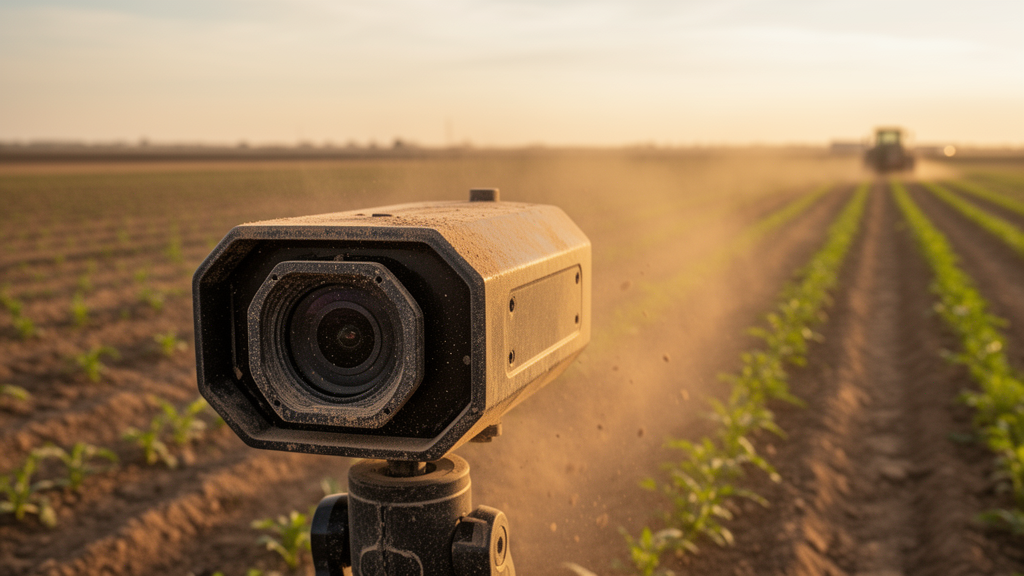
Dust kicked up by a plow or disk harrow is more than a nuisance for anyone following a tractor down a country road. For the cameras that will one day guide autonomous farm machinery, it is a direct threat to safety: a thick cloud of soil-borne dust can blind a vision system precisely when a person might be walking behind the implement. A research team in Bavaria, Germany, has now tackled the problem not with a new algorithm, but with something the field has been missing entirely: properly documented benchmark data and a rigorous comparison of the methods that already exist.
Their central finding is unexpectedly sobering: the methods that clean dust from images most convincingly are not necessarily the ones that make people easier to detect in those images. Prior-guided methods ranked worst on image quality metrics yet delivered the largest gains in person detection, while some unsupervised methods actually pushed detection performance below the level of the untreated, dusty images.
The first dataset, named DaN-Dust, was recorded with a camera mounted on the rear window of a Fendt Vario 516 tractor, pointing backward at the ground behind a disk harrow. The camera, a Lucid Vision TRI054S built around a Sony IMX490 sensor, is an automotive-grade device with a dynamic range of up to 120 decibels, chosen because the lighting contrast between bright daylight and dark nighttime scenes is extreme. Images were captured as raw, white-balanced, high-dynamic-range Bayer images at 2880 by 1860 pixels and two frames per second, with a fixed 2-millisecond exposure time. Nighttime recordings were made between 11 p.m. and midnight; daytime recordings in the early afternoon.
To generate dust, the driver made one fast pass along a track, varying speed up to roughly 4.17 meters per second, and then a second slow pass on the same track to capture nearly dust-free reference views. The 2023 harvest year complicated matters: weeks of rain after harvest meant the team had to wait until late August for the soil to dry enough to raise sufficient dust, and wind made completely dust-free images difficult to obtain. The resulting unpaired dataset contains 1,042 training image sets, each pairing a dusty image with a randomly chosen dust-free one, plus 105 dusty test images split between day and night. Daytime images came from three fields, but nighttime images were limited to a single field, a constraint the authors acknowledge.
The second dataset, RB-Dustv2, was designed to solve a problem the unpaired data cannot: providing a dust-free reference for the very same scene. A boom was mounted to the front of a tractor’s front loader with a camera attached, and a second tractor drove through this improvised half-sided gate to raise dust. Once the dust had settled, the dust-free reference image was recorded from the same viewpoint. Unlike the earlier RB-Dust dataset, which used an 8 mm lens pointed so that the sky was visible and left large parts of the image free of dust, the new version employed a 25 mm lens aimed toward the ground, producing a narrow field of view of 20 degrees by 15 degrees in which most of the image was obscured by dust of varying density. A Macbeth ColorChecker was placed next to the track as a color reference. In total, 60 image sets were recorded from four different camera positions, with 50 images from three positions reserved for training and 10 images from a fourth location held out for testing.
All recordings consisted of white-balanced, linear, 24-bit raw high-dynamic-range Bayer images that required substantial post-processing. The raw images were first debayered to reconstruct the red, green and blue channels while preserving their linear relationship to scene light intensity, then tone-mapped using the extended Reinhard operator and saved as 8-bit-per-channel RGB images. The key value and white point of the tone mapping were determined separately for daytime and nighttime recordings and kept constant within each lighting condition. Notably, the released datasets contain only the tone-mapped RGB images; the raw linear HDR Bayer recordings are not included.
With the data in hand, the authors benchmarked ten methods drawn from image dehazing, image translation, image restoration and image dedusting. Three prior-guided approaches — DCP, NLD and the spatially variant dust removal method the authors call SVDust — required no training. Two supervised methods, FFA-Net and FSNet, were trained on the paired RB-Dustv2 data. Five unsupervised methods — CUT, CycleGAN, UCL-Dehaze, UNSB and DedustGAN — were trained on the unpaired DaN-Dust data, with the generative approaches trained for 200 epochs and DedustGAN for 90. Because supervised and unsupervised methods could not share training data, all methods were evaluated on both test sets, and the authors caution that the training datasets differ considerably in size and scene diversity, which must be borne in mind when interpreting the results.
Evaluation relied on full-reference metrics for the paired data — PSNR, SSIM, LPIPS and VSI — and no-reference metrics for the unpaired data, namely NIQE, FADE, PIQE and IL-NIQE, calculated separately for day and night. On the paired RB-Dustv2 test set, DedustGAN, a method originally developed for removing sand dust using the Retinex model, was the clear leader, achieving the highest PSNR, SSIM and LPIPS and the second-highest VSI, for a mean rank of 1.250. CycleGAN came second. The prior-guided methods fell behind: DCP and NLD actually scored worse in PSNR than the untouched dusty input, which had a PSNR of 15.47 against the dust-free reference. An instructive discrepancy arose with FSNet, which produced visually clean, almost dust-free images yet scored low on PSNR and SSIM; the authors attribute this to the limited sensitivity of full-reference fidelity metrics to perceptual quality, noting that FSNet achieved the best VSI score of any method.
On the unpaired DaN-Dust test set, the picture shifted. CycleGAN achieved the best mean rank across the day and night no-reference metrics, with FSNet second, while DCP and SVDust shared the worst rank. DedustGAN outperformed every other method on NIQE and PIQE in daytime images and achieved the best PIQE score at night, but its FADE scores were comparatively weak. Averaging the two datasets equally, DedustGAN achieved the best overall dust removal rank at 3.125, followed by CycleGAN at 3.313 and FSNet at 4.188. Qualitatively, the methods failed in characteristic ways: CycleGAN generated artifacts resembling tilled soil in densely dusty areas and incorrectly rendered arable land as green grassland in nighttime images, DedustGAN produced increasingly blurry output as dust density rose, and UNSB yielded images that appeared dust-free but were practically unusable due to artifacts.
Runtime matters for deployment on the machine itself, and here the spread was wide. Measured at 960 by 620 pixels, CUT was the fastest at 41 milliseconds per image on a GPU, while UNSB required 626 milliseconds, which is slow for a GPU-based method. Among the prior-guided methods run on a laptop CPU, DCP needed only 89 milliseconds, SVDust 245, and NLD more than three seconds — slow enough, the authors note, to preclude on-machine use at the recorded frame rate. Several methods, the authors conclude, are fast enough to be combined with detection methods on the machine.
The most consequential experiment probed whether dust removal actually helps person detection, the safety-critical task that motivates the work. Two test drives were conducted: one in the same field where the dataset was recorded, using the disk harrow, and another on a different field with a rotary harrow on sandy soil, chosen because its dust distribution, coloring and background differ from the dataset. Five images per drive showed a person obscured by dust, labeled by a single annotator in COCO format, with heavily obscured parts labeled from previous frames. A pre-trained Faster R-CNN with a ResNet-50-FPN backbone was applied to the raw images and then to the dust-removed versions. The results upended expectations. All three prior-guided methods improved detection in both experiments: SVDust raised mean average precision by 13.48 percentage points in the first experiment and DCP by 9.32 and 10.17 percentage points across the two. DedustGAN improved detection by 1.27 and 4.72 percentage points. But CUT, CycleGAN and UNSB made detection worse in both experiments, and CycleGAN and UNSB were observed to partially or completely remove the person from the image during dust removal, making detection nearly impossible.
Comparing the aggregated ranks made the disconnect explicit: DCP and SVDust ranked best for person detection improvements at 2.0 while ranking among the worst for dust removal, whereas CycleGAN ranked second for dust removal but third-worst for detection. The authors emphasize that with only five labeled images per experiment, these differences should be interpreted cautiously, and they present the findings as preliminary evidence requiring further validation rather than a general conclusion.
The authors also acknowledge the limitations of their datasets. RB-Dustv2 is small and contains only arable field with no additional background, which may affect the generalizability of methods trained on it alone — the situation for both FSNet and FFA-Net — and they recommend that future work train on DaN-Dust and evaluate on RB-Dustv2. Nighttime images in DaN-Dust came from a single field. A recurring technical challenge is that soil-borne dust only partially obscures the image, and some methods struggle to preserve the clear regions without introducing noise. Looking forward, the authors suggest that future dust removal methods should employ a dust-specific mathematical formulation to improve both dust removal and person detection simultaneously, and that the intended objective — visual clarity, detection performance, or both — should guide the choice of method.
Subject of Research: Benchmark datasets and evaluation of soil-borne dust removal methods for agricultural camera imagery under day and night conditions
Article Title: Benchmark datasets for soil-borne dust removal in agricultural imagery under day and night conditions
Article References: Buckel, P., Dietmüller, T., & Oksanen, T. (2026). Benchmark datasets for soil-borne dust removal in agricultural imagery under day and night conditions. Smart Agricultural Technology, 15, Article 102659. https://doi.org/10.1016/j.atech.2026.102659
Image Credits: AI Generated
DOI: 10.1016/j.atech.2026.102659
Keywords: agricultural robotics, dust removal, computer vision, image dehazing, person detection, tractor imagery, benchmark dataset, machine learning, autonomous machinery, night vision, GAN, image quality metrics
Cite Scienmag News
Blake Davidson. (October 27, 2026). New Day-and-Night Dust Datasets Put Agricultural Image Cleaning to the Test. Scienmag. https://scienmag.com/new-day-and-night-dust-datasets-put-agricultural-image-cleaning-to-the-test/
Blake Davidson. "New Day-and-Night Dust Datasets Put Agricultural Image Cleaning to the Test." Scienmag, 27 October 2026, https://scienmag.com/new-day-and-night-dust-datasets-put-agricultural-image-cleaning-to-the-test/. Accessed 27 October 2026.
Blake Davidson. "New Day-and-Night Dust Datasets Put Agricultural Image Cleaning to the Test." Scienmag. October 27, 2026. https://scienmag.com/new-day-and-night-dust-datasets-put-agricultural-image-cleaning-to-the-test/


