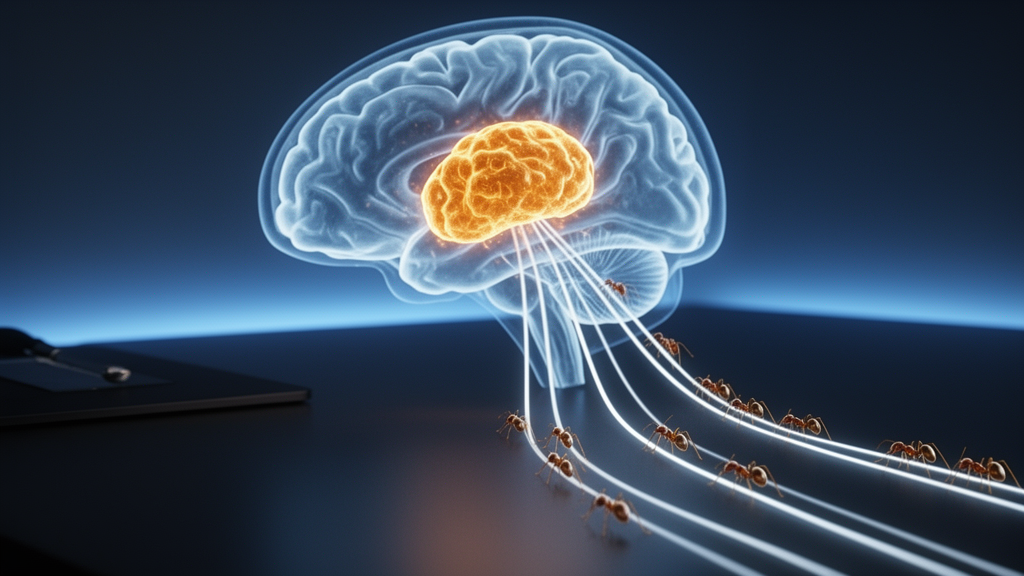
Researchers have combined ant colony optimization with a modified DeepLabV3+ segmentation network to delineate brain tumors on magnetic resonance imaging, reporting mean Dice scores above 0.96 across three benchmark MRI cohorts. The authors are careful to frame the work as retrospective computational evidence: the model was trained and evaluated on public benchmark datasets, and no external, multi-center, or prospective clinical validation has been performed.
The central problem the team set out to address is a familiar one in medical image analysis. Encoder–decoder architectures such as U-Net and DeepLabV3+ have pushed automated brain tumor segmentation to high accuracy, but their performance depends heavily on hyperparameters—learning rate, dropout, dilation rates of atrous convolutions, and the way high-level semantic features are blended with fine spatial detail. In most published systems these values are fixed by manual experimentation, which the authors argue contributes to non-reproducible behavior across datasets and institutions. Their answer is to let a metaheuristic search the configuration space rather than a human.
Ant Colony Optimization, inspired by the way real ants reinforce trails to food sources through pheromone deposits, builds candidate configurations probabilistically and then reinforces the parameter values that appear in the highest-scoring candidates. In this study the algorithm searched six interdependent variables simultaneously: learning rate, dropout rate, a dilation-rate index, the fusion weight of the new feature-fusion module, batch size, and filter count. Each candidate was evaluated through a short five-epoch training cycle scored on validation Dice and Jaccard values, with pheromone updates favoring the five elite candidates per iteration. After the search budget was exhausted, the best-scoring configuration—identified at iteration 274—was fixed for full-length training over 50 epochs, so the optimization adds no computational stage at inference time.
The architectural half of the contribution is the Residual Feature Fusion module. Standard DeepLabV3+ concatenates its Atrous Spatial Pyramid Pooling output, which carries long-range contextual information, with low-level features from the encoder that preserve edges and fine structure. The new module instead scales the upsampled ASPP features by a weight w and the low-level features by (1 − w), with w itself selected by the ant colony search, before concatenation and a 1×1 convolutional projection. The selected value of 0.5 gave equal scaling to both branches. The backbone is a ResNet50 encoder with pretrained weights frozen, and the decoder is deliberately shallow, using bilinear upsampling and a sigmoid output to produce binary tumor masks at 256×256 resolution.
Training used a combined binary cross-entropy and Dice loss to cope with the severe class imbalance between tumor and background, and an augmentation pipeline restricted to anatomically plausible transformations—horizontal flips, small rotations, brightness and contrast changes, Gaussian blur, elastic deformation, grid distortion, and random resized cropping—applied only to the training subset after subject-level data partitioning. That partitioning detail matters: all slices from the same patient were confined to a single fold, preventing the slice-level leakage that can inflate reported segmentation scores. The evaluation covered five metrics, including the Hausdorff Distance and Average Symmetric Surface Distance for boundary accuracy.
Under five-fold cross-validation, the model achieved mean Dice and Jaccard values of 0.9755 and 0.9528 on the FBTS dataset of contrast-enhanced T1 scans, 0.9708 and 0.9438 on BraTS 2021, and 0.9652 and 0.9345 averaged across the separately evaluated high-grade and low-grade glioma cohorts of BraTS 2018, with the whole-tumor target used for the BraTS data. Per-class results on FBTS were strongest for meningioma at a Dice of 0.9927 and lowest for pituitary tumors at 0.9651. The authors stress that the three datasets were processed, trained, and evaluated independently, so the results describe dataset-specific performance rather than cross-domain transfer by a single trained model.
The most controlled evidence comes from a same-protocol ablation study. Replacing a baseline U-Net with the DeepLabV3+–ResNet50 configuration raised the Dice score from 0.8268 to 0.9263, data augmentation lifted it further to 0.9409, and adding the fusion module without ant colony tuning reached 0.9609. Ant colony hyperparameter selection alone, without the fusion module, achieved 0.9458, while the complete framework reached 0.9724 on the FBTS test protocol. Freezing the pretrained encoder also outperformed fine-tuning it. Because these components interact, the authors caution against treating the gains as universally additive beyond the reported setting.
Statistical testing was narrower than the headline numbers might suggest. Paired t-tests over the five matched folds compared the ACO-tuned configuration without the fusion module against baseline U-Net and DeepLabV3+–ResNet50, yielding positive mean differences with p < 0.001, but the authors explicitly state these results cannot be attributed to the complete framework, and that cross-validation folds with overlapping training data are not fully independent replications. Comparisons with previously published methods are presented as literature-based context only, since dataset versions, splits, preprocessing, and metric definitions differ across studies.
The “lightweight” claim also comes with fine print. Relative to a standard DeepLabV3+–ResNet50 configuration, the framework trimmed total parameters from 14.04 million to 14.02 million, trainable parameters from 5.44 million to 5.43 million, and computational cost from 14.97 to 14.82 GFLOPs—reductions of roughly 0.13, 0.33, and 0.99 percent—while training time per epoch rose slightly on the NVIDIA A100 GPU used for all experiments. Against U-Net the picture reverses: the proposed model used more parameters, roughly twice the peak GPU memory, and slower inference. The authors conclude that U-Net remains preferable when memory and inference speed are the binding constraints, and that the efficiency measurements are hardware- and implementation-dependent rather than a universal runtime guarantee.
The limitations section is unusually candid. The study performs two-dimensional slice-level segmentation rather than volumetric modeling, focuses on binary whole-tumor masks without evaluating enhancing tumor, tumor core, or edema subregions, and includes no uncertainty estimation or calibration analysis. The ant colony search ran once within a predefined budget, without repeated runs across random seeds or comparison against alternative search strategies under equivalent compute. The authors say future work should address external patient-level and multi-center validation, three-dimensional architectures, subregion segmentation, domain-shift evaluation, and repeated optimization runs before any clinical translation is considered. Until then, the framework stands as a benchmark-dataset demonstration that a pheromone-guided search can systematically configure a segmentation network—and that the fusion of contextual and structural features, more than the optimization itself, drove the measured gains.
Subject of Research: Ant colony-optimized deep learning for brain tumor segmentation in MRI
Article Title: Ant colony-optimized lightweight DeepLabV3+ with residual feature fusion for multi-cohort brain tumor MRI segmentation
Article References: Saifullah, S., Dreżewski, R., & Yudhana, A. (2026). Ant colony-optimized lightweight DeepLabV3+ with residual feature fusion for multi-cohort brain tumor MRI segmentation. International Journal of Machine Learning and Cybernetics, 17(11), Article 512. https://doi.org/10.1007/s13042-026-03348-2
Image Credits: AI Generated
DOI: 10.1007/s13042-026-03348-2
Keywords: brain tumor segmentation, ant colony optimization, DeepLabV3+, medical image analysis, MRI, deep learning, hyperparameter optimization, feature fusion, BraTS, Dice similarity coefficient, residual networks, computational efficiency
Cite Scienmag News
Cassandra Pierce. (October 27, 2026). Ant colony algorithm tunes a leaner DeepLabV3+ to segment brain tumors across three MRI cohorts. Scienmag. https://scienmag.com/ant-colony-algorithm-tunes-a-leaner-deeplabv3-to-segment-brain-tumors-across-three-mri-cohorts/
Cassandra Pierce. "Ant colony algorithm tunes a leaner DeepLabV3+ to segment brain tumors across three MRI cohorts." Scienmag, 27 October 2026, https://scienmag.com/ant-colony-algorithm-tunes-a-leaner-deeplabv3-to-segment-brain-tumors-across-three-mri-cohorts/. Accessed 27 October 2026.
Cassandra Pierce. "Ant colony algorithm tunes a leaner DeepLabV3+ to segment brain tumors across three MRI cohorts." Scienmag. October 27, 2026. https://scienmag.com/ant-colony-algorithm-tunes-a-leaner-deeplabv3-to-segment-brain-tumors-across-three-mri-cohorts/