


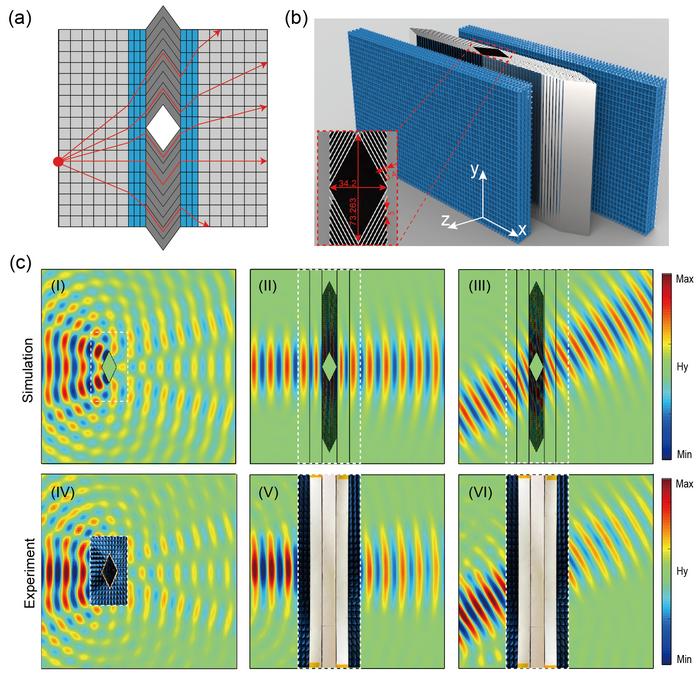
Recently, the team of Prof. Dexin Ye and Prof. Hongsheng Chen from Zhejiang University, and Prof. Yu Luo from Nanyang Technological University conducted research on the practical implementation of full-parameter transformation optical devices. Based on the linear transformation optics and the constitution theory of omnidirectionally matched transparent metamaterials, the research team designed and implemented a full-parameter omnidirectional invisibility cloak capable of concealing large-scale objects in the free space. This work has been published in National Science Review 2024, No. 3, entitled “Full-parameter omnidirectional transformation optical devices”, with Dr. Yuan Gao from Zhejiang University as the first author, Prof. Yu Luo, Prof. Hongsheng Chen and Prof. Dexin Ye as corresponding authors.

Credit: ©Science China Press
Recently, the team of Prof. Dexin Ye and Prof. Hongsheng Chen from Zhejiang University, and Prof. Yu Luo from Nanyang Technological University conducted research on the practical implementation of full-parameter transformation optical devices. Based on the linear transformation optics and the constitution theory of omnidirectionally matched transparent metamaterials, the research team designed and implemented a full-parameter omnidirectional invisibility cloak capable of concealing large-scale objects in the free space. This work has been published in National Science Review 2024, No. 3, entitled “Full-parameter omnidirectional transformation optical devices”, with Dr. Yuan Gao from Zhejiang University as the first author, Prof. Yu Luo, Prof. Hongsheng Chen and Prof. Dexin Ye as corresponding authors.
In 2006, Prof. Pendry from Imperial College London proposed the transformation optics, which describes the correspondence between the propagation path of electromagnetic (EM) waves and the constitutive parameters of materials, providing a universal and powerful method to control EM waves. The past decade has witnessed the rapid development of transformation optics, through which various novel optical devices such as invisibility cloaks, electromagnetic illusion devices and concentrators have been designed. However, the constitutive parameters of transformation optics media are anisotropic, and generally inhomogeneous or with singular values, making themselves difficult to be implemented. For example, the omnidirectional invisibility cloaks that have been experimentally implemented so far have always undergone some simplifications on the material parameters. The simplified designs sacrifice the impedance matching and thus deteriorate the performance of the transformation optical devices.
To address these issues, the research group designed a 2D full-parameter omnidirectional planar invisibility cloak composed of only two homogeneous materials based on the linear transformation optics. The constitutive parameters of the first material are anisotropic, with both zero and extreme values, and the EM waves propagating in the optical direction have an infinite phase velocity. This material is used to enable the EM wave to bypass a cloaking region with omnidirectional impedance matching and zero phase delay. The second material also possesses anisotropic constitutive parameters to achieve phase compensation with omnidirectional impedance matching, and the EM waves propagating in the optical direction have a subluminal phase velocity. In the experimental verification, researchers implemented these two materials with full-parameter constitutive parameters for the TM-polarized wave. The first one was realized using sub-wavelength metallic patch arrays with Fabry-Pérot resonance, while the second one was obtained with the structures composed of traditional I-shaped electric resonators and split-ring resonators. Finally, the researchers measured the magnetic fields around the full-parameter omnidirectional cloak composed of the previous two materials under the TM polarized wave incidence at different angles, demonstrating excellent invisibility performance.
This study demonstrated the first full-parameter omnidirectional invisibility cloak in free space, which can conceal a large-scale object for arbitrary incident illumination. The implemented cloak can be immediately used to suppress the scattering cross-section of the target in radar communication and bistatic detection. The approach presented in this work also has far-reaching implications on the practical implementations of other full-parameter transformation optical devices.
Journal
National Science Review
Cite Scienmag News
Grant Pearson. (April 19, 2024). Realization of an ideal omnidirectional cloak in free space. Scienmag. https://scienmag.com/realization-of-an-ideal-omnidirectional-cloak-in-free-space/
Grant Pearson. "Realization of an ideal omnidirectional cloak in free space." Scienmag, 19 April 2024, https://scienmag.com/realization-of-an-ideal-omnidirectional-cloak-in-free-space/. Accessed 4 September 2026.
Grant Pearson. "Realization of an ideal omnidirectional cloak in free space." Scienmag. April 19, 2024. https://scienmag.com/realization-of-an-ideal-omnidirectional-cloak-in-free-space/

