


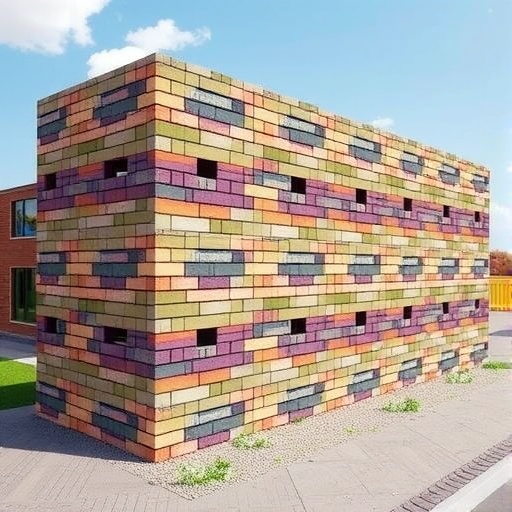
The construction industry stands at a pivotal junction, facing mounting pressure to curb resource depletion and greenhouse gas emissions. A significant contributor to environmental degradation is the vast amount of construction waste generated during building demolitions, especially for structures with fleeting lifespans ranging from ten to twenty years, such as consumer markets and temporary commercial buildings. Conventional construction methods bind materials like bricks with mortar, making them irretrievable once torn down and thereby amplifying material waste and carbon footprints. Addressing this challenge head-on, researchers at Graz University of Technology (TU Graz), in collaboration with leading Austrian brick manufacturer Wienerberger, have developed an unprecedented prefabricated brick wall system designed to be dismantled and reassembled multiple times without material degradation or loss of structural integrity.
At the heart of this groundbreaking innovation is the decoupling of the building material’s lifecycle from the building’s use phase. Unlike traditional masonry, which relies on permanent mortar joints, these industrially prefabricated brick wall elements are united through reversible joint solutions that facilitate non-destructive disassembly. This method ushers in a new paradigm for circular construction, where bricks maintain their value and functionality across multiple building lifecycles. Initial experimental results reveal a promising scenario: over three separate life cycles, CO₂ emissions can be reduced by a staggering 60 percent compared to conventional brick construction methodologies. Such an emission reduction is not merely incremental but transformative, signaling that reusability of high-quality building materials is a viable strategy in sustainable architecture.
The environmental rationale for reusing bricks is compelling. Brick production demands significant energy and resource input, making it one of the more resource-intensive building materials. By salvaging bricks intact post-demolition, the energy embedded within them is preserved, and the demand for new brick manufacturing diminishes drastically. This aspect is crucial as the construction sector currently accounts for one of the highest proportions of global carbon emissions. The life cycle assessment data affirm that significant emissions spikes occur during the initial phase of material production. Hence, extending brick utility via reusable wall systems circumvents repeated emissions tied to conventional mortar joint demolition and brick replacement.
Developing a reusable brick wall that maintains stringent structural standards posed formidable challenges. The system must adhere to tolerances maintaining dimensional accuracy, ensure load-bearing stability, provide airtightness, and guarantee sufficient thermal insulation—all without the rigidity of conventional mortar. Engineers solved these hurdles by optimizing wall thickness at 44 centimeters and integrating insulating wool within the bricks to meet modern thermal performance codes. Additionally, walls are prefabricated and pre-plastered within controlled factory environments to minimize onsite labor and installation errors. Two principal stabilizing techniques were innovated: either using a sufficiently heavy roof structure to provide downward compressive force or employing vertically aligned, pre-stressed threaded rods penetrating through the bricks. This dual approach ensures robustness under varying architectural configurations.
An essential breakthrough was the design of the reversible joint—a structural interface that combines the mechanical interlock and sealing requirements essential for building envelopes. Unlike traditional mortar, which irreversibly bonds brick units, these joints permit disassembly while maintaining load transfer capabilities. Micro-vibration analysis techniques, commonly referred to as modal analysis, were leveraged throughout the research to non-destructively monitor the structural health of these wall elements. By stimulating the prefabricated walls with vibrational energy, researchers established baseline natural frequencies corresponding to the healthy, undamaged state. Future frequency shifts indicate variations in structural integrity or load-bearing capacity, allowing predictive maintenance without intrusive inspection or invasive testing.
To validate their theoretical and laboratory work, the team constructed a full-scale demonstrator building composed entirely of these prefabricated brick walls. This prototype underwent assembly, dismantling, transportation, and reassembly at a new location, demonstrating extraordinary resilience and functional equivalence throughout the process. Remarkably, the building retained all architectural and structural characteristics after repeated use, confirming the robustness of the reversible joint and the overall construction system under practical conditions. This success not only substantiates the technical soundness but also points toward promising market applications where building reuse is economically advantageous and environmentally imperative.
The pioneering project further highlights a critical yet unaddressed issue in conventional construction—residual building value. Standard practice results in buildings becoming liabilities at the end of their service lives, generating costly demolition waste and demanding fresh resources. With reusable brick wall systems, buildings gain residual value as disassembled elements can be reconfigured or repurposed without loss of integrity. This value retention empowers property owners by enhancing asset longevity and offers an environmentally conscious approach, aligning with global sustainability targets.
Behind this innovation lies interdisciplinary collaboration among TU Graz’s Institutes of Building Physics, Services and Construction, Structural Design, and Structural Engineering, combined with Wienerberger’s manufacturing expertise. This synergy has enabled a holistic approach encompassing material science, structural mechanics, thermal dynamics, and practical assembly techniques. The Austrian Research Promotion Agency FFG supported the project financially, underscoring the growing institutional commitment to sustainable construction technologies.
The project’s implications extend well beyond bricks and buildings. It exemplifies how industrialized prefabrication married to smart engineering can create circular material flows in sectors historically dominated by linear, wasteful practices. As urbanization continues globally, and building stock expands rapidly, the relevance of reusable structural components cannot be overstated. The technical successes established here pave the way for further innovation; for example, integrating smart sensors for real-time structural health monitoring, optimizing joint designs for faster assembly, or even scaling to other building components beyond walls.
From a policy perspective, introducing circular construction techniques necessitates new building codes and standards recognizing reversible joints and reused materials. Market acceptance will hinge on demonstrating lifecycle cost savings alongside ecological benefits. Educational initiatives aimed at architects, engineers, and construction workers will be vital in proliferating these methods. Importantly, the research sets a precedent for incentivizing deconstruction over demolition, shifting industry mindsets toward preservation and reuse.
Looking ahead, the durability of these prefabricated brick wall elements over prolonged timeframes remains a focus. The application of modal analysis as a monitoring tool is foundational here, allowing stakeholders to ascertain when components require intervention, refurbishment, or final recycling. This predictive capacity enhances safety while optimizing material usage, shaping a proactive approach to building maintenance.
In conclusion, the TU Graz and Wienerberger collaboration has delivered not merely a new construction product but a transformative concept aligning architecture with circular economy principles. Reusable prefabricated brick walls embody a pragmatic convergence of engineering innovation and environmental responsibility capable of reshaping the construction landscape. As this technology matures and expands its reach, the potential for significantly lowering the sector’s carbon footprint and resource demand is immense. The future might well see a construction industry where bricks themselves narrate stories of buildings past, revived anew without waste and with minimal ecological cost.
News Publication Date: 12-Aug-2026
Keywords
Circular construction, reusable brick walls, prefabrication, reversible joints, building lifecycle, CO2 reduction, sustainable architecture, construction waste, structural health monitoring, modal analysis, building physics, industrialized construction
Cite Scienmag News
Denise Maddox. (May 21, 2026). Innovative Reusable Brick Walls Revolutionize Construction Industry. Scienmag. https://scienmag.com/innovative-reusable-brick-walls-revolutionize-construction-industry/
Denise Maddox. "Innovative Reusable Brick Walls Revolutionize Construction Industry." Scienmag, 21 May 2026, https://scienmag.com/innovative-reusable-brick-walls-revolutionize-construction-industry/. Accessed 3 September 2026.
Denise Maddox. "Innovative Reusable Brick Walls Revolutionize Construction Industry." Scienmag. May 21, 2026. https://scienmag.com/innovative-reusable-brick-walls-revolutionize-construction-industry/


