


A groundbreaking study led by Curtin University has unveiled an astonishing level of marine biodiversity concealed within the deep submarine canyons along Western Australia’s Nyinggulu (Ningaloo) coast. This extensive research expedition, spearheaded by the Western Australian Museum and deployed aboard the Schmidt Ocean Institute’s research vessel R/V Falkor, ventured into the enigmatic depths of the Cape Range and Cloates Canyons, located roughly 1200 kilometers north of Perth. The team collected over a thousand biological samples from astonishing depths reaching as far down as 4510 meters, shedding light on species previously unseen or entirely unknown to science in this region.
Employing the innovative technique of environmental DNA (eDNA) analysis, the researchers captured fragments of genetic material naturally excreted or shed by marine organisms into seawater, enabling them to detect a plethora of species without the need to physically observe or capture individual animals. This non-invasive, cutting-edge molecular method allows for a comprehensive survey of biodiversity that surpasses the limitations typical of traditional deep-sea exploration techniques like trawls or cameras, which often fail to record elusive or delicate species.
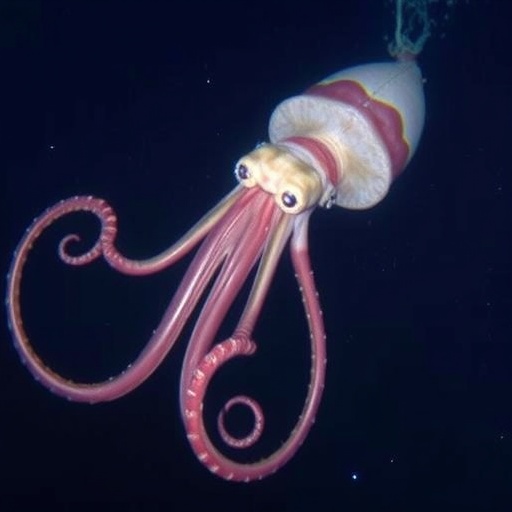
One of the most captivating discoveries revealed by the eDNA samples was the presence of the giant squid (Architeuthis dux) within both the Cape Range and Cloates Canyons, identified across six individual samples. The giant squid, known for its remarkable size that can exceed the length of a city bus, ranges between 10 and 13 meters in length, and weighing anywhere from 150 to 275 kilograms. Notably, this creature possesses the largest eyes known in the animal kingdom, measuring up to 30 centimeters, roughly the diameter of a large pizza, adaptations that assist in the abyssal darkness of its deep-sea habitat.
Beyond this iconic cephalopod, the team detected genetic traces of deep-diving marine mammals such as the pygmy sperm whale (Kogia breviceps) and Cuvier’s beaked whale (Ziphius cavirostris), species that frequent the profound underwater ecosystems and evoke significant interest in marine biology due to their elusive nature and poorly understood behaviors. The ability to confirm their presence through eDNA signals an important advance in monitoring these cryptic species non-invasively.
Over the course of the study, a remarkable total of 226 species spanning 11 major animal groups were documented. These groups encompassed rare deep-sea fish species, cnidarians like corals and jellyfish, echinoderms including starfish and sea urchins, various squids, and other marine mammals. The richness of the biological assemblages detected underscores the complex ecological networks sustained within these abyssal canyons.
Among the species identified, dozens had never before been recorded in waters off Western Australia. This includes remarkable finds such as the sleeper shark (Somniosus sp.), faceless cusk eel (Typhlonus nasus), and the slender snaggletooth fish (Rhadinesthes decimus). These discoveries hint at a rich, uncharted biodiversity that challenges the existing understanding of species distribution within the eastern Indian Ocean and emphasizes the unrecognized ecological importance of these deep-sea habitats.
Dr. Georgia Nester, the lead author and an emerging marine molecular ecologist from Curtin University, currently affiliated with the Minderoo OceanOmics Centre at The University of Western Australia, highlighted the profound gap in knowledge regarding Australia’s deep-sea environments. She emphasized that while sightings of extraordinary creatures like the giant squid grab public attention, they merely represent the tip of a vast and intricate ecosystem awaiting scientific exploration.
“The vast array of species we discovered that don’t neatly align with any known records doesn’t imply they are all new to science, but it strongly indicates that the biodiversity of these deep waters remains largely undocumented,” Dr. Nester noted. This revelation pushes the frontiers of marine biology by underscoring the potential for many undiscovered taxa lurking within deep-sea ecosystems.
In a testament to the rarity of such findings, Dr. Lisa Kirkendale, Head of Aquatic Zoology at the Western Australian Museum and Curator of Molluscs, pointed out that prior records of giant squid off Western Australia are scarce, with no physical specimens or verified sightings logged for over 25 years. The detection of Architeuthis dux via eDNA marks the first recorded evidence of this species off the Western Australian coast using molecular techniques and extends its known range to the northernmost parts of the eastern Indian Ocean.
Sampling covered a vast vertical profile, collecting water from the surface down to depths exceeding four kilometers. This eDNA analysis was complemented by the deployment of the remotely operated vehicle SuBastian, which collected physical specimens for taxonomic identification. These specimens now reside in the Western Australian Museum’s Collection and Research Facility, serving as invaluable genetic reference material to enrich the accuracy of environmental DNA analyses.
Dr. Kirkendale affirmed the importance of combining specimen-based taxonomy with molecular methods, noting, “The local curated genetic reference library developed from identified specimens was crucial for strengthening the confidence and resolution of our eDNA findings.” This approach effectively bridges traditional taxonomic expertise with state-of-the-art molecular tools, resulting in a more robust understanding of ecosystem structure.
The utility of eDNA in capturing biodiversity signatures is particularly notable in such remote and extreme environments. Dr. Nester underscored that this technology is adept at detecting species that are fragile, rare, or highly mobile—organisms that traditional cameras and nets often fail to observe. The ability to extract comprehensive ecological data from mere water samples highlights a transformative shift in marine biodiversity assessments.
“With a single water sample, we can identify hundreds of species coexisting in these intricate habitats,” remarked Dr. Nester. The data revealed not only a rich diversity but also distinct biological communities stratified by depth, even between adjacent submarine canyons. Such depth-stratified biodiversity patterns reveal the ecological complexity and potential vulnerability of these ecosystems to environmental changes.
Associate Professor Zoe Richards, senior author from Curtin University’s School of Molecular and Life Sciences, emphasized the pressing need to explore and protect deep-sea habitats in light of increasing anthropogenic impacts. “Deep-sea ecosystems are expansive, remote, and costly to study, yet they face unprecedented threats from climate change, commercial fishing, and resource extraction,” she explained. eDNA offers a scalable, non-invasive means to establish baseline biodiversity data essential for effective conservation strategies.
“You simply cannot manage or conserve ecosystems you do not understand,” Associate Professor Richards stressed. The volume and ecological significance of the discoveries made in this study—including the presence of large, charismatic megafauna—make clear that significant knowledge gaps persist in our understanding of the Indian Ocean’s deep-sea realms.
Dr. Nester further highlighted that enhanced knowledge of deep-sea biodiversity is critical for guiding marine park zoning, assessing environmental impacts, and monitoring ecological changes over time. “The synergistic use of eDNA alongside classical deep-sea survey techniques allows us to construct a more complete and nuanced picture of species distribution and ecological dynamics,” she said.
This integrative methodology provides invaluable data for marine spatial planning and resource management by revealing species assemblages and community structures across depth gradients. With threats escalating and exploration capabilities expanding, the study sets a precedent for how emerging molecular tools can illuminate the hidden diversity of the ocean’s depths and inform sustainable stewardship.
The marine expedition received support from multiple stakeholders, including the Schmidt Ocean Institute and the Western Australian Museum, and encompassed collaboration among researchers from Curtin University, University of Western Australia, Minderoo OceanOmics Centre at UWA, University of Tasmania, and Research Connect Blue. Their combined expertise leveraged innovative technology and traditional scientific rigor to paint a vibrant portrait of life within these remote submarine canyons.
This pioneering research, titled “Environmental DNA Reveals Diverse and Depth-Stratified Biodiversity in East Indian Ocean Submarine Canyons,” appeared in the esteemed journal Environmental DNA, offering a crucial contribution to marine science and highlighting the untapped exploration potential of the deep ocean.
News Publication Date: 7-Mar-2026
Web References: DOI 10.1002/edn3.70261
Cite Scienmag News
Violet Maxwell. (May 5, 2026). Rare and Elusive Giant Squid Spotted Off the Coast of Western Australia. Scienmag. https://scienmag.com/rare-and-elusive-giant-squid-spotted-off-the-coast-of-western-australia/
Violet Maxwell. "Rare and Elusive Giant Squid Spotted Off the Coast of Western Australia." Scienmag, 5 May 2026, https://scienmag.com/rare-and-elusive-giant-squid-spotted-off-the-coast-of-western-australia/. Accessed 4 September 2026.
Violet Maxwell. "Rare and Elusive Giant Squid Spotted Off the Coast of Western Australia." Scienmag. May 5, 2026. https://scienmag.com/rare-and-elusive-giant-squid-spotted-off-the-coast-of-western-australia/


