


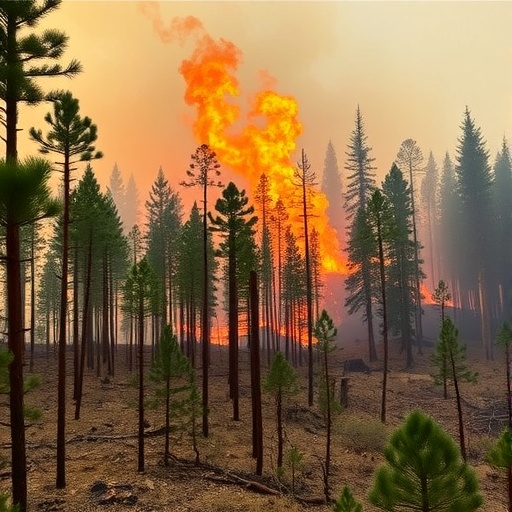
Wildfires moving at extreme speed may be doing more than expanding the burned area across western North America: they may be pushing forests past a biological tipping point. A new study published in Science Advances finds that the fastest-spreading fires are also disproportionately severe, killing nearly all trees across larger portions of the landscape and leaving fewer living trees close enough to reseed the burned ground. Without those seed sources, conifer forests that once regenerated naturally may fail to return. Instead, they could transition over time into shrublands, grasslands or other vegetation communities better suited to a warmer and drier climate.
The research examined nearly 3,500 wildfires that burned conifer-dominated forests across western and boreal North America between 2012 and 2023. Rather than treating each fire as a single event defined mainly by its final size, the scientists analyzed more than 33,000 individual daily spread events. This allowed them to connect the rate at which flames advanced with the ecological damage left behind. Their central finding was clear: fire speed was not simply a measure of how quickly a fire consumed land. It was also a predictor of how completely forests were destroyed and how difficult recovery would become.
“People often focus on the size of a wildfire because that’s what makes headlines,” said lead author Jonathan Coop, a professor at Western Colorado University. “But how fires burn is as important as how much they burn. In forests, fire speed not only increases acres burned but also leads to outsized impacts to each of those acres.” The distinction is important because two fires can burn the same number of hectares while producing very different ecological outcomes. A slower fire may leave patches of surviving trees, whereas a rapidly advancing fire can generate intense heat and flames that kill trees across nearly continuous expanses.
The researchers measured fire spread against indicators of post-fire forest survival, including the proportion of an area experiencing near-total tree mortality and the distance to surviving trees capable of producing seeds. Many conifer species in western North America depend heavily on nearby mature trees for natural regeneration. Their seeds generally do not travel vast distances, meaning that the presence of living trees around a burn can determine whether seedlings appear in the following years or decades. When high-severity fire removes those trees across broad areas, the landscape can become functionally isolated from its nearest seed sources.
This mechanism helps explain why rapid wildfires may leave a legacy that extends far beyond the flames themselves. In a severely burned stand, the loss of mature trees eliminates not only the current forest canopy but also the reproductive infrastructure needed to rebuild it. Seedlings must then establish under increasingly difficult conditions, including hotter soils, lower moisture availability, intense sunlight and competition from grasses or shrubs. If drought persists, young trees may die before reaching maturity. Repeated fires arriving before a new forest develops can further prevent conifers from re-establishing, locking the ecosystem into a different state.
“When severe fires leave large expanses without seed trees, the forest has a harder time recovering and, in some places, may not recover as a forest at all,” said Camille Stevens-Rumann, director of the Colorado Forest Restoration Institute and a professor at Colorado State University. The study’s findings suggest that this risk is not distributed evenly across burned landscapes. It rises as fires move faster, because rapid spread is commonly associated with extreme weather conditions such as low humidity, high winds, dry vegetation and prolonged drought. These conditions can drive flames through forest fuels with exceptional intensity and reduce the time available for suppression efforts.
The study builds on earlier work showing that a relatively small number of extreme fire-spread events account for a disproportionate share of the land burned in western North America. Climate change is increasing the likelihood of the hot, dry and windy conditions that support those events. The new analysis adds an ecological dimension to that trend: the most extreme spread days may also be responsible for a disproportionate share of the forest-conversion risk. In other words, climate-driven fire behavior could alter not only the amount of forest lost in a given year but also the type of ecosystem that occupies the landscape afterward.
The potential transformation is especially significant because forests store carbon, regulate water, provide wildlife habitat and support communities through recreation and natural-resource economies. A shift from conifer forest to open shrubland or grassland can change snow accumulation, streamflow, soil stability and the timing of water delivery to downstream ecosystems. It can also affect species that depend on forest structure, from cavity-nesting birds to mammals requiring continuous canopy cover. Although some post-fire transitions can increase biodiversity or create valuable habitat, a rapid, widespread loss of forests may reduce ecological resilience when it is driven by repeated extreme events rather than by the normal range of fire variability.
The researchers point to forest management and restoration as possible tools for reducing the risk, while emphasizing that no intervention can eliminate the influence of a rapidly warming climate. Thinning dense stands, using prescribed fire and allowing wildfires to burn under non-extreme conditions can reduce the amount and continuity of combustible material in some forests. These approaches may slow fire growth or lower intensity, potentially preserving the living trees that provide seeds. After a fire, managers may also need to identify areas where natural regeneration is unlikely and consider targeted restoration, including the planting of locally appropriate tree species. Such actions are complicated by uncertainty over which species will remain suited to future climates.
“Wildfire has always been part of western forests,” Coop said. “What’s changing is the pace and impacts of fires. As extreme events become more common in a hotter, drier climate, we can’t count on forests to persist or grow back the way they have in the past.” The researchers argue that the speed of a fire should therefore become a central measure in assessing wildfire risk. A fast-moving blaze is not merely a larger version of a slower one; it can create a fundamentally different pattern of mortality, seed limitation and ecosystem recovery. As the American West and Canada confront increasingly extreme fire seasons, the study suggests that the most consequential question may not be how many acres burned, but whether the forest still has the biological capacity to return.
Web References: https://www.science.org/doi/10.1126/sciadv.aeg5802
References: Science Advances, DOI: 10.1126/sciadv.aeg5802; research supported by the U.S. National Science Foundation, Southwest Climate Adaptation Science Center and Western Wildland Environmental Threat Assessment Center.
Cite Scienmag News
Alan Morgan. (August 12, 2026). Rapid wildfires reduce forests’ ability to recover, study finds. Scienmag. https://scienmag.com/rapid-wildfires-reduce-forests-ability-to-recover-study-finds/
Alan Morgan. "Rapid wildfires reduce forests’ ability to recover, study finds." Scienmag, 12 August 2026, https://scienmag.com/rapid-wildfires-reduce-forests-ability-to-recover-study-finds/. Accessed 3 September 2026.
Alan Morgan. "Rapid wildfires reduce forests’ ability to recover, study finds." Scienmag. August 12, 2026. https://scienmag.com/rapid-wildfires-reduce-forests-ability-to-recover-study-finds/


