


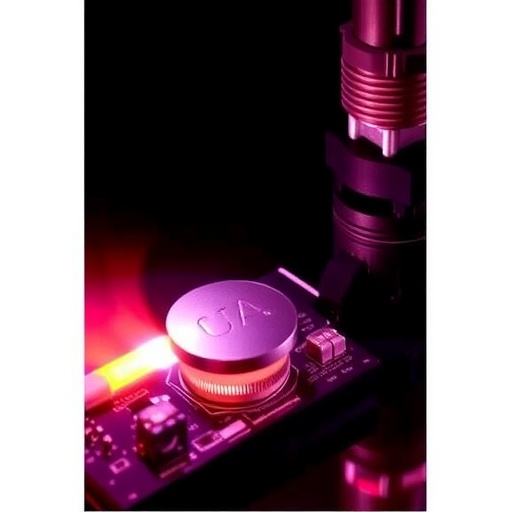
In a remarkable advancement poised to redefine the rare earth element (REE) recycling landscape, a collaborative team of researchers led by James Tour and Shichen Xu at Rice University has unveiled a groundbreaking technique that enables the ultrafast extraction of REEs from discarded magnets. Published in the prestigious Proceedings of the National Academy of Sciences on September 29, 2025, this pioneering method offers a sustainable, economically viable, and environmentally benign alternative to traditional recycling processes that have long been hampered by inefficiencies and hazardous waste byproducts.
Rare earth elements, critical components in diverse high-tech applications ranging from renewable energy technologies to consumer electronics, face growing scrutiny due to supply vulnerabilities and ecological concerns. Conventional recycling strategies, primarily reliant on hydrometallurgical or pyrometallurgical methods, are often energy-intensive and involve corrosive chemicals, generating toxic residues that burden waste streams and ecosystems. The urgency of securing a resilient, circular supply of these strategic materials has accelerated the search for innovative techniques that can circumvent these challenges.
At the core of this novel approach lies Flash Joule Heating (FJH), a cutting-edge technique characterized by an extraordinary surge in temperature—thousands of degrees Celsius—achieved within mere milliseconds. Coupled with an atmosphere enriched with chlorine gas, the process exploits fundamental thermodynamic principles to facilitate selective separation of REEs from complex magnet waste matrices. By harnessing precise control over reaction environments and temperature profiles, FJH orchestrates the rapid chlorination and vaporization of non-REE metals such as iron and cobalt, leaving behind a concentrated oxide residue comprising the valuable rare earth fractions.
This strategy leverages differences in Gibbs free energy and boiling points among constituent elements to achieve unparalleled selectivity and efficiency. Under the influence of reactive chlorine species and ultra-rapid thermal ramping, transition metals engage in volatilization through chloride formation, effectively purging them from the solid waste phase. Consequently, the residual material exhibits a significantly enriched concentration of REEs, such as neodymium and samarium, enhancing recovery yields and purity while simultaneously minimizing secondary waste generation.
Practical trials utilizing neodymium-iron-boron and samarium-cobalt magnet scrap have demonstrated the method’s proficiency in achieving over 90% purity and recovery yield in a single, continuous step. The instantaneous nature of the process, operating on a timescale measured in seconds, starkly contrasts with conventional methodologies that often require protracted, multi-stage chemical treatments. Such operational speed not only curtails energy consumption dramatically but also streamlines processing throughput, underscoring the technique’s industrial scalability.
Complementing laboratory experiments, extensive life cycle assessments (LCA) and techno-economic analyses (TEA) have been conducted to quantify environmental and economic advantages. These evaluations revealed transformative reductions across multiple metrics — an 87% decrease in energy utilization, an 84% diminution in greenhouse gas emissions, and a 54% cut in overall operating costs compared to hydrometallurgical systems. Crucially, the process eliminates the need for water or acid inputs, rendering it exceptionally clean and congruent with stringent environmental regulations.
The implications of this technology extend beyond mere laboratory success. Its modular design allows for the fabrication of compact, user-friendly recycling units deployable close to electronic waste accumulation points. This decentralization has the potential to revolutionize supply chains by reducing transportation-related emissions and costs, facilitating localized circular economies, and fostering sustainable resource stewardship within communities and industries.
James Tour emphasized the strategic significance of this innovation, highlighting its alignment with national priorities for securing critical material supply chains. “We have demonstrated that rapid recovery of rare earth elements from electronic waste is achievable with minimal environmental impact,” he stated. “Our method represents a vital leap forward towards circularity and resilience in the materials economy.”
First author and Rice postdoctoral associate Shichen Xu elaborated on the thermodynamic foundation underpinning the method, asserting that the interplay of Gibbs free energy and element volatility is key to the process’s selectivity and cleanliness. “Unlike traditional recycling routes dependent on water or acids, our technique circumvents these requirements, shattering prior assumptions about what is feasible in rare earth recovery,” Xu explained.
This breakthrough has attracted commercial interest, culminating in the licensing of the intellectual property to Flash Metals USA, a Texas-based startup poised to commence production by early 2026. The transition from laboratory innovation to industrial application heralds a new era in responsible material management and electronic waste valorization.
The research, supported by the Defense Advanced Research Projects Agency, the Air Force Office of Scientific Research, and the U.S. Army Corps of Engineers, represents a seminal collaboration among scholars including Justin Sharp, Bing Deng, Qiming Liu, Lucas Eddy, Weiqiang Chen, Jaeho Shin, Shihui Chen, Haoxin Ye, Khalil JeBailey, Bowen Li, Tengda Si, and Kai Gong, who collectively contributed to this milestone publication.
As global demand for rare earth elements intensifies, innovations such as ultrafast flash Joule heating redefine the economics and sustainability of resource recovery. By integrating fundamental physical chemistry principles with engineering ingenuity, this approach not only mitigates environmental degradation but also fortifies supply resilience—an indispensable achievement for the advancing technological age.
News Publication Date: 29-Sep-2025
Web References:
– https://www.pnas.org/doi/10.1073/pnas.2507819122
Cite Scienmag News
Courtney Benton. (September 29, 2025). Rapid Flash Joule Heating Enables Efficient Recovery of Rare-Earth Elements from Electronic Waste. Scienmag. https://scienmag.com/rapid-flash-joule-heating-enables-efficient-recovery-of-rare-earth-elements-from-electronic-waste/
Courtney Benton. "Rapid Flash Joule Heating Enables Efficient Recovery of Rare-Earth Elements from Electronic Waste." Scienmag, 29 September 2025, https://scienmag.com/rapid-flash-joule-heating-enables-efficient-recovery-of-rare-earth-elements-from-electronic-waste/. Accessed 3 September 2026.
Courtney Benton. "Rapid Flash Joule Heating Enables Efficient Recovery of Rare-Earth Elements from Electronic Waste." Scienmag. September 29, 2025. https://scienmag.com/rapid-flash-joule-heating-enables-efficient-recovery-of-rare-earth-elements-from-electronic-waste/


