


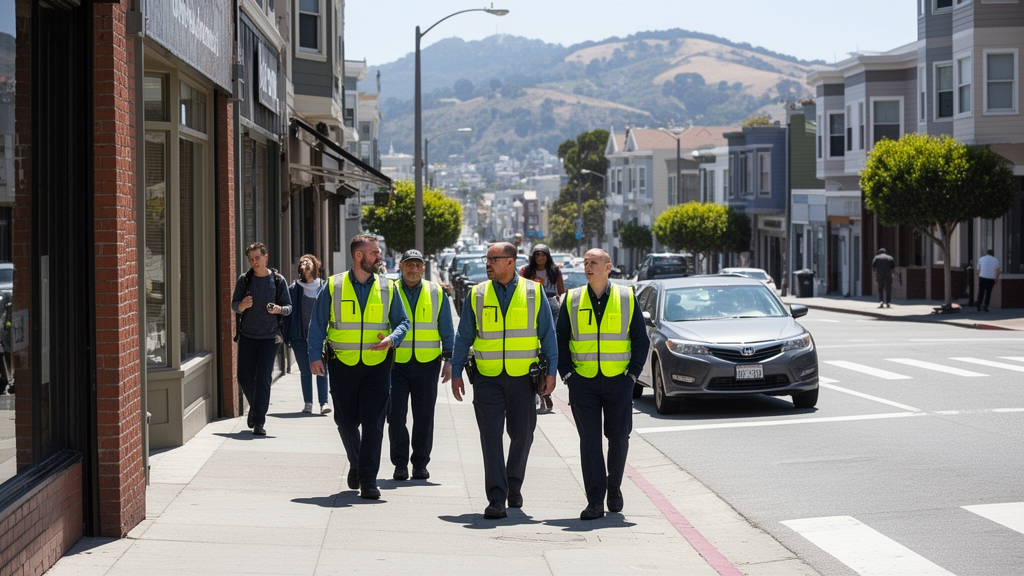
A quasi-experimental evaluation found that San Francisco neighborhoods patrolled by non-police public safety practitioners had significantly fewer behavioral health-related incidents and lower total crime than comparable periods and locations without practitioners. The study examined the Tenderloin, Mid-Market and South of Market neighborhoods, where the Urban Alchemy program deploys civilian community guardians to defuse tensions, assist people in behavioral health crises and help prevent situations from escalating into calls for police.
Urban Alchemy practitioners are unarmed civilians with experience of poverty, homelessness, substance use and the criminal legal system. Their work focuses on informal de-escalation, early intervention and referrals to services. The program seeks to provide a consistent community presence in areas affected by urban disorder, with the stated goal of intervening before circumstances escalate far enough to require a police response.
Researchers compared crime before and after Urban Alchemy began and compared crime during and after practitioners’ work hours, controlling for time-of-day effects. They also compared intersections where practitioners were posted with intersections where they were absent. Across these analyses, neighborhoods with practitioners showed significantly lower levels of behavioral health-related and total crime than neighborhoods without them. The authors characterized the reduction in behavioral health-related incidents as strong and consistent, while reductions in drug crime were modest.
Effects varied by offense category. The evaluation found a slight reduction in violent crime in areas with practitioners and no change in property crime. Because this was a quasi-experimental evaluation rather than a randomized trial, the findings link practitioner presence with reduced crime but do not establish a precise causal effect size. The study also focused on three San Francisco neighborhoods, and the results did not show uniform reductions across all categories of crime.
The authors interpret the findings as evidence that civilianized safety interventions can reduce crime and disorder in some urban settings. They attribute the program’s approach to consistent relationships with residents and referrals to services, which are intended to address the conditions associated with disorder before escalation. Within the scope of the evaluation, the strongest measured results concerned behavioral health-related incidents, with smaller changes in drug and violent crime and no measured change in property crime.
Subject of Research: Evaluation of civilian public safety practitioners and crime in three San Francisco neighborhoods
Article Title: Non-police safety practitioners reduce crime
Article References: Non-police safety practitioners reduce crime. Original publication (Bibliographic details unavailable.)
Image Credits: AI Generated
DOI: Not provided
Keywords: Urban Alchemy, San Francisco, public safety, crime reduction, behavioral health, community guardianship, de-escalation, service referrals, quasi-experimental study, Non-police, safety, practitioners
Cite Scienmag News
Courtney Benton. (October 25, 2026). Quasiexperimental study links civilian safety practitioners to less San Francisco crime. Scienmag. https://scienmag.com/quasiexperimental-study-links-civilian-safety-practitioners-to-less-san-francisco-crime/
Courtney Benton. "Quasiexperimental study links civilian safety practitioners to less San Francisco crime." Scienmag, 25 October 2026, https://scienmag.com/quasiexperimental-study-links-civilian-safety-practitioners-to-less-san-francisco-crime/. Accessed 25 October 2026.
Courtney Benton. "Quasiexperimental study links civilian safety practitioners to less San Francisco crime." Scienmag. October 25, 2026. https://scienmag.com/quasiexperimental-study-links-civilian-safety-practitioners-to-less-san-francisco-crime/


