

Sunday, November 15, 2026
Science
No Result
View All Result
  • Login
  • HOME
  • SCIENCE NEWS
  • CONTACT US
  • HOME
  • SCIENCE NEWS
  • CONTACT US
No Result
View All Result
Scienmag
No Result
View All Result
Home Science News Social Science

Study maps three paths for localising foreign architecture in Jiangnan

October 25, 2026
in Social Science
Courtney Benton
By Courtney Benton Scienmag Editorial Profile - Science and Technology Policy
Reading Time: 3 mins read
0
Study maps three paths for localising foreign architecture in Jiangnan

Study maps three paths for localising foreign architecture in Jiangnan

65
SHARES
587
VIEWS
Share on FacebookShare on Twitter
ADVERTISEMENT

A mixed-method study of 83 foreign public buildings in modern Jiangnan, China, identifies three pathways for architectural localisation: cultural integration, precise adjustment, and flexibility and variability. The analysis focused on Jiangsu Province and Shanghai between 1840 and 1949, a period marked by the proliferation of foreign-influenced architecture. The authors describe the resulting eclectic building forms as a postcolonial paradox, in which Western colonial influence and indigenous cultural subjectivity became increasingly difficult to separate.

To investigate how foreign architecture was adapted, the researchers combined three analytical components. First, they reviewed 179 representative publications from the preceding two decades, identifying nine architectural elements that constitute building form. Second, they used an entropy weight method on the sample of 83 foreign public buildings to determine the weights and variability of those elements. Third, they selected typical buildings for case study analysis, using the cases to interpret the three measured localisation paths and the selection logic behind them. The mixed-method design was intended to connect the broader quantitative pattern with interpretation of individual buildings and to offer a replicable framework for comparable research in other regions.

The study classified four features as a stable form of localisation with high weight and low entropy: the building’s main material structure, plan shape contour, plan spatial form, and building roof material structure. The authors associate this pattern with cultural integration. In the study’s analytical terms, these elements occupy a stable position within the sampled architectural system. The findings do not provide a causal account of why each feature received a particular weight or entropy value, but they do show that the four elements differed from the façade and proportional features classified into the other pathways.

A second path, described as precise adjustment, was associated with the façade shape contour. This element was characterised by medium weight and medium entropy, placing it in an intermediate category between the stable and differentiated features. The case study analysis was used to verify this pathway and elaborate its underlying selection logic. Because the supplied findings do not report the names or detailed characteristics of the case-study buildings, the broader pattern cannot be linked here to a specific structure or site.

The third path, characterised as flexibility and variability, was associated with plan proportion, façade proportion, the material structure of doors and windows, and façade decorative pattern. These four elements had low weight and high entropy in the analysis, distinguishing them from the façade shape contour and the four elements assigned to cultural integration. The results therefore present localisation as a differentiated process at the level of individual architectural components: four elements formed the stable category, one occupied the precise-adjustment category, and four were assigned to the more variable category. The study’s scope is the analysed corpus of 83 foreign public buildings in the Jiangnan region during 1840–1949; the reported findings do not establish that all foreign buildings in the region followed the same patterns. By combining literature analysis, entropy weighting, and case studies, the authors offer a structured way to examine how imported building types were localised within a postcolonial architectural context.

Subject of Research: Mixed-method analysis of three architectural localisation pathways in 83 foreign public buildings across modern Jiangnan, China.

Article Title: Autonomous paths for the localisation of foreign public buildings in the modern Jiangnan region, China, based on a mixed method

Article References: Wang, X., Liu, C., Yang, Z., & Guo, W. (2026). Autonomous paths for the localisation of foreign public buildings in the modern Jiangnan region, China, based on a mixed method. Humanities and Social Sciences Communications. https://doi.org/10.1057/s41599-026-09467-z

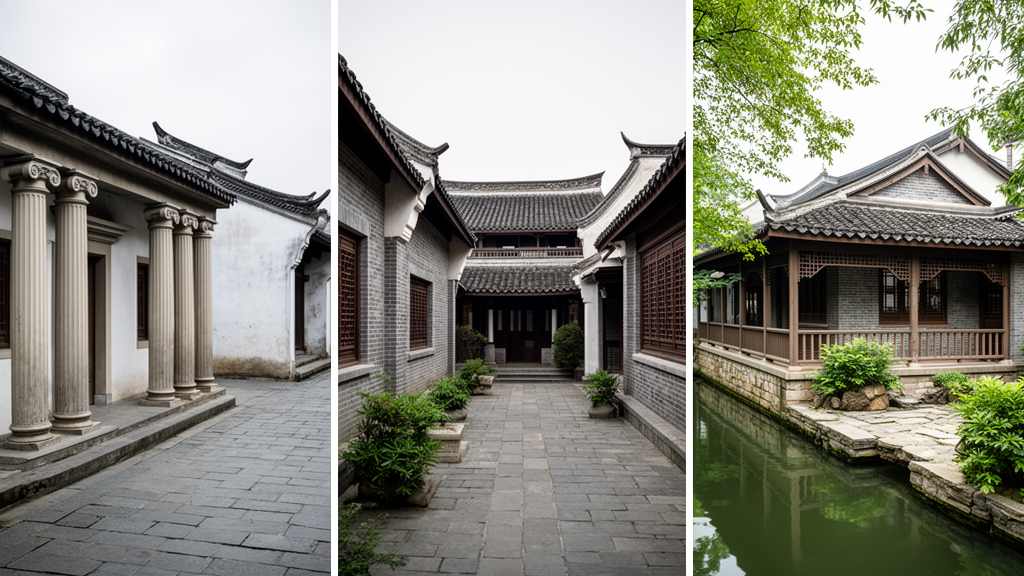
Image Credits: AI Generated

DOI: 10.1057/s41599-026-09467-z

Keywords: architectural history, foreign architecture, Jiangnan, cultural localisation, entropy weight method, postcolonial architecture, case study analysis, building form, China, architectural heritage, Autonomous, paths

Cite Scienmag News

Courtney Benton. (October 25, 2026). Study maps three paths for localising foreign architecture in Jiangnan. Scienmag. https://scienmag.com/study-maps-three-paths-for-localising-foreign-architecture-in-jiangnan/

Courtney Benton. "Study maps three paths for localising foreign architecture in Jiangnan." Scienmag, 25 October 2026, https://scienmag.com/study-maps-three-paths-for-localising-foreign-architecture-in-jiangnan/. Accessed 15 November 2026.

Courtney Benton. "Study maps three paths for localising foreign architecture in Jiangnan." Scienmag. October 25, 2026. https://scienmag.com/study-maps-three-paths-for-localising-foreign-architecture-in-jiangnan/

Tags: architectural adaptation methodsarchitectural form analysisarchitectural heritagearchitectural historyautonomousbuilding formcase study analysiscase study of foreign buildings in Jiangsu and ShanghaiChinacolonial influence and indigenous culture in architecturecultural integration in architecturecultural localisationeclectic architectural styles in Jiangnanentropy weight methodentropy weight method in architectureforeign architectureForeign architecture localisation in Jiangnanforeign influence on Chinese public buildingsJiangnanmixed-method research in architecturepathspostcolonial architectural identitypostcolonial architectureregional architectural history China
Share26Tweet16
Previous Post

Refugee Peer Helpers Turn Lived Experience Into Support for Fellow Refugees

Next Post

Solar-Powered Watch Tracks Children’s Outdoor Light Exposure in Pilot Study

Related Posts

Extending Planned Behaviour Model in Sport Research Risks Weakening Theoretical Rigour
Social Science

Extending Planned Behaviour Model in Sport Research Risks Weakening Theoretical Rigour

November 15, 2026
Adults With Autism Display Marked Individual Variability in Brain Activity
Social Science

Adults With Autism Display Marked Individual Variability in Brain Activity

November 15, 2026
Parental Incarceration Linked to Accelerated Epigenetic Aging in Mexican American Adolescents
Medicine

Parental Incarceration Linked to Accelerated Epigenetic Aging in Mexican American Adolescents

November 15, 2026
Accumulating Homophobic Violence Across Multiple Settings Strongly Tracks Elevated Psychiatric Vulnerabilities in France
Medicine

Accumulating Homophobic Violence Across Multiple Settings Strongly Tracks Elevated Psychiatric Vulnerabilities in France

November 15, 2026
Survey Finds Church Conflict Is Highest-Rated Stressor Among Baptist Pastors in Ghana
Social Science

Survey Finds Church Conflict Is Highest-Rated Stressor Among Baptist Pastors in Ghana

November 15, 2026
Workplace Injuries Associated With Elevated Household Food Insecurity Among Dhaka Day Laborers
Social Science

Workplace Injuries Associated With Elevated Household Food Insecurity Among Dhaka Day Laborers

November 15, 2026
Next Post
Solar-Powered Watch Tracks Children’s Outdoor Light Exposure in Pilot Study

Solar-Powered Watch Tracks Children's Outdoor Light Exposure in Pilot Study

  • Mothers who receive childcare support from maternal grandparents show more optimized

    Mothers who receive childcare support from maternal grandparents show more parental warmth, finds NTU Singapore study

    27656 shares
    Share 11059 Tweet 6912
  • University of Seville Breaks 120-Year-Old Mystery, Revises a Key Einstein Concept

    1061 shares
    Share 424 Tweet 265
  • Bee body mass, pathogens and local climate influence heat tolerance

    682 shares
    Share 273 Tweet 171
  • Researchers record first-ever images and data of a shark experiencing a boat strike

    546 shares
    Share 218 Tweet 137
  • Groundbreaking Clinical Trial Reveals Lubiprostone Enhances Kidney Function

    531 shares
    Share 212 Tweet 133
Science

Embark on a thrilling journey of discovery with Scienmag.com—your ultimate source for cutting-edge breakthroughs. Immerse yourself in a world where curiosity knows no limits and tomorrow’s possibilities become today’s reality!

RECENT NEWS

  • Endogenous Tagging Platform Identifies Flupentixol as Mitophagy Inducer in Alzheimer’s Models
  • Molecular Cascade and Gene Variant Control Theanine Accumulation in Tea Plants
  • Dexamethasone Restores Uterine Fluid Clearance and Implantation Receptivity in Fertility Model
  • Low-Temperature Zinc Oxide Photodetectors Fabricated on Flexible Plastic Substrates

Categories

  • Agriculture
  • Anthropology
  • Archaeology
  • Athmospheric
  • Biology
  • Biotechnology
  • Blog
  • Bussines
  • Cancer
  • Chemistry
  • Climate
  • Earth Science
  • Editorial Policy
  • Marine
  • Mathematics
  • Medicine
  • Pediatry
  • Policy
  • Psychology & Psychiatry
  • Science Education
  • Science News
  • Social Science
  • Space
  • Technology and Engineering

Subscribe to Blog via Email

Enter your email address to subscribe to this blog and receive notifications of new posts by email.

Join 5,150 other subscribers

© 2026 Scienmag - Science Magazine

Welcome Back!

Login to your account below

Forgotten Password?

Retrieve your password

Please enter your username or email address to reset your password.

Log In
No Result
View All Result
  • HOME
  • SCIENCE NEWS
  • CONTACT US

© 2026 Scienmag - Science Magazine

Discover more from Science

Subscribe now to keep reading and get access to the full archive.

Continue reading

