


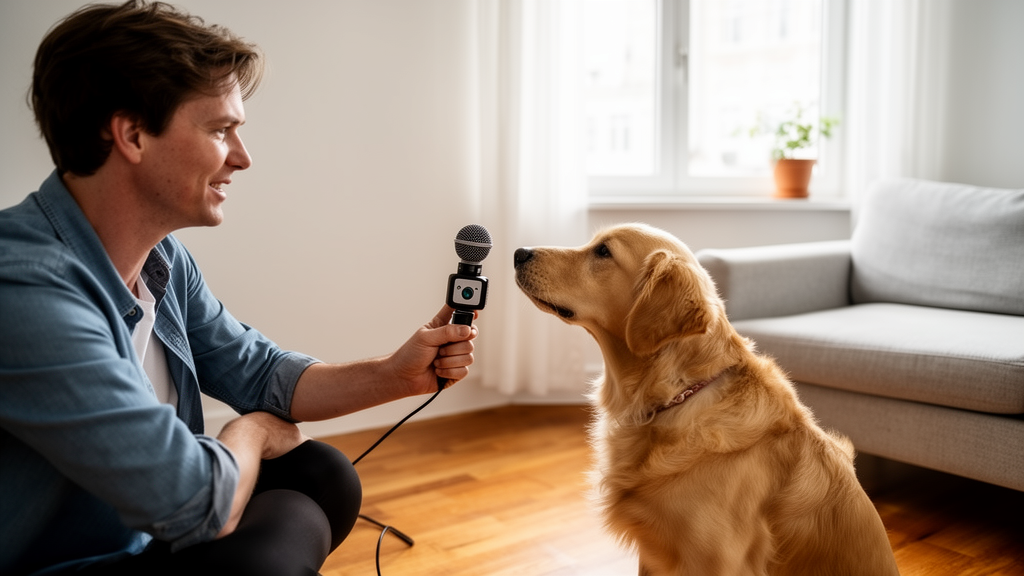
Researchers at the University of Arizona have developed what they describe as the first reliable coding system for measuring how people speak to dogs and cats during everyday life. The tool, named AURAL-Pet for Audio-based Understanding of Relational Animal-directed Language, identifies features of owner-pet conversations such as praise, questions, commands, frustration, nicknames and the treatment of animals as confidants. In an observational analysis of 5,072 audio clips collected from 240 participants, 22 of the system’s 23 binary variables were judged reliable by two independent human coders. The study does not establish that any particular way of talking to a pet improves health, but it offers a standardized way to collect behavioral evidence for future investigations of the mixed relationship between pet ownership, social interaction and human well-being.
The analysis, published in Frontiers in Psychiatry, drew clips from four archival studies using the Electronically Activated Recorder, or EAR, a smartphone application that activates at random moments to capture short recordings of participants’ surroundings. Participants consented to the recordings being used for research but were not told the specific research question, reducing the risk that people would deliberately alter their behavior because they knew their speech to pets was under investigation. Researchers searched the recordings for clips in which a dog or cat could be heard or mentioned, then used AURAL-Pet to classify the human-animal interaction represented in each clip. This approach differs from questionnaire studies, which depend on owners’ recollections of how they interact with their animals.
The coding system was designed around observable features that might help explain how pets affect people. Categories cover forms of speech directed toward an animal, including praise, questions, commands and expressions of frustration, as well as broader interaction patterns such as addressing a pet by nickname or speaking to it as a confidant. These features were selected because they could plausibly relate to a pet functioning as a social partner or acting as a social catalyst that prompts conversations with other people. AURAL-Pet is not an automated speech-recognition program in the analyzed study; it is a checklist-based framework through which trained human coders mark whether specified characteristics are present or absent in each recording.
To test the framework, two human coders independently scored the same clips. Agreement for 22 of the 23 yes-or-no variables was considered sufficient to demonstrate that the coding system could be applied reliably in future work involving human-pet interactions. The researchers reported large variation in owners’ conversational styles. Some referred to a pet by a nickname in every sampled clip, while others never did. Other interactions included animated praise, questions, commands, expressions of frustration and emotional disclosure. The observed diversity suggests that “pet talk” is not a single uniform behavior, an important consideration for researchers seeking to explain why studies of pet ownership have produced inconsistent associations with loneliness, depression and other health outcomes.
The recordings also indicated that pet-directed speech occupied about one-tenth of the total speaking time captured from participating pet owners. That estimate concerns the recorded sample rather than every waking moment in the owners’ lives, because the EAR captured brief episodes at randomized intervals. The study itself did not measure whether speaking to pets caused better mental health or whether owners who speak differently report different well-being outcomes. Instead, it established a measurement approach for studying the issue. As study lead author Dara Jonkoski put it, the researchers hope future work can examine how differences in interaction styles map onto mental-health and well-being outcomes in people.
The need for such objective behavioral data stems partly from the long-running uncertainty surrounding the so-called “pet effect,” the idea that living with animals can positively influence human health. Some studies have associated pet ownership with lower rates of loneliness or depression, whereas others have found little or no association. Those mixed results do not show that the idea is inherently false, but they make it difficult to determine which aspects of human-animal relationships may be relevant. A standardized measure of what owners actually say and do provides information that supplements self-reported surveys and may allow future studies to compare interaction styles rather than treating pet ownership as a single, undifferentiated exposure.
Senior author Emily Bray, an assistant professor in the University of Arizona College of Veterinary Medicine, said the tool was designed to capture raw behavior separately from owners’ answers on questionnaires. The investigators also considered what pets may add to a person’s social environment. A pet can create opportunities for owners to interact with strangers, and an animal may become a recipient of conversation that functions like disclosure to a social partner. The source material illustrates the latter possibility with an example of someone returning home after a difficult day and telling a pet that it is always glad to see them and makes them feel good. Such exchanges are not direct evidence of a mental-health benefit; AURAL-Pet is intended to identify and quantify them so their consequences can be tested.
The archival design gave the study a broad collection of naturalistic speech, but it also limits the conclusions that can be drawn. The clips came from EAR studies originally conducted for other research questions, and only recordings in which a dog or cat was audible or mentioned were retained. Although participants were unaware of the present research question while their recordings were being collected, the analyzed subsample was selected retrospectively. The study was observational, and the reported reliability evaluation focused on whether human coders consistently applied the checklist. It did not test whether the categories predict well-being, establish a causal effect of pet-directed speech or determine how representative the participants and clips are of the broader population of pet owners.
The research team is now using AURAL-Pet in a separate project called the C.A.R.E. study, led by Matthew Grilli and Jessica Andrews-Hanna, associate professors in the Department of Psychology. That study collects mental-health and well-being information from adults over the age of 60. The researchers hope the coding system can help determine whether conversations with pets are associated with outcomes in this older adult population and whether an animal operates as a substitute for a social partner, a source of emotional support or a catalyst for interactions with other people. Because the new project is ongoing, the source provides no results about those questions. AURAL-Pet supplies a way to characterize potentially relevant behavior; the direction and strength of any relationship with well-being remain to be established.
For science, the advance is both methodological and conceptual. AURAL-Pet translates a familiar but poorly standardized subject—how owners speak to their animals—into observable variables that can be applied consistently to naturalistic recordings. The system may help explain why the evidence on pets and health has been mixed by testing whether specific forms of interaction, rather than ownership alone, track meaningful differences in people’s lives. That possibility remains a research aim rather than a demonstrated effect. The present study’s firmest finding is that day-to-day pet speech varies widely among owners and can be coded with high inter-rater reliability. By capturing behavior at the moment it occurs, the approach gives future investigations a common observational foundation for examining the complex links among pets, conversation, social connection and well-being.
Subject of Research: Development and validation of a coding system for analyzing everyday human speech directed toward pets
Article Title: New U of A tool decodes pet talk and may help explain how pets affect our well-being
Article References: New U of A tool decodes pet talk and may help explain how pets affect our well-being. Original publication (Bibliographic details unavailable.)
Image Credits: AI Generated
DOI: Not provided
Keywords: AURAL-Pet, human-animal communication, pet ownership, well-being, behavioral coding, naturalistic audio, dog-owner interaction, cat-owner interaction, observational research, tool, decodes, talk
Cite Scienmag News
William Thompson. (October 25, 2026). Audio coding system captures how people talk to pets. Scienmag. https://scienmag.com/audio-coding-system-captures-how-people-talk-to-pets/
William Thompson. "Audio coding system captures how people talk to pets." Scienmag, 25 October 2026, https://scienmag.com/audio-coding-system-captures-how-people-talk-to-pets/. Accessed 25 October 2026.
William Thompson. "Audio coding system captures how people talk to pets." Scienmag. October 25, 2026. https://scienmag.com/audio-coding-system-captures-how-people-talk-to-pets/


