


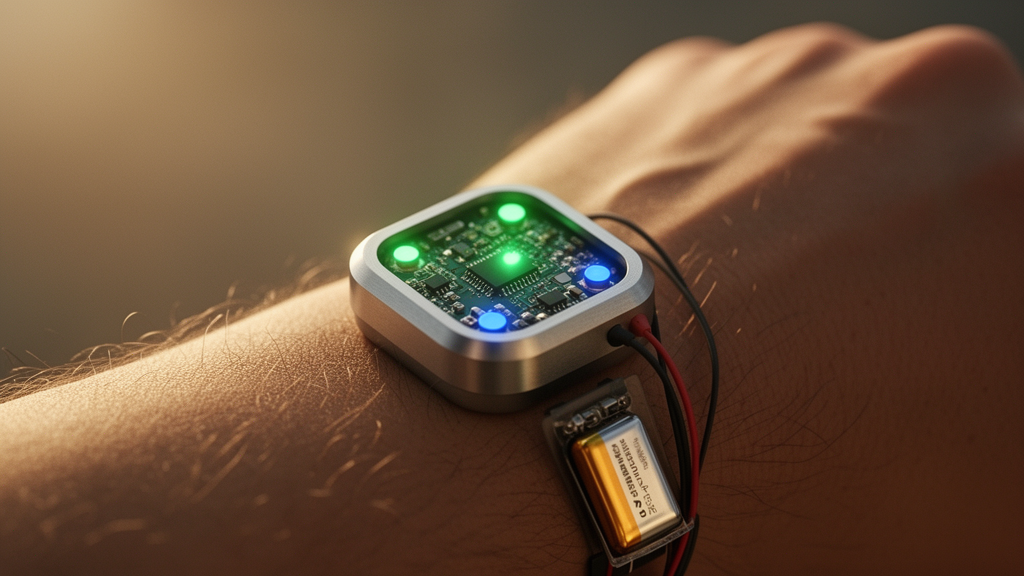
Imagine a network of tiny sensors pinned to your chest, wrist, and limbs, streaming your heartbeat, temperature, and motion to a doctor’s dashboard around the clock. Now imagine that every one of those sensors runs on a coin-sized battery that cannot be replaced without surgery or a trip to the clinic. That is the daily reality of Wireless Body Area Networks, the wearable and implantable nervous system of modern digital healthcare. A new study published in the journal Cognitive Computation proposes a way to make these fragile networks dramatically smarter, longer-lived, and faster when lives hang in the balance, by letting each sensor learn, predict, and even borrow mathematical ideas from quantum computing.
The framework, called QuantumEERP-Net, was developed by Ben Othman Soufiane of King Faisal University in Saudi Arabia and Naima Saeed of Aden University in Yemen. Their central insight is that body-worn sensors fail not because they lack radios or batteries, but because they lack judgment. Conventional routing protocols follow fixed rules: send data along the shortest path, or wait until a link degrades and then react. On a human body, where walking, running, and posture changes constantly reshape the wireless landscape, such static strategies waste precious energy on redundant transmissions and stumble precisely when a cardiac crisis demands instant delivery. The authors argue that only a cognitive, self-optimizing architecture can cope with the coupled chaos of physiology and radio physics.
At the heart of the system is a multi-agent deep reinforcement learning design. Every sensor node operates as an autonomous agent running a Dueling Double Deep Q-Network, a neural architecture that separates the value of being in a particular situation from the advantage of taking a specific action. Each agent observes an eight-dimensional local state: its residual battery energy, the packet reception rate to its best neighboring link, its hop count to the wearable hub known as the Body Control Unit, the wearer’s current mobility state, and the urgency class of the data it carries. Through continuous trial, error, and experience replay, the agent learns which neighbor to forward each packet to, balancing its own survival against network-wide reliability. A consensus mechanism weighted by remaining energy steers traffic away from nodes approaching exhaustion, spreading the burden across the network rather than burning out a handful of overworked relays.
The quantum element, perhaps the study’s most eye-catching ingredient, is deliberately practical. The Quantum-Inspired Dual Prediction Model does not run on a quantum computer; it simulates a six-qubit variational quantum circuit with three entangling layers on ordinary embedded processors. Using angle encoding and the parameter-shift rule for exact gradient estimation, this compact hybrid network forecasts two things at once: the next value of the physiological signal being measured, such as an electrocardiogram sampled at 125 hertz, and the node’s own future battery level. When the model predicts that the next reading will deviate from the current one by less than an adaptive threshold, the node simply stays silent. Because a healthy heart rhythm is largely predictable, the network avoids transmitting a steady stream of data that adds no clinical information, cutting redundant packet generation by as much as 52.3 percent in long-term monitoring.
Context awareness forms the third pillar. A real-time engine fuses inertial measurements sampled at 50 hertz with ECG signals to classify the wearer’s activity as static, walking, or running using a Hidden Markov Model, and to detect genuine emergencies. Falls are recognized through a distinctive acceleration signature, an impact exceeding 2.5 g followed by near-motionlessness below 0.2 g within one and a half seconds, while dangerous arrhythmias are flagged when heart rate exceeds 180 beats per minute or heart rate variability collapses below an adaptive threshold. On a held-out test set of 150,000 samples drawn from a hybrid dataset of 450,000 labeled examples built on the PhysioNet MIMIC-III and MHEALTH repositories, the engine achieved a detection accuracy above 0.991, with false negatives for emergencies below 0.3 percent.
That detection triggers the framework’s most dramatic behavior: a policy override. The learned reinforcement learning policy is suspended, and the node switches to an emergency regime enforcing minimum-hop routing over links with packet reception rates above 0.95, direct transmission when energy permits, and preemptive priority in the medium-access queue. Emergency packets bypass the predictive suppression mechanism entirely. In simulations spanning 20,000 cycles, emergency data arrived with a packet delivery ratio of 1.000 and a mean end-to-end delay of 13.8 milliseconds, comfortably inside the 18-millisecond ceiling demanded for life-critical alerts, and well ahead of the 24.5 milliseconds achieved by the strongest baseline protocol.
The lifetime gains are equally striking. With ten nodes powered by 0.620-joule CR2032-style batteries and a realistic log-normal shadowing channel with a standard deviation of 6.5 decibels, the first node in the QuantumEERP-Net network died at 10,250 rounds, an 83 percent improvement over the EAFST baseline, while the last node survived 84.3 percent longer. Residual energy after 20,000 cycles was more than double that of several competing protocols, and the coefficient of variation across repeated runs was a mere 0.015, indicating that the improvements were stable rather than the product of lucky random seeds. Statistical significance held at p-values below 10 to the power of minus 10 in comparisons against EAFST, E-HARP, EERP, and EERP-DPM.
Critically, the authors confronted the objection that such intelligence must be too heavy for a battery-powered microcontroller. They compiled their models using INT8 quantization, fixed-point arithmetic, and kernel fusion via the ARM CMSIS-NN library, then benchmarked inference on an nRF52832 system-on-chip with an ARM Cortex-M4F processor. The full D3QN forward pass consumed 2.1 microjoules in 1.9 milliseconds, and the quantum-inspired prediction added 1.5 microjoules, a total of roughly 3.6 microjoules per cycle. Because inference is duty-cycled and triggered only when a packet would be generated, the average power contribution is negligible compared with the cost of radio transmission, which remains the dominant expense in body-area communication.
Security was treated as a differentiated service rather than a blanket tax. On-demand clinician queries are authenticated with HMAC-SHA256 challenge-response using dynamic session keys and encrypted with AES-128 in counter mode, achieving a compliance rate of 0.995, well above the 0.95 target, at an energy cost of about 0.1 nanojoules per bit. Routine monitoring traffic, by contrast, relies on lightweight CRC-based integrity checks, so cryptographic overhead is paid only where confidentiality genuinely matters. The authors note that future iterations may explore post-quantum algorithms such as Falcon or SPHINCS+ and edge-assisted authentication to keep pace with evolving threats without draining batteries faster.
An ablation study confirms that none of these components is decorative. Removing the quantum-inspired predictor cut network lifetime by 28.7 percent; disabling context awareness pushed emergency latency from 13.8 to 20.1 milliseconds and dropped packet delivery from 0.995 to 0.968; replacing learned routing with shortest-path forwarding degraded load balancing and raised routine latency; and stripping out the NSGA-II multi-objective tuner that balances energy, reliability, and latency left the system unable to find Pareto-optimal trade-offs. Together, the results sketch a convincing vision of the next generation of body-area networks: not passive data pipes, but foresighted, self-optimizing systems in which every sensor understands its own battery, its wearer’s body, and the urgency of what it must say. For remote patient monitoring, chronic disease management, and elderly fall detection, that could mean wearables that last years instead of months, and cardiac alerts that arrive in under fifteen milliseconds, every time.
Subject of Research: Quantum-inspired deep reinforcement learning routing for energy-efficient wireless body area networks in healthcare monitoring
Article Title: A Cognitive, Quantum-Inspired Learning Framework for Energy-Efficient and Reliable Routing in Wireless Body Area Networks
Article References: Soufiane, B. O., & Saeed, N. (2026). A Cognitive, Quantum-Inspired Learning Framework for Energy-Efficient and Reliable Routing in Wireless Body Area Networks. Cognitive Computation, 18(1), Article 118. https://doi.org/10.1007/s12559-026-10665-9
Image Credits: AI Generated
DOI: 10.1007/s12559-026-10665-9
Keywords: wireless body area networks, quantum-inspired computing, deep reinforcement learning, routing protocols, energy efficiency, healthcare monitoring, context-aware computing, variational quantum circuits, wearable sensors, network lifetime, emergency detection, embedded machine learning
Cite Scienmag News
Katie Riggs. (October 15, 2026). Quantum-Inspired AI Teaches Body Sensors to Outsmart Their Own Batteries. Scienmag. https://scienmag.com/quantum-inspired-ai-teaches-body-sensors-to-outsmart-their-own-batteries/
Katie Riggs. "Quantum-Inspired AI Teaches Body Sensors to Outsmart Their Own Batteries." Scienmag, 15 October 2026, https://scienmag.com/quantum-inspired-ai-teaches-body-sensors-to-outsmart-their-own-batteries/. Accessed 15 October 2026.
Katie Riggs. "Quantum-Inspired AI Teaches Body Sensors to Outsmart Their Own Batteries." Scienmag. October 15, 2026. https://scienmag.com/quantum-inspired-ai-teaches-body-sensors-to-outsmart-their-own-batteries/


