


On the tidal flats of Hailing Island in southern China, a quiet accounting problem is unfolding in the mud beneath the mangroves. Scientists have long tracked the health and carbon storage of these coastal forests by weighing how fast dead leaves disappear. A new field study suggests that this familiar yardstick may be missing most of the story: when different mangrove species’ leaves decay together, the chemistry of the remaining litter shifts far more often than its bulk mass does, meaning nutrient cycles can be rearranged even when the scales barely move.
The research, published in Frontiers in Marine Science, was led by Zhouxiang Zheng of Huizhou University with colleagues at Sun Yat-Sen University and partner institutions. The team ran two field experiments in the Hailing Island Mangrove National Wetland Park in Guangdong Province, a subtropical monsoon site where roughly 1,816 millimeters of rain falls each year and where natural and planted mangrove stands share the intertidal flats. One experiment examined how added nitrogen changed decomposition; the other, the study’s centerpiece, tested what happens when leaves from three mangrove species are mixed in the same litterbag.
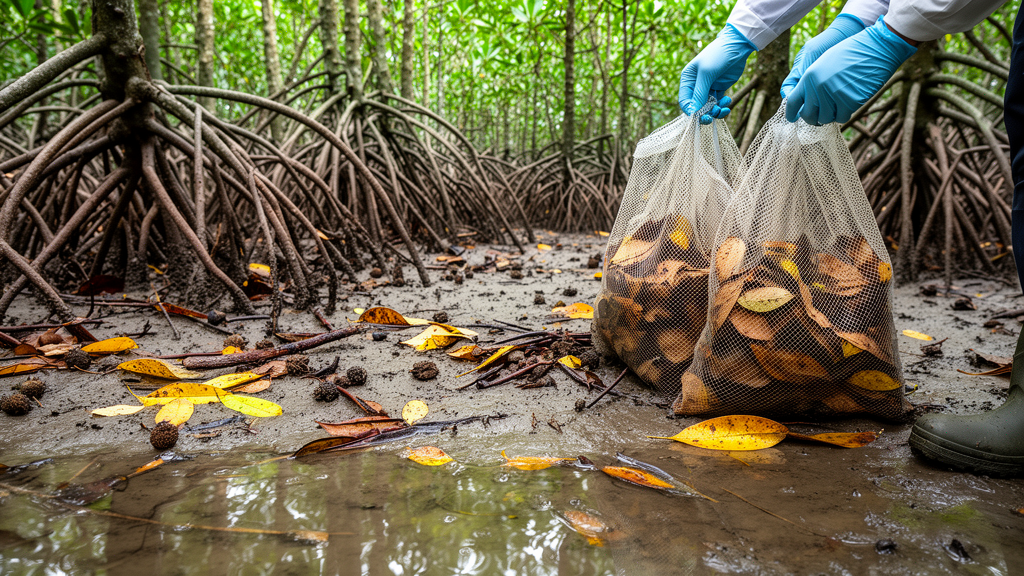
The three species were ecologically telling choices. Sonneratia apetala is an introduced fast-growing species, while Kandelia obovata and Avicennia marina are natives of southern China. Freshly fallen yellow leaves and small branches were collected from all three, along with fine and coarse roots, sealed into mesh litterbags, and staked out on the sediment or buried twenty centimeters below the surface. The researchers then retrieved the bags at intervals ranging from seven days to a year and measured how much dry mass remained, along with concentrations of total organic carbon, total nitrogen, and total phosphorus.
Species identity mattered enormously. Avicennia marina leaves decomposed fastest, with a fitted decay constant of 0.0227 per day and an estimated half-life of just 18 days. Sonneratia apetala followed closely at 20 days, but Kandelia obovata lingered, holding half its mass for 55 days. That sluggish pace tracked the leaf chemistry: Kandelia litter started with only 6.72 grams of nitrogen per kilogram and high carbon-to-nitrogen and carbon-to-phosphorus ratios of 66.36 and 625.30, whereas the two faster species carried roughly double the nitrogen and far lower ratios. Below ground, the hierarchy largely repeated itself, though fine roots everywhere decomposed glacially slowly, with half-lives stretching past a thousand days for Sonneratia.
The nitrogen-enrichment experiment, conducted earlier on the same island, applied urea to four adjacent plots at rates of zero, 22.85, 114.24, and 228.48 grams of nitrogen per square meter per year, spanning the range of nutrient pollution that aquaculture and wastewater can deliver to mangrove wetlands. Because each treatment occupied a single plot, the authors are careful to frame these results as descriptive rather than statistically conclusive. What emerged was not a tidy dose-response curve. Mass loss varied among plots in species-specific, non-monotonic ways, and the most striking signal was chemical rather than physical: in the highest-nitrogen plot, aboveground litter carried 14.02 percent more phosphorus and an 11.53 percent lower nitrogen-to-phosphorus ratio than litter from the untreated control.
That decoupling between nutrient balance and bulk decay set the stage for the mixing experiment, which asked a deceptively simple question: when two or three species’ leaves rot together, does the mixture behave as the weighted average of its parts? For each mixture and each sampling date, the team calculated an expected value from separately deployed single-species bags, weighted by the initial mass proportions, and compared it with what the mixed bag actually contained. Across four mixture compositions and five sampling dates, that yielded twenty comparisons for each response variable.
The results were lopsided in a way that should make ecologists rethink their instruments. Only four of twenty mass-remaining comparisons, or 20 percent, deviated significantly from expectation, and those departures split evenly between faster and slower than predicted. But for total organic carbon, 65 percent of comparisons were non-additive; for total nitrogen, 70 percent; for total phosphorus, 55 percent. The carbon-to-phosphorus and nitrogen-to-phosphorus ratios each departed from expectation in 60 percent of cases. In other words, mixing rewrote the elemental ledger of the decaying litter several times more often than it changed how much material remained.
Timing and direction added further texture. Most elemental departures occurred during the early and intermediate stages of decomposition, between days 15 and 60, when soluble compounds and readily available nutrients are most mobile. The deviations also leaned downward: concentrations of nitrogen and phosphorus fell below the weighted expectation far more often than they rose above it, suggesting that mixed litters tend to shed or immobilize nutrients in ways single-species bags do not capture. Notably, the three-species mixture did not consistently out-decompose the two-species combinations, reinforcing that species identity and chemical contrast, not species count, drive the dynamics.
The authors are candid about the limits of their null model. Because the component species could not be separated after co-decomposition, expected values relied on initial mass fractions, which become increasingly inaccurate as faster-decaying species shrink in contribution over time. Some apparent non-additivity in elemental concentrations may therefore reflect shifting mixture composition rather than true interspecific transfer of nutrients. The 90-day window also captures only early and intermediate decay, leaving long-term stabilization unexplored, and the measurements stopped at bulk carbon, nitrogen, and phosphorus without lignin, tannins, microbial biomass, enzymes, or sediment redox chemistry.
Even with those caveats, the implications ripple outward. Mangroves are among the planet’s most carbon-rich ecosystems, and restoration programs increasingly rely on species choices to rebuild blue-carbon stocks. If particular species combinations alter the timing and stoichiometry of nutrient return without visibly changing mass loss, then planting decisions could shift whether litter-derived nitrogen and phosphorus feed microbes, flush into coastal waters, or lock into sediments, all beneath the radar of conventional decay measurements. For a field that has long equated decomposition with disappearing mass, the message from Hailing Island is that the most consequential chemistry may be happening invisibly, in the ratios rather than the remainder.
Subject of Research: Elemental stoichiometry and decomposition of mixed mangrove litter under nitrogen enrichment
Article Title: Mangrove litter mixing alters elemental composition more frequently than mass loss, with species-specific patterns across nitrogen-enrichment plots
Article References: Zheng, Z., Cao, Q., Chen, Y., Zheng, M., Liu, Z., & Peng, Y. (2026). Mangrove litter mixing alters elemental composition more frequently than mass loss, with species-specific patterns across nitrogen-enrichment plots. Frontiers in Marine Science, 13, Article 1976668. https://doi.org/10.3389/fmars.2026.1976668
Image Credits: AI Generated
DOI: 10.3389/fmars.2026.1976668
Keywords: mangroves, litter decomposition, ecological stoichiometry, nitrogen enrichment, blue carbon, litter mixing, carbon cycling, nutrient cycling, coastal wetlands, Frontiers in Marine Science, Mangrove, litter
Cite Scienmag News
Bethany Barker. (October 15, 2026). Mangrove Litter Mixing Reshapes Nutrient Chemistry More Often Than It Speeds Decay. Scienmag. https://scienmag.com/mangrove-litter-mixing-reshapes-nutrient-chemistry-more-often-than-it-speeds-decay/
Bethany Barker. "Mangrove Litter Mixing Reshapes Nutrient Chemistry More Often Than It Speeds Decay." Scienmag, 15 October 2026, https://scienmag.com/mangrove-litter-mixing-reshapes-nutrient-chemistry-more-often-than-it-speeds-decay/. Accessed 15 October 2026.
Bethany Barker. "Mangrove Litter Mixing Reshapes Nutrient Chemistry More Often Than It Speeds Decay." Scienmag. October 15, 2026. https://scienmag.com/mangrove-litter-mixing-reshapes-nutrient-chemistry-more-often-than-it-speeds-decay/


