


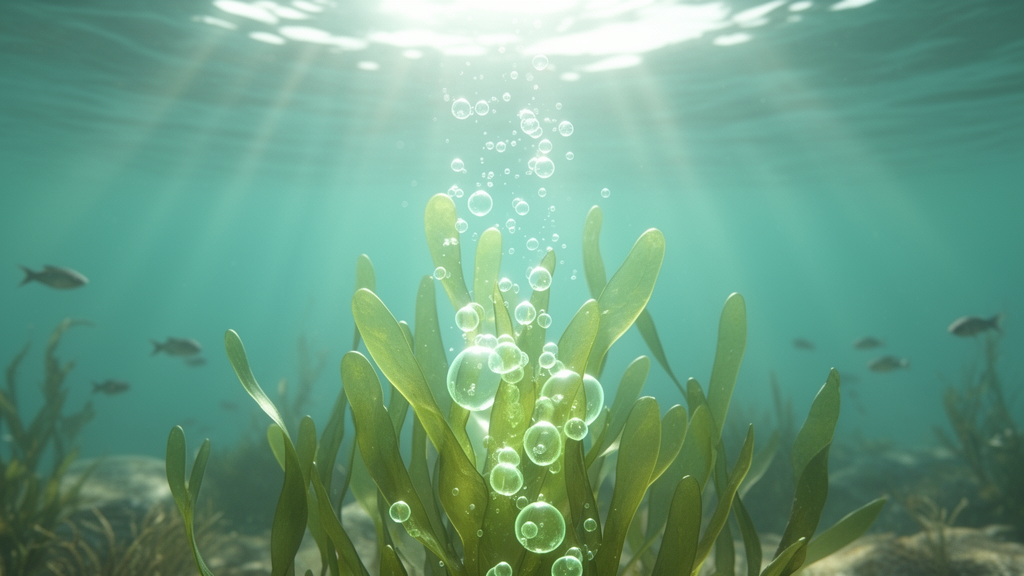
The ocean has always been a powerhouse of photosynthesis, and a growing body of research argues that its smallest inhabitants could soon feed our gas grids. A new review published in Estuarine Management and Technologies examines whether marine micro- and macroalgae can become a practical feedstock for biomethane, the renewable gas produced when microbes digest organic matter without oxygen. The verdict is cautiously optimistic: the yields are real, the obstacles are serious, and the path forward runs through clever process engineering rather than any single breakthrough. The study, which synthesizes experimental results from the past two decades alongside a bibliometric map of the field, arrives at a moment when coastal nations are urgently hunting for bioenergy sources that do not compete with food crops for land or freshwater.
The core technology, anaerobic digestion, is anything but new. Wastewater plants, farms, and municipal composters have relied on it for generations, feeding sludge, manure, or food waste into sealed reactors where microbial consortia dismantle organic polymers in four stages: hydrolysis, acidogenesis, acetogenesis, and finally methanogenesis, in which archaea strip electrons from acetate or combine hydrogen with carbon dioxide to release methane. Conventional plants running on familiar substrates operate with hydraulic retention times of 15 to 30 days and reliably deliver biogas containing 50 to 70 percent methane at volumetric rates near 0.9 to 1.1 cubic meters per reactor volume per day. The question the review confronts is whether seaweed and marine microalgae can slot into that mature infrastructure, or whether the ocean’s chemistry sabotages the microbes on contact.
The appeal of marine algae is easy to see. Microalgae can exceed 90 tons of dry matter per hectare per year, convert a large share of incoming light into biomass, and grow in seawater, meaning no irrigation and no farmland. Their cells pack 30 to 60 percent protein, 10 to 30 percent carbohydrate, and 5 to 20 percent lipid depending on species and cultivation conditions, a rich menu for anaerobic microbes. Macroalgae add a second opportunity: beach-cast seaweed such as the brown alga Saccorhiza polyschides can be collected as waste and converted at yields of roughly 0.15 cubic meters of methane per kilogram of volatile solids, turning a coastal nuisance into fuel. Reported methane yields across the literature span an enormous range, from about 0.05 to 0.58 cubic meters per kilogram of volatile solids, a spread that itself signals how strongly species, composition, and operating conditions shape outcomes.
Salinity is the first villain in the story. Sodium and sulfate ions abundant in marine biomass impose osmotic stress and ionic imbalance on methanogenic archaea, and methane production measurably suffers at salinity levels above roughly 10 to 15 grams per liter, well below the roughly 35 grams per liter of full seawater. Experiments with the microalga Isochrysis galbana showed sodium inhibition cutting methane yields, though simple biomass washing recovered part of the loss. Yet the picture is not hopeless: microbial communities gradually acclimated to salt have maintained stable digestion at salinities close to 27 to 35 grams per liter, effectively learning to operate in the chemistry of the sea itself. In co-digestion trials mixing marine microalgae with sewage sludge, salt-adapted consortia sustained methane production of about 0.20 cubic meters per kilogram of volatile solids, proof that adaptation can substitute for dilution.
The second bottleneck is architectural. Many algal cells are armored with rigid, chemically resistant walls that resist microbial hydrolysis, the very first and typically slowest stage of digestion. When the microbes cannot crack the cell wall, much of the protein, starch, and lipid inside simply passes through the reactor undigested. Studies on Phaeodactylum tricornutum in anaerobic membrane bioreactors recovered only about 52 percent of the chemical oxygen demand as biogas, a number that captures how much energy can be stranded behind a stubborn cell envelope. Because hydrolysis gates the entire process, a large fraction of the review’s proposed fixes converge on one goal: breaking or weakening algal walls before digestion begins.
Pretreatment is the most direct approach. Ultrasound cavitation applied at 150 watts for 20 minutes to the marine microalgae Tetraselmis suecica and Nannochloropsis oceanica lifted methane yields to roughly 0.10 to 0.17 cubic meters per kilogram of volatile solids, with outcomes varying sharply between species, a reminder that cell-wall architecture differs as much as the organisms themselves. Mechanical, thermal, and chemical pretreatments have all shown similar promise in raising soluble substrate availability. The catch is energetic: energy-intensive pretreatment can consume much of the energy it unlocks, so the review stresses that these steps must be optimized against a full energy balance rather than judged on methane yield alone. Co-digestion and microbial acclimation, by contrast, tend to carry more favorable cost-benefit ratios because they leverage existing infrastructure and biology instead of brute-force engineering.
Co-digestion deserves particular attention because it solves two problems at once. Marine microalgal biomass is protein-heavy and therefore nitrogen-rich, with a low carbon-to-nitrogen ratio that pushes digesters toward ammonia accumulation; free ammonia above roughly 1500 to 3000 milligrams per liter is toxic to methanogens. Blending algae with carbon-rich substrates such as sewage sludge at a ratio of about 20 to 80 by weight rebalances the feed and stabilized mesophilic digestion, with reported biogas production of approximately 0.44 cubic meters per kilogram of volatile solids. The strategy also has a pragmatic virtue: it lets algal biomass ride on digesters already operating at wastewater treatment plants, shortening the road from laboratory promise to installed capacity.
Biorefinery integration may be the most elegant strategy of all. Instead of digesting whole algal cells, integrated schemes first extract valuable lipids for biodiesel or nutraceuticals and then send the protein- and carbohydrate-rich residue to the digester. Because lipid extraction ruptures cells and strips the fractions most valuable for other products, the residue digests readily, and experiments with residues of the microalga Crypthecodinium cohnii achieved yields up to 0.58 cubic meters of methane per kilogram of volatile solids, the highest figure in the review, translating to energy recovery approaching 5.8 kilowatt-hours per kilogram of volatile solids. Earlier techno-economic analyses estimated that anaerobic digestion of microalgal biomass could generate an overall value of roughly 2.13 euros per kilogram of total solids when biogas sales and nutrient recycling from digestate are counted together.
To test whether these laboratory numbers survive scale, the authors ran a kinetic simulation anchored to modified Gompertz parameters measured for marine macroalgae: a methane potential of 0.082 cubic meters per kilogram of volatile solids, a maximum production rate of 0.0072 cubic meters per kilogram per day, and a lag phase of 9.8 days. Assuming a slurry feed of 250 tons per day at 10 percent total solids, equivalent to harvesting about 90 tons of dry matter per hectare per year, the model calls for four digesters of roughly 1719 cubic meters each, a 25-day hydraulic retention time, and an organic loading rate of 2.46 kilograms of volatile solids per cubic meter per day. Under those conditions the system would produce about 1287 cubic meters of methane daily, roughly 93 percent of the ultimate kinetic potential, corresponding to an estimated 4490 kilowatt-hours of electricity per day or about 1.6 gigawatt-hours per year at 35 percent combined heat and power efficiency.
The economics remain the sobering counterweight. Terrestrial digestion systems at wastewater plants typically achieve benefit-to-cost ratios of only 1.08 to 1.14, with sludge management eating more than half of total expenses, so algal systems will need every efficiency gain they can find to compete. The review’s closing argument is that no single strategy, not pretreatment, not acclimation, not co-digestion, is sufficient alone; large-scale viability will depend on integrated configurations that chain algae cultivation, lipid extraction, digestion, and nutrient recovery into one loop. What emerges is a vision of coastal biorefineries anchored to the sea’s own productivity, turning saltwater, sunlight, and carbon dioxide into pipeline-grade gas while returning digestate nutrients to the cultivation ponds. The biology, the review concludes, is ready; the engineering and economics must now catch up.
Subject of Research: Biomethane production from marine algae via anaerobic digestion
Article Title: Sustainable biomethane production from marine algae: challenges and process strategies
Article References: Bianco, F. (2026). Sustainable biomethane production from marine algae: challenges and process strategies. Estuarine Management and Technologies, 3, 135-146. https://doi.org/10.3897/emt.3.190933
Image Credits: AI Generated
DOI: 10.3897/emt.3.190933
Keywords: marine algae, biomethane, anaerobic digestion, microalgae, macroalgae, salinity inhibition, pretreatment, co-digestion, biorefinery, ammonia toxicity, Gompertz kinetics, renewable energy
Cite Scienmag News
Denise Maddox. (October 15, 2026). Marine Algae Could Turn Coastal Waters Into Biomethane Power Plants. Scienmag. https://scienmag.com/marine-algae-could-turn-coastal-waters-into-biomethane-power-plants/
Denise Maddox. "Marine Algae Could Turn Coastal Waters Into Biomethane Power Plants." Scienmag, 15 October 2026, https://scienmag.com/marine-algae-could-turn-coastal-waters-into-biomethane-power-plants/. Accessed 15 October 2026.
Denise Maddox. "Marine Algae Could Turn Coastal Waters Into Biomethane Power Plants." Scienmag. October 15, 2026. https://scienmag.com/marine-algae-could-turn-coastal-waters-into-biomethane-power-plants/


