


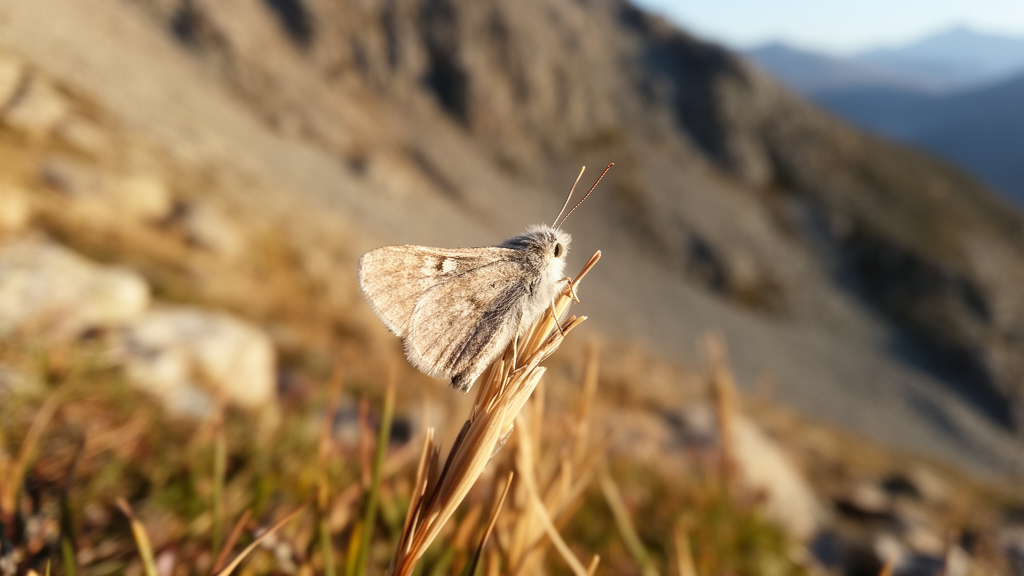
High in the Sierra Nevada of southern Spain, above 1,900 meters where the air thins and grasses bend under mountain winds, a small moth has been hiding in plain sight for more than six decades. Agriphila hispanodeliella, first described in 1959 from specimens collected near Albarracín in the province of Teruel, was quietly demoted to a mere subspecies soon after its discovery and then largely forgotten by science. A new study published in Nota Lepidopterologica has now restored it to full species rank, combining modern DNA barcoding with careful anatomical analysis to show that this Iberian insect is not a regional variant of a widespread European moth but a distinct evolutionary lineage found nowhere else on Earth.
The story begins with the genus Agriphila, a group of grass-feeding moths in the subfamily Crambinae that flutters across temperate Eurasia and North America. Europe hosts twenty-one species of the genus, twelve of which occur in the Iberian Peninsula. Among them, Agriphila deliella, originally described from Germany in 1813, enjoys a vast distribution stretching from Continental Europe through Asia Minor, North Africa, Transcaucasia, the West Siberian Plain and even Afghanistan. These moths fly from August to October in dry, open habitats covered with grasses, on which their larvae feed. In the Iberian Peninsula, A. deliella was first recorded in 1927 at Albarracín in Teruel, with later records from Serra da Estrela in Portugal and numerous Spanish localities including Zaragoza, Segovia, Burgos, Soria and Madrid.
Into this picture stepped the Polish lepidopterist Jan Błeszyński, who in 1959 described Agriphila hispanodeliella on the basis of five male specimens captured at Albarracín by Anthon Schmidt and deposited in the Hungarian National Museum in Budapest. Błeszyński noted several differences from A. deliella: the ground color of the forewing, the coloration of the wing veins and antennae, the size of the pointed prominence on the frons, and features of the male genitalia. Yet just six years later, in 1965, Błeszyński himself downgraded his species to a subspecies of A. deliella without providing any justification for the reversal. The taxonomic limbo deepened in 2008 when the specialist František Slamka suggested that the moth was merely a local variant of A. deliella, a judgment that effectively erased it from most faunistic treatments.
The resurrection of A. hispanodeliella rests on a series of specimens collected in the Sierra Nevada Natural Area in the province of Almería, in the extreme south-east of the Iberian Peninsula. Male moths were taken at several high-elevation sites between 2015 and 2025, including Puerto de la Ragua at 2,100 meters, Collado de Gabiarra at 2,120 meters, Fuente París at 1,940 meters and Cruz del Pescadero at 2,210 meters. These localities lie within the supra- and oromediterranean vegetation belts, open mountain landscapes rich in grasses, including the grey hair-grass Corynephorus canescens, which the researchers presume serves as the larval host plant. All voucher specimens are now deposited in the Research Collection of Animal Biology at the University of Murcia.
The morphological evidence assembled by the team is detailed and consistent. The redescribed males bear wingspans of 28 to 33 millimeters, notably larger than the approximately 27 millimeters typical of A. deliella. The forewings range from beige to creamy, marked with a distinct longitudinal white stripe running from the wing base to the outer margin, edged below by a short narrow brown line and above by a broad dark brown stripe, with two short parallel white lines above it and a broad brown band along the trailing edge. The male antennae are short and pectinate, weakly ringed in brown and greyish white, and the frons projects forward with a distinct pointed apex. Some individuals show much reduced markings and an almost uniformly pale beige forewing, revealing appreciable variation within the population.
The decisive anatomical differences emerge in the male genitalia, the traditional proving ground of moth taxonomy. In A. hispanodeliella the valva, a clasper-like structure, narrows to a relatively pointed apex, whereas in A. deliella it is clearly rounded. The costal arm is weakly developed and scarcely visible in the Spanish moth, while in A. deliella it is well developed and clearly separated from the valva. The uncus and gnathos are slender in A. hispanodeliella but broader in its congener, and the aedeagus is narrower with a distinct ventral thorn and no cornuti. Taken together, the wingspan, forewing pattern and genital architecture provide a reliable morphological diagnosis separating the two taxa.
Morphology alone, however, rarely settles debates of this kind, so the researchers turned to molecular evidence. Two legs were removed from each barcoded specimen and submitted to the Canadian Centre for DNA Barcoding in Guelph, Ontario, where the standard 658-base-pair barcode segment of the mitochondrial cytochrome c oxidase I gene, the COI-5P region, was sequenced using high-throughput protocols. The resulting sequences were deposited in GenBank and the Barcode of Life Data System, where all voucher data, images, sequences and trace files are publicly available. Genetic distances were computed with the Kimura 2-parameter model, and neighbor-joining and maximum-likelihood trees were reconstructed in MEGA6 from 56 nucleotide COI sequences, including reference material of A. deliella, A. tristella, A. selasella and A. aeneociliella, with the crambine Catoptria bolivari serving as an outgroup to root the tree.
The genetic results are striking. The COI sequences of A. hispanodeliella form their own barcode index number cluster, BOLD:AGX2565, and differ from A. deliella by a mean pairwise divergence of 3.5 percent. Against the other European congeners the distances are far larger still: an average of 8.33 percent across all comparisons, reaching a maximum of 9.2 percent relative to the three distinct BINs of A. tristella and a minimum of 6.8 percent relative to A. selasella. This magnitude of divergence falls squarely within the range reported for COI differences between recognized congeneric insect species, and it places A. hispanodeliella on a phylogenetically isolated branch that is well supported by both the molecular and the anatomical data. In other words, the moth that Błeszyński described in 1959 is exactly what he thought it was.
Despite this convergence of evidence, important questions remain open. The true extent of the species’ range is uncertain, because specimens from other parts of the Iberian Peninsula and from North Africa that were previously identified as A. deliella may in fact belong to the resurrected species, or may not; re-examination is needed. It is also unknown whether A. hispanodeliella and A. deliella occur together in northern Spain, and whether their ranges overlap or meet along a contact zone. The female of A. hispanodeliella has never been described, leaving female genitalia, which earlier authors identified as the key missing evidence, still unstudied. The researchers emphasize that new molecular datasets covering these areas will be crucial to resolving the biogeography of the pair, and that biological investigation of the living moths would further cement the case.
The rehabilitation of Agriphila hispanodeliella carries implications beyond nomenclatural housekeeping. As an endemic restricted to a handful of localities in the center and south-east of the Iberian Peninsula, and confined to high mountain grasslands that are vulnerable to climate change and habitat degradation, the species now requires assessment in its own right rather than being subsumed within a widespread Eurasian generalist. The study also illustrates the power of DNA barcoding to correct historical taxonomic decisions made with limited material and no genetic tools, a century-scale correction that transforms a forgotten synonym into a recognized component of Europe’s biodiversity. For a moth no larger than a thumb-width of grass blade, it is a remarkable second act in the mountains of Andalusia.
Subject of Research: Taxonomic resurrection and DNA barcoding of the Iberian grass moth Agriphila hispanodeliella
Article Title: Redescription and DNA barcoding of Agriphila hispanodeliella Błeszyński, 1959, bona sp., stat. rev. from the Iberian Peninsula ( Lepidoptera , Pyraloidea , Crambinae )
Article References: Girdley, J., Garre, M., Rubio, R. M., & Ortiz, A. S. (2026). Redescription and DNA barcoding of Agriphila hispanodeliella Błeszyński, 1959, bona sp., stat. rev. from the Iberian Peninsula (Lepidoptera, Pyraloidea, Crambinae). Nota Lepidopterologica, 49, 109-116. https://doi.org/10.3897/nl.49.191476
Image Credits: AI Generated
DOI: 10.3897/nl.49.191476
Keywords: Agriphila hispanodeliella, Lepidoptera, Crambidae, DNA barcoding, COI gene, Sierra Nevada, Iberian Peninsula, taxonomy, species delimitation, endemic species, BOLD, mountain biodiversity
Cite Scienmag News
Gavin Prescott. (October 15, 2026). Hidden Grass Moth of Spain’s Sierra Nevada Regains Species Status Through DNA Barcoding. Scienmag. https://scienmag.com/hidden-grass-moth-of-spains-sierra-nevada-regains-species-status-through-dna-barcoding/
Gavin Prescott. "Hidden Grass Moth of Spain’s Sierra Nevada Regains Species Status Through DNA Barcoding." Scienmag, 15 October 2026, https://scienmag.com/hidden-grass-moth-of-spains-sierra-nevada-regains-species-status-through-dna-barcoding/. Accessed 15 October 2026.
Gavin Prescott. "Hidden Grass Moth of Spain’s Sierra Nevada Regains Species Status Through DNA Barcoding." Scienmag. October 15, 2026. https://scienmag.com/hidden-grass-moth-of-spains-sierra-nevada-regains-species-status-through-dna-barcoding/


