


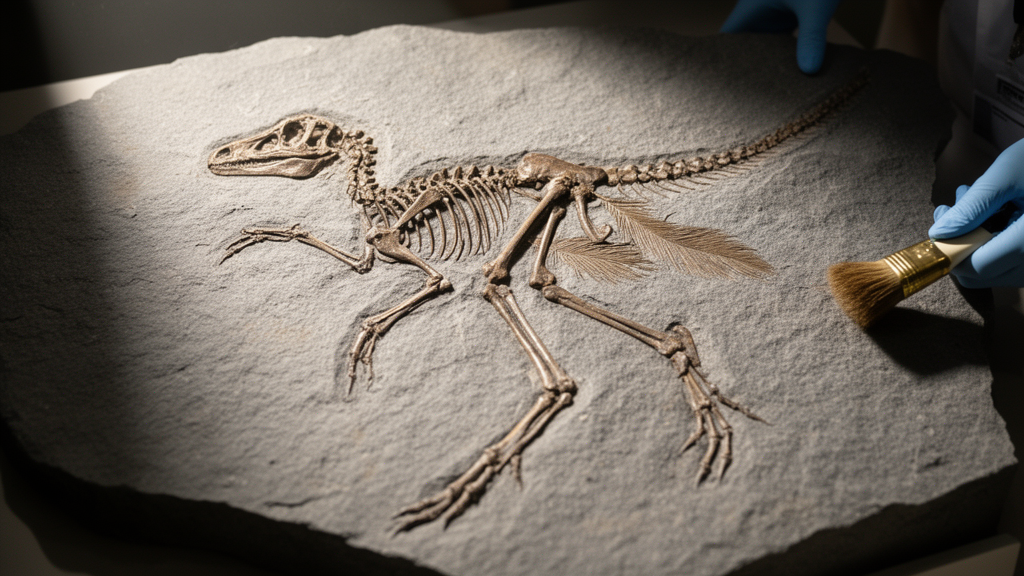
A remarkably well-preserved postcranial skeleton unearthed in Inner Mongolia is reshaping what scientists know about Sinovenator changii, one of the earliest and most informative members of the troodontids, the sleek, bird-like predatory dinosaurs that rank among the closest relatives of modern birds. The new specimen, catalogued as SDUST-V1062, was recovered from fossil beds in the Ningcheng Basin and is described in the Swiss Journal of Palaeontology. It represents the first troodontid dinosaur ever recorded from the Jehol Biota in Inner Mongolia, extending the known geographic range of this celebrated Early Cretaceous ecosystem and adding a wealth of anatomical detail to a species previously known mostly from its skull.
The specimen was collected during field expeditions in 2014 at the Duanjiagou site in Ningcheng County, Chifeng City. It consists of an articulated, three-dimensionally preserved postcranial skeleton: ten cervical vertebrae, nine dorsal vertebrae, sixteen caudal vertebrae, fragments of ribs, partial pectoral girdles and forelimbs, a partial right pelvic girdle, and nearly complete hindlimbs. The fossil beds at the site are lithologically identical to the Lujiatun Unit of the Yixian Formation in western Liaoning, and uranium-lead dating of zircon crystals has constrained the deposit to approximately 125.7 million years ago, give or take 1.5 million years. That places the animal squarely within the same time window that produced the classic Jehol troodontids of Liaoning Province.
Assigning the skeleton to a species required a distinctive anatomical signature, and the researchers found one: two pneumatic foramina, small air-filled openings, on the lateral surface of the anterior cervical vertebrae, a feature recognized as diagnostic of Sinovenator changii. High-resolution X-ray computed tomography at Zhejiang University, producing more than 2,500 slices at 40-micrometer thickness, allowed the team to visualize these delicate structures inside the articulated neck. A phylogenetic analysis of 853 anatomical characters across 170 taxa, run under both equal and implied weighting schemes in the software TNT, independently recovered SDUST-V1062 as the sister group of Sinovenator, corroborating the identification.
Equally important is the evidence that this individual had reached adulthood. Histological thin sections, cut 30 micrometers thick from the right ulna and examined under polarized light, revealed four lines of arrested growth, the annual markers that record seasonal pauses in bone deposition. Critically, the outermost spacing between these lines is extremely narrow and nearly devoid of blood vessels, a configuration known as an external fundamental system. This signal indicates that skeletal growth had essentially ceased and that the animal had attained nearly its maximum body size when it died. Complete fusion of the cervical neural arches and centra further supports its adult status, making this a mature reference specimen rather than a growing juvenile whose proportions might mislead comparisons.
The completeness of the skeleton allows the first detailed look at the postcranial anatomy of Sinovenator changii. The neck vertebrae lengthen toward the sixth cervical, the longest in the series at 28.3 millimeters, before shortening again, and the proatlas, a rarely preserved plate-like element above the atlas, is fully intact. Within Troodontidae, the proatlas has previously been reported only in Gobivenator and Sinovenator itself. The forelimb shows a humerus about 68 percent of femoral length, with a short deltopectoral crest covering roughly 30 percent of the humerus, proportions typical of early troodontids but far from the massively crested humeri of some Late Cretaceous relatives such as Linhevenator. A crescent-shaped semilunate carpal, the wrist bone central to the evolution of the avian wing, caps the metacarpals as in most maniraptorans.
Perhaps the most evolutionarily telling feature lies in the pelvis. At the proximal end of the pubis, the new specimen bears a moderately developed ambiens process, a bony projection that anchors the M. ambiens, one of the principal knee-extensor muscles in dinosaurs. In Late Cretaceous troodontids such as Saurornithoides, Gobivenator, and Latenivenatrix, this process is dramatically elongated front to back, far exceeding the length of the ischial peduncle. In SDUST-V1062 it is shorter than the ischial peduncle, a condition the authors interpret as an incipient stage in the process’s elongation. Because the length of this bony attachment sets the moment arm of the muscle, the modestly developed process implies a shorter mechanical advantage, hinting that early troodontids like Sinovenator had comparatively constrained sprinting and weight-bearing capacities relative to their later, more powerful-running relatives.
The specimen also turns out to be the largest known troodontid from the Jehol Biota. Body-size estimates derived from femoral length place it at roughly 1.24 meters in body length and 4.53 kilograms in mass. That figure sits within a broader pattern the study documents across the Deinonychosauria, the group uniting troodontids and their dromaeosaurid cousins such as Velociraptor. Troodontids range from about 0.54 to 2.82 meters in length, a roughly five-fold spread, whereas dromaeosaurids span 0.49 to 4.94 meters, a ten-fold disparity that reaches up to 368 kilograms in estimated mass. The authors suggest this gap may reflect greater diversity in locomotion, ecological niches, or growth strategies among dromaeosaurids. Intriguingly, the pattern is already visible in the Jehol Biota itself, where the largest dromaeosaurid, a subadult Tianyuraptor at 1.82 meters, dwarfs the largest troodontid.
Biogeographically, the discovery matters because nearly all Early Cretaceous Chinese troodontids had been confined to Liaoning and Hebei provinces. Sinovenator, Sinusonasus, Mei, Daliansaurus, and Liaoningvenator all come from the Yixian Formation of western Liaoning, and Jinfengopteryx from Hebei. Finding Sinovenator changii some distance west in Inner Mongolia demonstrates that at least one early troodontid species ranged across a wider swath of the ancient northeastern Chinese landscape than previously recognized. The site itself has already yielded eusauropod teeth and a symmetrodont mammal named Ningchengodon foxi, and the new troodontid adds a key predatory component to this emerging fossil assemblage, which mirrors the famous Lujiatun beds hundreds of kilometers to the east.
For researchers tracing the dinosaur-bird transition, Sinovenator occupies a pivotal position. As one of the earliest-diverging troodontids, it combines unmistakable troodontid traits, such as an asymmetrical foot with a slender second metatarsal and a robust fourth, with primitive paravian features inherited from deeper in the family tree. Previous work on the species concentrated on exquisitely preserved skulls, leaving the skeleton comparatively understudied. The new specimen also clarifies a point of contention: a reported lateral cnemial crest on the tibia of the paratype IVPP V12583 is absent in SDUST-V1062, and the authors argue that poor preservation and possible taphonomic distortion in the paratype make that character uncertain, prompting a re-evaluation of what was thought diagnostic of the species.
Ultimately, SDUST-V1062 is more than a single new fossil; it is a bridge connecting the dawn of troodontid evolution with its later flourishing. By documenting an adult, near-complete skeleton in three dimensions, the study gives paleontologists a firm anatomical baseline for one of the most ancient members of the lineage, reveals the first stages of a biomechanical trend that unfolded over tens of millions of years, and redraws the map of where these agile, feathered predators roamed. As excavations continue in the Ningcheng Basin, this Inner Mongolian troodontid may prove to be the first of many surprises from a corner of the Jehol Biota that is only beginning to give up its secrets.
Subject of Research: Postcranial anatomy, ontogeny, and paleogeographic range of the Early Cretaceous troodontid dinosaur Sinovenator changii
Article Title: A new postcranial skeleton of Sinovenator changii ( Theropoda , Troodontidae ) from the Jehol Biota of the Ningcheng Basin, Inner Mongolia, China
Article References: Yu, D., Zhang, H., Zhou, C.-F., & Pei, R. (2026). A new postcranial skeleton of Sinovenator changii (Theropoda, Troodontidae) from the Jehol Biota of the Ningcheng Basin, Inner Mongolia, China. Swiss Journal of Palaeontology, 145, 901-926. https://doi.org/10.3897/sjp.145.196379
Image Credits: AI Generated
Keywords: Sinovenator changii, Troodontidae, Jehol Biota, Yixian Formation, Inner Mongolia, Early Cretaceous, paleontology, osteohistology, deinonychosaurians, ambiens process, phylogenetics, dinosaur-bird transition
Cite Scienmag News
Gavin Prescott. (October 15, 2026). Exquisite New Fossil Reveals an Adult Sinovenator and Expands the Range of Early Troodontids. Scienmag. https://scienmag.com/exquisite-new-fossil-reveals-an-adult-sinovenator-and-expands-the-range-of-early-troodontids/
Gavin Prescott. "Exquisite New Fossil Reveals an Adult Sinovenator and Expands the Range of Early Troodontids." Scienmag, 15 October 2026, https://scienmag.com/exquisite-new-fossil-reveals-an-adult-sinovenator-and-expands-the-range-of-early-troodontids/. Accessed 15 October 2026.
Gavin Prescott. "Exquisite New Fossil Reveals an Adult Sinovenator and Expands the Range of Early Troodontids." Scienmag. October 15, 2026. https://scienmag.com/exquisite-new-fossil-reveals-an-adult-sinovenator-and-expands-the-range-of-early-troodontids/


