


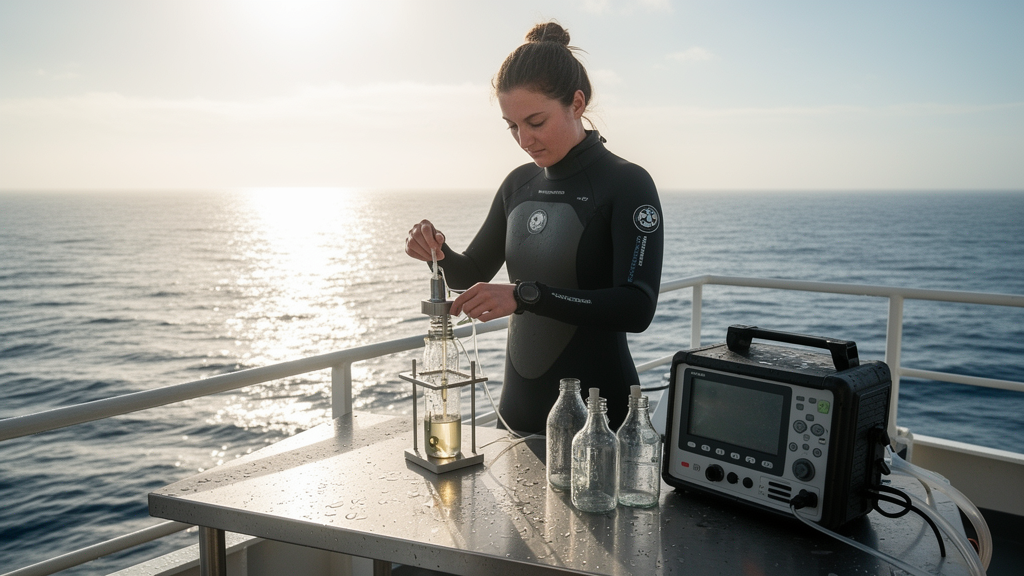
A single liter of seawater can carry the genetic traces of fish, dolphins, and whales that no diver or sonar ever spotted. That promise has made environmental DNA, or eDNA, one of the fastest-growing tools in marine biology, but the field has been haunted by a stubborn problem: two labs analyzing the same water sample can reach different conclusions simply because they made different technical choices along the way. A new study published in Metabarcoding and Metagenomics tackles that inconsistency head-on, testing extraction protocols, polymerase enzymes, and a new bioinformatics pipeline to figure out where hidden biases creep into marine vertebrate monitoring.
The research team, working with seawater collected aboard the research vessel Miguel Oliver during the PELACUS 0324 survey, sampled three stations off the northwest Iberian Peninsula: Northern Galicia, Costa da Morte, and the Ria de Arousa. At each site, they filtered eight liters of seawater through Sterivex cartridge filters and then split the material between two extraction strategies. The first was the standard DNeasy PowerWater Sterivex protocol, a widely used commercial kit designed specifically for enclosed filters. The second added a preliminary bead-beating homogenization step, in which the filter membrane was removed from its cartridge, cut into fragments, and physically shattered with metal beads before following the standard protocol, on the theory that breaking open more cells would release more DNA.
The result was a clear win for simplicity. The standard, hands-off protocol yielded DNA concentrations roughly six to seventeen times higher than the bead-beating variant across the three stations, and it also recovered slightly more amplicon sequence variants, the fine-grained genetic units used to measure biodiversity. Both methods captured a broadly similar cast of marine vertebrates, including sardines, anchovies, sea bream, and even a fin whale at one station, but the extra handling involved in the modified method appears to have cost more than it gained, likely through DNA loss and increased contamination risk when the filter was manipulated outside its sealed unit.
One of the more intriguing questions the study addressed concerns free extracellular DNA, or f-exDNA: genetic material floating loose in seawater, not attached to cells or particles. Some researchers have suggested this fraction could pass straight through filter membranes and be lost. Using controlled seawater samples spiked with common dolphin DNA at known concentrations, the team found that recovery of this free DNA remained low with both extraction methods, generally below one percent, and actually declined as DNA concentrations rose, possibly because binding sites on the filter membrane became saturated. The finding suggests that particle-associated DNA, rather than free-floating strands, is what filters and extraction kits are mostly capturing, though the authors caution that more work is needed to disentangle the different DNA subfractions in natural waters.
The next variable under scrutiny was the polymerase enzyme, the molecular workhorse that copies target DNA during PCR. The team compared a high-fidelity proofreading polymerase, Platinum SuperFi II, which corrects its own replication errors using exonuclease activity, with a cheaper non-proofreading enzyme, Supreme NZYTaq. There is a technical wrinkle here: the same exonuclease activity that makes proofreading enzymes accurate can also chew back mismatches at the ends of primers, potentially altering which taxa amplify successfully. Using artificial mock communities containing DNA from sixteen vertebrate species at equal concentrations, the researchers ran paired statistical tests on the read outputs of both enzymes.
The verdict was taxon-dependent and, in a way, counterintuitive. The proofreading enzyme generated significantly more reads from fish, amplifying bony fish DNA more effectively, while the non-proofreading enzyme produced significantly more cetacean reads, although that effect was weaker and more variable. Both enzymes detected all sixteen species in the mock communities, meaning the cheaper enzyme did not miss anything. In real environmental samples, the picture was messier: the two enzymes produced overlapping but distinct species lists, with seven species shared, six detected only with the proofreading enzyme, and four only with the non-proofreading one, a discrepancy the authors attribute to the inherent stochasticity of the metabarcoding workflow rather than to enzyme choice alone.
For practical purposes, the message is that budget-conscious monitoring programs may not need the expensive high-fidelity option. The non-proofreading enzyme delivered comparable overall species detection in environmental samples and excelled at cetacean detection, making it a cost-effective choice when the goal is tracking marine mammals. The authors do note that polymerases can introduce sequence-composition biases related to guanine-cytosine content, which may distort relative abundance estimates even when presence or absence data remain reliable, so abundance-based ecological interpretations still warrant caution.
The third pillar of the study is MVeM, the Marine Vertebrate eDNA Metabarcoding bioinformatics pipeline, an open-source, adaptable workflow now available on GitHub. After raw reads are trimmed and processed with the DADA2 algorithm to infer sequence variants, taxonomic assignment proceeds through BLAST searches against the NCBI nucleotide database with stringent filters: at least ninety-nine percent sequence identity, sufficient alignment length, and exclusion of generic environmental sample entries so that every assignment traces back to vouchered tissue specimens. The pipeline then layers on several safeguards against false positives.
Among those safeguards are a customizable geographic ban list that automatically screens out species implausible for the study region, a filter against nuclear mitochondrial DNA segments, or NUMTs, which are mitochondrial fragments lurking in the nuclear genome that can masquerade as genuine detections, and a Lowest Common Ancestor fallback that assigns ambiguous matches to a genus or family rather than gambling on a species call. Contamination control is handled with an unusual touch of machine learning: instead of a fixed read threshold, an unsupervised classification method flags potential contaminants sample by sample, accounting for variable sequencing depth while still preserving genuinely abundant biological signals that might appear as faint traces in control blanks.
Importantly, the authors are candid that their environmental comparisons rest on limited replication, so the extraction and enzyme trends should be read as exploratory rather than statistically definitive. Even so, the study lands at a moment when eDNA is moving from research curiosity to policy tool, feeding into fisheries assessments and conservation planning. By showing that a simple, minimally invasive extraction, a thoughtfully chosen polymerase, and a rigorous, transparent bioinformatics framework can together deliver reliable marine vertebrate inventories, the work offers exactly what the field has been asking for: a standardized, accessible recipe for reading the ocean’s genetic fingerprint, one water sample at a time.
Subject of Research: Optimization of environmental DNA metabarcoding methods for monitoring marine vertebrate biodiversity
Article Title: Evaluating eDNA metabarcoding methods for marine vertebrate monitoring
Article References: Afonso, L., Álvarez-González, M., Pascoal, F., Sánchez-Barreiro, F., Rojo, V., Saavedra, C., Costa, J., Covelo, P., Pierce, G. J., Correia, A. M., Magalhães, C., & Suarez-Bregua, P. (2026). Evaluating eDNA metabarcoding methods for marine vertebrate monitoring. Metabarcoding and Metagenomics, 10, Article e191426. https://doi.org/10.3897/mbmg.10.191426
Image Credits: AI Generated
Keywords: environmental DNA, eDNA metabarcoding, marine vertebrates, biodiversity monitoring, DNA extraction, polymerase, bioinformatics pipeline, MVeM, Sterivex filters, cetaceans, contamination control, marine conservation
Cite Scienmag News
Juliet Wilcox. (October 15, 2026). eDNA Metabarcoding Gets a Tuning Kit: New Study Standardizes How We Read the Ocean’s Genetic Fingerprints. Scienmag. https://scienmag.com/edna-metabarcoding-gets-a-tuning-kit-new-study-standardizes-how-we-read-the-oceans-genetic-fingerprints/
Juliet Wilcox. "eDNA Metabarcoding Gets a Tuning Kit: New Study Standardizes How We Read the Ocean’s Genetic Fingerprints." Scienmag, 15 October 2026, https://scienmag.com/edna-metabarcoding-gets-a-tuning-kit-new-study-standardizes-how-we-read-the-oceans-genetic-fingerprints/. Accessed 15 October 2026.
Juliet Wilcox. "eDNA Metabarcoding Gets a Tuning Kit: New Study Standardizes How We Read the Ocean’s Genetic Fingerprints." Scienmag. October 15, 2026. https://scienmag.com/edna-metabarcoding-gets-a-tuning-kit-new-study-standardizes-how-we-read-the-oceans-genetic-fingerprints/


