


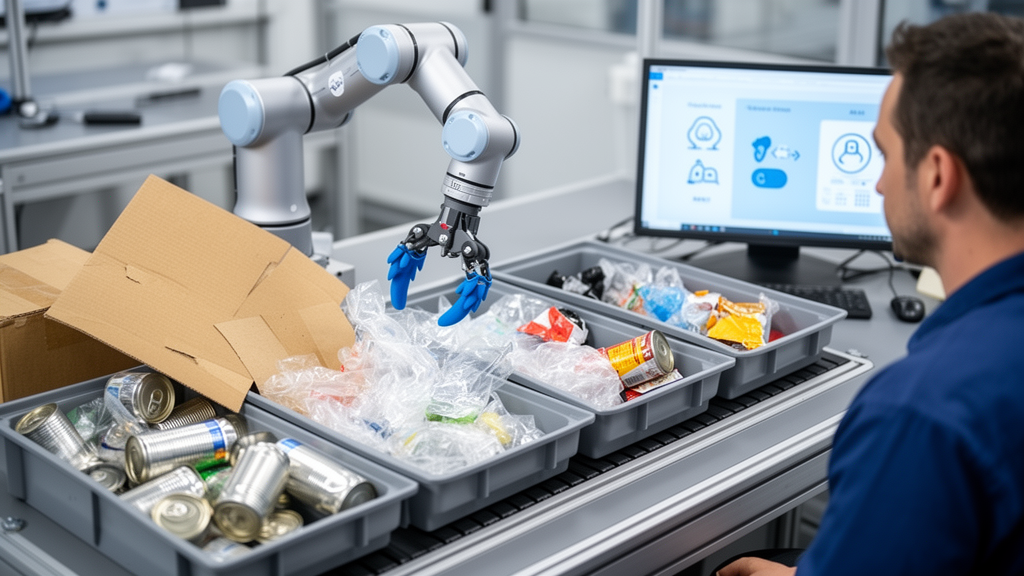
Robotic waste sorting has largely been a game for giants. The automated systems that dominate municipal recycling facilities—such as those developed by AMP Robotics and ZenRobotics—are engineered for continuous, high-throughput operation, with price tags and rigid installations to match. But a growing class of industrial environments, from small-batch manufacturers to logistics and warehouse operations, generate packaging waste in modest volumes, with material streams that change from week to week. For them, the economics of large-scale sorting infrastructure simply do not add up. A team of Serbian researchers now reports a laboratory-validated alternative: a modular collaborative robotic workstation that pairs foundation-model-based perception with a human-safe robot arm, designed from the ground up for flexibility rather than raw throughput.
The study, published in Frontiers in Robotics and AI by researchers at the University of Belgrade’s School of Electrical Engineering and the University of Kragujevac, addresses a persistent gap in circular economy practice. Global municipal solid waste is projected to reach roughly 3.40 billion tons by 2050, up from 2.01 billion tons in 2018, and efficient sorting is a key enabler of recycling, reuse, and recovery—the strategies that keep material value circulating rather than consigning it to landfill. Yet while the waste industry has automated considerably, a stubborn fraction of material at the end of sorting lines still demands manual labor, and existing robotic solutions remain poorly matched to the realities of small-batch production: limited waste volumes, frequent material changes, and the need for rapid reconfiguration.
At the heart of the new system is a perception architecture that departs from conventional deep-learning pipelines. Most robotic sorters rely on supervised models such as convolutional neural networks or YOLO-style detectors, which require large annotated datasets and retraining whenever new object types appear—a serious liability in dynamic industrial settings where waste composition shifts constantly. The researchers instead combined the Segment Anything Model (SAM), a foundation model capable of class-agnostic segmentation without task-specific training, with a lightweight MobileNetV2 classifier for material recognition. The segmentation stage isolates individual items from the conveyor and its surroundings; the classifier then assigns each segmented object to a waste category. Because SAM generalizes across object appearances, adapting to a new packaging type reduces data preparation to sorting cropped images into class folders rather than laborious instance-segmentation annotation.
One practical wrinkle in foundation-model segmentation is redundancy: SAM frequently generates multiple proposals for different parts of the same physical object, such as a bottle’s label or cap. The team’s post-processing pipeline merges these fragments, treating objects almost fully enclosed within a larger bounding box as subregions and merging neighboring masks that share more than 20 percent of their joint contour. Pixel counting across the merged parts then determines the dominant material class. The result is a single bounding box and mask per physical item—the clean, stable representation that downstream localization and grasp planning require.
The perception stack is deliberately hierarchical. Its first level handles core localization and classification for real-time operation. An optional second level adds geometric reasoning: point clouds processed with Open3D are fed to a PointNet network that assigns each object to a grasp-relevant primitive—cylindrical, box-like, or irregular—enabling robust grasp-strategy selection under partial occlusion and independence from surface texture and printing, which vary wildly across packaging brands. A third optional module performs damage assessment using Dynamic Graph Convolutional Neural Networks (DGCNN), refining discrete class outputs into a continuous damage score through a calibrated fuzzy estimator. Damage information is not merely diagnostic: heavily deformed items may need adapted grasping strategies, while sharp or broken objects should be preferentially routed to the robot to keep human operators away from hazardous edges.
The hardware reflects the same collaborative philosophy. The workstation’s centerpiece is a MAiRA Pro M, a seven-degree-of-freedom collaborative robot equipped with torque sensors in every joint and a six-axis force-torque sensor at the end-effector—sensing that underpins safe operation in shared workspaces. Vision comes from an Intel RealSense D455 stereo depth camera, which provides depth resolution up to 1,280 by 800 pixels at 30 frames per second and enables three-dimensional reconstruction of item shape and volume. For grasping, the team selected a modular four-finger soft pneumatic gripper from the SoftGripping construction kit, whose silicone fingers conform to irregular geometries and handle deformable items such as cans, Tetra Pak cartons, and plastic bottles without crushing them. The four-finger configuration was chosen over a three-finger alternative because it proved more robust under uncertainties in object position, orientation, and mass distribution—precisely the conditions a moving conveyor generates.
Software integration runs on ROS2, with motion planning handled by MoveIt and conveyor synchronization achieved through the industrial OPC UA protocol, which feeds encoder data to the control system so it can continuously update the predicted rendezvous point for dynamic grasping. A data-driven task scheduler sits at the top of the hierarchy, allocating work between robot and human operator based on five perception outputs: waste classification, object position, damage level, safety level, and conveyor speed. Objects meeting predefined safety and manipulation constraints go to the robot; items requiring human dexterity or exceeding the robot’s safe handling envelope are delegated to the operator. Notably, occluded, ambiguous, or out-of-distribution objects are labeled as unknown, allowing the system to hand them to a human rather than gamble on a low-confidence grasp—an explicit embodiment of the Industry 5.0 principle that automation should complement rather than replace human workers.
Grasping on a moving conveyor without halting the belt is orchestrated by a six-phase state machine. The robot first moves toward an estimated intersection point where its end-effector trajectory will meet the object’s path, calculated from the object’s initial location and conveyor velocity. It then aligns, synchronizing gripper velocity with the object’s motion along the conveyor line; grasps while actively tracking; lifts vertically to clear the belt; breaks synchronization and moves above the destination bin determined by the initial classification; and finally releases the object before returning to its home position. The approach echoes recent planning-oriented frameworks such as RaapWaste, which decouple task-level scheduling from motion-level planning, but extends them by folding human availability and object safety into the allocation decision.
Laboratory validation focused on three representative packaging categories—aluminium cans, plastic bottles, and Tetra Pak containers—with items manually spaced on the conveyor to emulate the output of an upstream industrial singulation stage. The SAM plus MobileNetV2 pipeline achieved an accuracy of 0.93, precision of 0.93, recall of 0.92, and F1-score of 0.92. The DGCNN damage module reached validation accuracies of 83.5 percent for cans, 88.2 percent for bottles, and 78.7 percent for Tetra Pak, for an overall 83.9 percent across 740 validation samples. On the manipulation side, 200 grasp attempts yielded a 92.0 percent grasp success rate; of the 184 successful grasps, 178 completed the full pick-and-place sequence, giving an end-to-end sorting success rate of 89.0 percent and a mean cycle time of 10.47 seconds—roughly 5.73 picks per minute under controlled conditions. Analysis of the 16 failures pointed to three culprits: unstable initial grasps on severely deformed objects in seven cases, object loss during transfer in five, and gripper-to-object misalignment in four.
The authors are candid about the study’s boundaries. Validation was confined to controlled laboratory conditions with three waste categories, mechanically preconditioned inputs, and a single robotic platform, gripper, and camera; the complete perception pipeline averaged 238.1 milliseconds per frame on an NVIDIA TITAN RTX—about 4.2 frames per second—though the modular architecture allows swapping in faster variants such as FastSAM or EfficientSAM without redesigning the rest of the system. Collaborative scheduling efficiency and operator workload were not quantitatively evaluated. Even so, the work stands as a proof of feasibility for a different vision of recycling automation: one where perception, semantic understanding, and human-robot task sharing are integrated in a reconfigurable workstation sized to the factories that actually need it. As packaging designs and material streams continue to evolve, that flexibility may prove to be the technology’s most valuable output.
Subject of Research: A modular collaborative robotic workstation using SAM-based perception for small-batch packaging waste sorting
Article Title: Development of a small batch flexible station for packaging waste sorting in circular economy applications
Article References: Development of a small batch flexible station for packaging waste sorting in circular economy applications. (n.d.). https://doi.org/10.3389/frobt.2026.1870171
Image Credits: AI Generated
DOI: 10.3389/frobt.2026.1870171
Keywords: circular economy, collaborative robots, waste sorting, Segment Anything Model, deep learning, packaging waste, human-robot collaboration, ROS2, soft gripper, recycling automation, Industry 5.0, computer vision
Cite Scienmag News
Denise Maddox. (October 15, 2026). Collaborative Robot Workstation Brings Flexible AI Sorting to Small-Batch Packaging Waste. Scienmag. https://scienmag.com/collaborative-robot-workstation-brings-flexible-ai-sorting-to-small-batch-packaging-waste/
Denise Maddox. "Collaborative Robot Workstation Brings Flexible AI Sorting to Small-Batch Packaging Waste." Scienmag, 15 October 2026, https://scienmag.com/collaborative-robot-workstation-brings-flexible-ai-sorting-to-small-batch-packaging-waste/. Accessed 15 October 2026.
Denise Maddox. "Collaborative Robot Workstation Brings Flexible AI Sorting to Small-Batch Packaging Waste." Scienmag. October 15, 2026. https://scienmag.com/collaborative-robot-workstation-brings-flexible-ai-sorting-to-small-batch-packaging-waste/


