


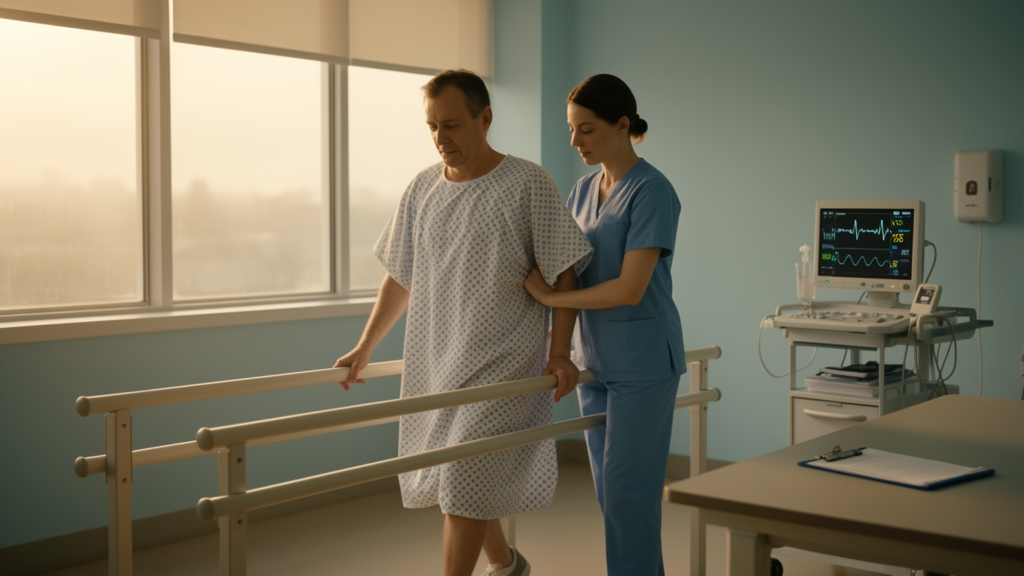
When patients wake up in an intensive care unit after open-heart surgery, the experience of trying to move again is often impossible to put into words. There is the fog in the brain, the tangle of tubes and intravenous lines, the fear of pain whose source is unclear, and the strange, powerful feeling that being able to move means having survived. A research team in Canada has now built a structured method for capturing exactly those hard-to-verbalize experiences and turning them into concrete research priorities, using an arts-based technique called body mapping combined with virtual consensus-building workshops. The approach, described in Frontiers in Rehabilitation Sciences as part of the Early mobility to improVE health outcomes following cardiac surgery (EVE) clinical feasibility trial development study, offers researchers a practical template for putting lived experience at the center of intervention design.
Patient engagement in research has become an internationally recognized pillar of health science. People with living or lived experience, often abbreviated PWLE, can contribute at every stage of a project, from grant development and outcome design to recruitment, analysis, and interpretation. The rationale is straightforward: patients carry expertise that clinicians and scientists do not, and integrating that expertise shifts research toward the priorities of those who actually receive care, which in turn helps overcome the stubborn gap between published findings and clinical practice. Yet the dominant engagement methods, advisory groups, one-on-one meetings, and town halls, lean heavily on verbal communication, and verbal communication captures only what can be spoken.
That limitation is precisely where body mapping enters. As an arts-based research method, body mapping asks participants to create a life-sized tracing of their own body in a position of their choosing. The outline is then filled in with paint, markers, crayons, collage, or words, guided by reflective questions from the research team, so that the participant recreates their experience of a healthcare event in visual form. Because the method bypasses the need to articulate everything in language, it opens a channel to embodied knowledge: the senses, emotions, and feelings that resist verbal description. The technique has been used in contexts ranging from drug and alcohol treatment programs to research with women experiencing stigma and with people of differing intellectual abilities, suggesting broad accessibility across populations and settings.
The Canadian team, led by Emily K. Phillips of the University of Manitoba together with colleagues at St. Boniface Hospital, Brock University, the University of British Columbia, and Northwestern University, went a step further than previous body mapping studies. Where earlier work largely stopped at data collection and analysis, the new model shows how embodied knowledge can be transformed into prioritized research directions, barriers and facilitators, and outcome and experience measures. The published paper is a methods article, meaning its contribution is the operational blueprint itself: a sequential series of co-facilitated workshops in which patients and researchers co-create, co-analyze, and co-synthesize body maps, then distill what emerges into actionable research guidance.
The case example that carried the model focused on early mobility after cardiac surgery in the intensive care unit. The clinical backdrop is significant. Post-intensive care syndrome, a deterioration in cognitive, mental, or physical health following an ICU admission, affects between 16 and 99 percent of patients in the cardiac surgery ICU, according to the source review. Early mobility interventions improve physical outcomes, have been shown to be safe, and carry guideline recommendations, yet they remain poorly integrated into routine cardiac surgery ICU care. Notably, the research teams that have investigated these interventions have been dominated by physicians, nurses, and physiotherapists, and none had previously included people with lived experience of cardiac surgery.
Recruitment for the case study drew ten participants, patients and their care partners, from a database of people who had undergone cardiac surgery at St. Boniface Hospital in Winnipeg and had agreed to be contacted for future research. Inclusion criteria required adults over eighteen who had undergone, or had a loved one undergo, elective or semi-urgent coronary artery bypass grafting, valve surgery, or a combination of the two within the previous five years. The inclusion of care partners was suggested by the two patient research team members themselves, who explained how difficult it is to remember an ICU hospitalization and how essential care partners are in piecing those memories together. Each participant received 475 dollars in compensation, calculated from Canadian Institutes of Health Research recommendations of 25 dollars per hour for engagement up to four hours at a time, covering an estimated nineteen hours of workshops and preparatory work.
The workshop sequence unfolded over roughly four weeks. Workshop 1 comprised three in-person sessions, each about four hours long, held in the same building that houses the cardiac surgery ICU, a deliberate choice intended to elicit thoughts and emotions through the familiar environment. The first session built relationships and introduced body mapping; the second was devoted to creating the maps with one facilitator per participant; the third brought each map to the wall for group discussion using compositional interpretation, a structured visual analysis that examines content, color, spatial organization, light, and expressive content. Probing questions asked why particular colors appeared, why red might stand for pain, or why images such as dumbbells or rabbits found their way onto a map. Because the participants themselves explained the meaning of their choices, the analysis captured their intent rather than the research team’s interpretation.
Two virtual workshops followed. Before Workshop 2, the team prepared summaries that reused the participants’ own words rather than clinical translations; the phrase seeing things was preserved rather than converted to hallucinations. In that session, patients reached a striking consensus on what early mobility actually means: the definition should be person-specific and tied to patient assessments and milestones rather than a fixed postoperative timeframe, and mobility itself should be understood as a spectrum of activities, from sitting at the edge of the bed to walking, that reflects what a person needs in order to go home. The group also generated lists of barriers, including brain fuzziness, weakness, fear, unclear sources of pain, and the paraphernalia of lines and tubes, and facilitators, including encouragement, positive attitude, education, good food, and confidence in the care team. Workshop 3, held about two weeks later, applied the nominal group technique, a structured consensus method in which participants independently rank items on a survey, discuss the least-agreed items first, and then re-rank a revised survey, producing prioritized outcome and experience measures grouped into cognitive, mental, and physical domains aligned with the components of post-intensive care syndrome.
The methodological machinery behind the workshops deserves attention. Reporting followed the GRIPP-2 long-form checklist for patient and public involvement, and the study received ethics approval from the University of Manitoba and the St. Boniface Hospital Research Review Committee in March 2024. Body map discussions were video recorded so that body language, facial expressions, and gestures could inform later analysis, a meaningful addition given that non-verbal communication is estimated to account for over 90 percent of emotional expression. Post-workshop analysis combined narrative inquiry of the transcripts with participant observation of the videos, conducted by independent researchers to mitigate bias. The authors also flag practical considerations that any team adopting the model must plan for: realistic timelines, since meaningful engagement extends project duration; funding for fair compensation, with early conversations about how payment might interact with income support; and safeguards for participants reliving difficult experiences, ranging from breakout-room check-ins to referral protocols and, where warranted, psychologist involvement.
The model has limitations the authors acknowledge candidly. It was developed at a single center, so adaptability to other contexts remains to be tested. It may exclude people who do not feel able to create art, a concern partly addressed through explanation and reassurance that there is no wrong way to make a body map, and it may exclude those lacking digital literacy, since the later workshops are virtual. Facilitators, too, must be experienced in discussing emotions. Even so, the payoff is tangible: the co-created understanding, the patient-centered definition of early mobility, and the prioritized barriers, facilitators, and outcome measures are now being folded directly into the design of the EVE early mobility intervention, with the top barriers and facilitators shaping the intervention itself and the identified measures guiding its evaluation. For a field where one-fifth to two-thirds of patient and caregiver preferences were previously missing from the literature, giving researchers a repeatable way to access embodied knowledge may prove as consequential as any single trial result.
Subject of Research: A participatory research model using body mapping and virtual consensus workshops to engage patients in designing early mobility interventions after cardiac surgery
Article Title: Early mobility to improve health outcomes following cardiac surgery (EVE) clinical trial development: engagement methods using body mapping and virtual consensus building
Article References: Phillips, E. K., Hay, J. L., Gregora, A., Smith, K., Shaski, C., Gilchrist, S., Fagan, A., Ashe, M. C., Schultz, A. S. H., Arora, R. C., Duhamel, T. A., O’Keefe-McCarthy, S., & Chudyk, A. M. (2026). Early mobility to improve health outcomes following cardiac surgery (EVE) clinical trial development: engagement methods using body mapping and virtual consensus building. Frontiers in Rehabilitation Sciences, 7, Article 1801084. https://doi.org/10.3389/fresc.2026.1801084
Image Credits: AI Generated
DOI: 10.3389/fresc.2026.1801084
Keywords: body mapping, patient engagement in research, cardiac surgery, early mobility, intensive care unit, arts-based research, nominal group technique, post-intensive care syndrome, lived experience, rehabilitation science, consensus building, patient-oriented research
Cite Scienmag News
Ophelia Keating. (October 15, 2026). Body Maps and Virtual Consensus: Patients Shape Early Mobility Research After Cardiac Surgery. Scienmag. https://scienmag.com/body-maps-and-virtual-consensus-patients-shape-early-mobility-research-after-cardiac-surgery/
Ophelia Keating. "Body Maps and Virtual Consensus: Patients Shape Early Mobility Research After Cardiac Surgery." Scienmag, 15 October 2026, https://scienmag.com/body-maps-and-virtual-consensus-patients-shape-early-mobility-research-after-cardiac-surgery/. Accessed 15 October 2026.
Ophelia Keating. "Body Maps and Virtual Consensus: Patients Shape Early Mobility Research After Cardiac Surgery." Scienmag. October 15, 2026. https://scienmag.com/body-maps-and-virtual-consensus-patients-shape-early-mobility-research-after-cardiac-surgery/


