


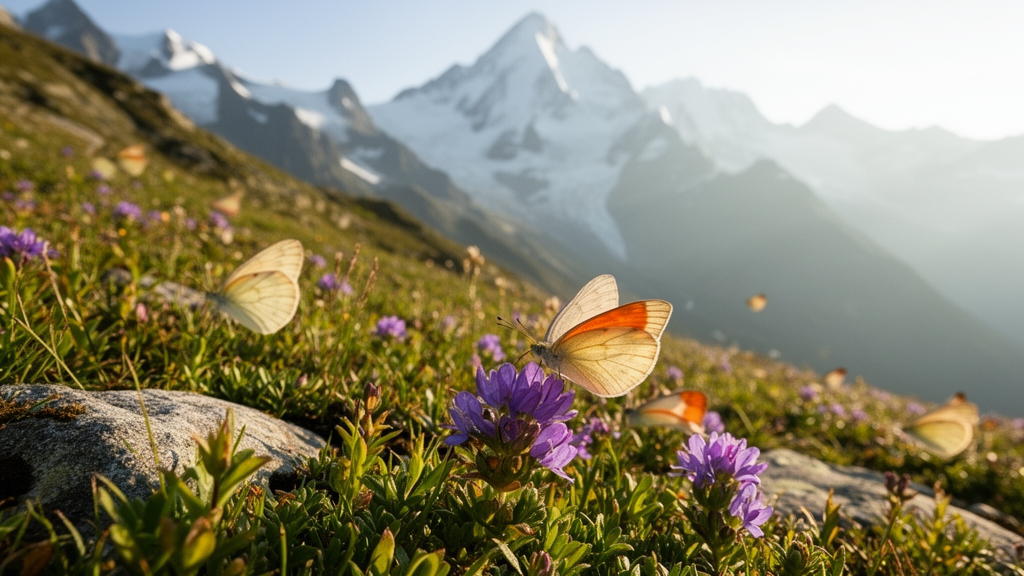
High in the Swiss Alps, butterflies are racing uphill faster than almost anything else on the mountain. A new survey of the Swiss National Park has found that butterfly species now live, on average, 135 metres higher than they did two decades ago, a shift that almost exactly matches what local warming would predict. But the study, published in Alpine Entomology, also delivers a surprising twist: the composition of alpine butterfly communities is shaped far more by the habitats available to them than by elevation itself, and the species most vulnerable to climate change are not simply those adapted to the coldest conditions, but those tied to the narrowest range of habitats.
The research team revisited one of the Alps’ longest-running natural laboratories. The Swiss National Park, founded in 1914 as the region’s oldest national park, enforces strict preservation of natural processes across 170 square kilometres of terrain ranging from 1,380 to 3,173 metres above sea level. Earlier butterfly surveys conducted between 1998 and 2004 had hinted at upward shifts in species distributions but could not quantify them across a broader area. Since then, temperatures in the park region have climbed by 0.9 degrees Celsius. Given the standard atmospheric cooling of roughly 0.6 degrees per 100 metres of elevation, the researchers expected butterflies to have moved upslope by about 140 to 160 metres if they were keeping pace with warming.
To test this, the team established two continuous transects in 2025, following hiking trails across more than 13 kilometres of mountain terrain. One transect climbed 883 metres through the dolomite valley of Val dal Botsch; the other stretched across 1,125 metres of elevation on the crystalline bedrock of the Macun plateau and the adjacent Val Zeznina. Each transect was walked twelve times between June and September, with observers counting every butterfly within a five-metre semicircle. In total, the survey recorded 6,030 individuals from 82 species, providing an unusually complete picture of how butterfly communities are arranged along the elevational gradient.
The first major finding concerned what actually determines which butterflies live where. Using variance partitioning, the researchers separated the influence of habitat composition from that of elevation. Habitat availability explained nearly half of the variation in community composition, with an adjusted R-squared of 0.464, while elevation alone accounted for just 1.5 percent. A substantial shared effect, representing the availability of specific habitats at specific elevations, explained a further 10 percent. The result confirms that butterflies in the Alps are not simply stacked up the mountain by temperature; they are filtered by the presence of the grasslands, scree fields, gravel banks and avalanche tracks that host their caterpillars and nectar sources.
This habitat dependency has deep ecological roots. The vast majority of butterfly species rely on a limited set of host plants for their larval development, and their caterpillars occupy narrow microclimatic niches shaped by soil chemistry, moisture and vegetation structure. Because these habitats themselves depend on elevation, climate change acts on alpine butterflies in two ways: directly, through rising temperatures, and indirectly, through the slow transformation of the landscapes they depend on. The indirect pathway is particularly consequential because alpine plants have been shown to lag considerably behind warming in their advance to higher elevations, creating a potential mismatch between butterflies that move quickly and the vegetation they need that moves slowly.
The second finding concerned how communities have changed over time. The researchers calculated a Community Temperature Index for both survey periods, a measure reflecting the average temperature adaptation of all individuals recorded. In 2025, communities were significantly more warm-adapted than two decades earlier, with the difference most pronounced at medium elevations between 1,900 and 2,300 metres. The team also calculated a Swiss-specific version of the index using fine-scale temperature data at 25-metre resolution, which better captures the climatic heterogeneity of mountain terrain. Both indices told the same story: butterfly communities in the park are becoming increasingly thermophilic as the climate warms.
The species-level analysis was equally striking. Of 32 species that could be compared between the two periods, only one, the Essex skipper Thymelicus lineola, shifted downward. The rest moved uphill by an average of 134 metres, with individual shifts ranging from a slight descent to a remarkable 345-metre climb by the silvery ringlet Erebia gorge. The overall mean shift of 135 metres corresponds closely to the expected displacement of 140 to 160 metres based on local warming, suggesting that butterflies in the park are largely keeping pace with climate change, at least in terms of their mean elevational occurrence.
Yet the study found no statistically reliable relationship between a species’ temperature adaptation and the magnitude of its upward shift. Cold-adapted species did not consistently move further than warm-adapted ones, contrary to what some previous studies had reported. Instead, the strongest predictor of upslope movement was the diversity of habitats a species occupies locally. Species restricted to a narrow range of habitat types, measured using the Shannon diversity index of habitats surrounding their observation points, shifted significantly further uphill than habitat generalists. The relationship was clear: as habitat diversity decreased, upward displacement increased, with a regression estimate of nearly 216 metres per unit of Shannon diversity.
This pattern points to a troubling conclusion for high-alpine specialists. Species such as the mountain fritillary Boloria pales, which feeds on multiple host plants across a broad elevational range, showed the weakest upward shifts, while the scree-dwelling Erebia gorge, confined to sparsely vegetated rocky habitats, climbed the furthest. Specialist species cannot simply expand into new microhabitats when conditions change; instead, they track suitable thermal conditions through elevational movement, making them disproportionately sensitive to warming. Because many of these narrow-niche species are also cold-adapted alpine endemics, the study suggests that climate change threatens them through a double bind: rising temperatures push them upslope while the habitats they depend on are simultaneously being transformed by the same warming.
The implications for conservation are significant. The researchers project that if current trends continue, high-alpine species such as Pontia callidice and the mountain fritillary Euphydryas aurinia debilis will have shifted their entire distributions above 3,000 metres by the start of the next century, an elevation exceeded by few mountain summits in the region. Local extinctions may occur even earlier if warming accelerates as expected. The authors emphasise that preserving and restoring high-quality, diverse habitats will be central to conserving alpine butterfly communities, and that traditional grazing practices, which counteract the upward march of treelines and maintain open alpine grasslands, may play a vital role. As newly exposed ground emerges from melting glaciers and thawing permafrost, some refugia may offer temporary sanctuary, but the long-term fate of these cold-adapted specialists depends on how quickly their habitats can keep pace with a rapidly warming sky.
Subject of Research: Habitat availability shapes composition and climate change response of alpine butterfly communities
Article Title: Habitat availability shapes composition and climate change response of alpine butterfly communities
Article References: Habitat availability shapes composition and climate change response of alpine butterfly communities. (n.d.). https://doi.org/10.3897/alpento.10.186978
Image Credits: AI Generated
DOI: 10.3897/alpento.10.186978
Keywords: Habitat, availability, shapes, composition, climate, change, response, alpine, butterfly, communities, scientific research
Cite Scienmag News
Margaret Porter. (October 15, 2026). Alpine butterflies climb higher as warming reshapes Swiss mountain habitats. Scienmag. https://scienmag.com/alpine-butterflies-climb-higher-as-warming-reshapes-swiss-mountain-habitats/
Margaret Porter. "Alpine butterflies climb higher as warming reshapes Swiss mountain habitats." Scienmag, 15 October 2026, https://scienmag.com/alpine-butterflies-climb-higher-as-warming-reshapes-swiss-mountain-habitats/. Accessed 15 October 2026.
Margaret Porter. "Alpine butterflies climb higher as warming reshapes Swiss mountain habitats." Scienmag. October 15, 2026. https://scienmag.com/alpine-butterflies-climb-higher-as-warming-reshapes-swiss-mountain-habitats/


