


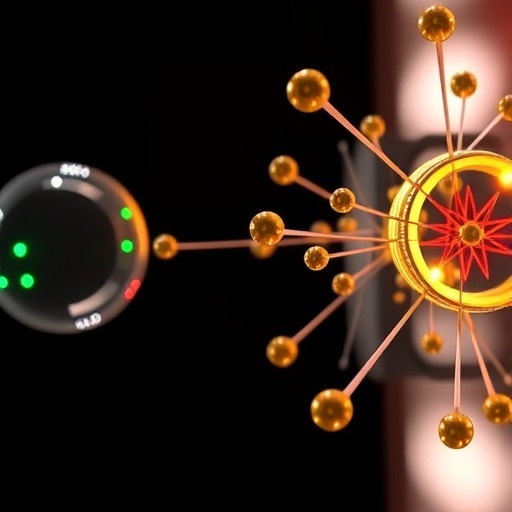
In a groundbreaking breakthrough that could accelerate the advent of large-scale quantum computing, researchers at the University of New South Wales (UNSW) have successfully demonstrated the entanglement of nuclear spins separated by a significant distance within a silicon chip. This achievement heralds a pivotal advancement in overcoming one of the most formidable challenges facing the quantum computing community: the realization of scalable, noise-resistant quantum processors using well-isolated atomic nuclei embedded in technologically relevant materials.
Quantum entanglement — the phenomenon where two or more particles become inseparably linked such that the state of one instantaneously influences the state of another regardless of distance — sits at the heart of the immense promise quantum computers hold over classical counterparts. However, harnessing this phenomenon in practical devices requires not just maintaining coherence but also engineering precise interactions between qubits, the quantum analogues of classical bits. UNSW’s novel approach employs the nuclear spins of phosphorus atoms precisely implanted in silicon, a widely used semiconductor substrate, to store and process quantum information.
For over 15 years, the UNSW team, led by Scientia Professor Andrea Morello, has made persistent strides in harnessing phosphorus nuclear spins, which are renowned as some of the most isolated quantum objects in the solid state. The exceptionally long coherence times—on the order of 30 seconds—combined with the ability to perform quantum logic operations with fidelity surpassing 99%, position these nuclear spins as ideal qubit candidates. Yet, the intrinsic isolation that renders them so clean simultaneously impedes controlled interaction, making it challenging to engineer robust multi-qubit operations necessary for universal quantum computing.
Traditionally, entangling multiple nuclear spins required positioning them in immediate proximity so they could share the same resident electron, the quantum mediator enabling coherent coupling. Unfortunately, this proximity requirement severely limits device scalability and complicates individual qubit addressability. The new UNSW study circumvents this bottleneck by introducing an innovative mechanism whereby two nuclear spins, separated by about 20 nanometers — roughly one-thousandth the width of a human hair — become entangled through electron-mediated communication that does not necessitate their sharing the same electron.
This electron-mediated interaction can be thought of as a quantum telephone line between distant atomic nuclei. Rather than restricting qubits to a confined “room,” where interactions are limited and cannot extend beyond immediate neighbors, electrons serve as delocalized mediators capable of “reaching out” and coupling nuclear spins located in physically separated regions of the silicon lattice. The scientists demonstrated this by controlling electron exchange interactions that effectively act as quantum gates, generating entangled states even when nuclei are spatially separated beyond the reach of direct coupling.
Such a manipulation of electron wavefunctions to enable remote entanglement represents a leap forward because it aligns perfectly with current silicon fabrication technologies. The scale of 20 nanometers is directly compatible with the transistor dimensions used in modern commercial microchips, meaning this quantum architecture has the potential to be integrated within existing semiconductor manufacturing pipelines. This compatibility is crucial for transitioning quantum computing from isolated laboratory demonstrations to industrial-grade, scalable quantum processors.
The team’s approach also maintains the key advantage of phosphorus nuclear spin qubits: their exceptional coherence. Unlike other physical qubit systems prone to environmental noise and rapid decoherence, the nuclear spins in this system remain well-isolated from disruptive interactions. By leveraging electrons as controllable mediators that can be dynamically moved and shaped into elongated wavefunctions, the researchers have demonstrated fast, tunable quantum operations without sacrificing coherence, a balance that has eluded many alternative quantum platforms.
Lead researcher Dr. Holly Stemp elaborates that the electron-mediated entanglement scheme offers a powerful means to scale up quantum processors. The electron “telephones” can be switched on and off with precision, allowing selective gate operations between desired pairs of nuclei while preventing unwanted crosstalk. This flexibility paves the way not only for two-qubit entanglement but also for more complex multi-qubit architectures, by increasing the number of electrons and dynamically controlling their spatial distribution within the silicon crystal.
This scalable design also brings with it a remarkable robustness. Owing to the universal nature of electron wavefunctions and well-understood silicon fabrication processes, the architecture opens a clear route toward manufacturable large-scale quantum chips. Integrating ultra-pure silicon substrates from Japan’s Keio University and precisely implanting phosphorus atoms using advanced ion implantation techniques honed at the University of Melbourne, the study underscores the profound importance of interdisciplinary collaborations in turning quantum science into viable technology.
The implications of this research are profound. By overcoming the need for nuclear spins to be bound to a single electron and instead enabling long-distance entanglement mediated by electron exchange, the UNSW team effectively removes one of the most significant barriers to developing quantum devices scalable to millions of qubits. This breakthrough brings the vision of silicon-based quantum computers—leveraging decades of semiconductor industry expertise—much closer to reality.
Moreover, the entanglement demonstrated in this work is not only a theoretical achievement but also experimentally verifiable, marking a critical step toward practical quantum error correction schemes and fault-tolerant quantum computing. As quantum processors grow in size and complexity, maintaining high-fidelity entanglement across well-isolated qubits at industrially relevant scales will be essential to realizing the full promise of quantum advantage across cryptography, simulation, and optimization.
Professor Morello emphasizes that while this result was obtained with a pair of nuclear spins, the principles underpinning the electron-mediated interactions readily scale to many more qubits. By shaping electrons into elongated wavefunctions—akin to quantum “fingers” reaching across the chip—it becomes feasible to network distant nuclei, achieving a coherent, controllable quantum processor architecture. This represents one of the most promising pathways to breaking the current quantum computing bottleneck.
Taken collectively, the UNSW team’s pioneering demonstration of scalable, electron-exchange-mediated nuclear spin entanglement marks a monumental stride forward on the quest for practical quantum computers. It not only showcases the power of silicon quantum devices but also highlights the elegant solutions that emerge at the confluence of fundamental physics, cutting-edge materials science, and innovative engineering. The future, it seems, increasingly belongs to the quantum revolution unfolding at the atomic scale inside everyday silicon chips.
News Publication Date: 18-Sep-2025
References:
DOI: 10.1126/science.ady3799
Cite Scienmag News
Chase Armstrong. (September 18, 2025). Quantum Computing Engineers Connect Atoms for Long-Distance ‘Conversations’ Like a Phone Call. Scienmag. https://scienmag.com/quantum-computing-engineers-connect-atoms-for-long-distance-conversations-like-a-phone-call/
Chase Armstrong. "Quantum Computing Engineers Connect Atoms for Long-Distance ‘Conversations’ Like a Phone Call." Scienmag, 18 September 2025, https://scienmag.com/quantum-computing-engineers-connect-atoms-for-long-distance-conversations-like-a-phone-call/. Accessed 4 September 2026.
Chase Armstrong. "Quantum Computing Engineers Connect Atoms for Long-Distance ‘Conversations’ Like a Phone Call." Scienmag. September 18, 2025. https://scienmag.com/quantum-computing-engineers-connect-atoms-for-long-distance-conversations-like-a-phone-call/


